
A Thank You Across Time
Every now and then, life introduces us to people who change us without ever meeting us.
A teacher. A writer. A thinker. Someone whose words arrive at the right moment and stay with us long after we have turned the last page.
Over the years, I have been fortunate to encounter a few such people. Ayn Rand is one of them.
I have read many books and admired many writers. Some entertained me. Some challenged me. Some helped me understand life a little better. But only a handful left a lasting mark on the way I think, live, and see myself. Ayn Rand belongs to that rare group.
I first encountered her work in my mid-twenties, at a time when I was searching for direction and trying to understand myself. I did not realize it then, but opening The Fountainhead would become one of those small moments that quietly alter the course of a life.
Since then, I have returned to her books many times. During different phases of my life, different struggles, and different crossroads, I found myself reaching for The Fountainhead, Atlas Shrugged, Anthem, and her other works once again. Every time, I discovered something new. Every time, I walked away with a deeper understanding of myself.
What moved me most was the courage of her characters. Their refusal to betray what they believed to be true. Their willingness to stand alone when necessary. Their determination to remain faithful to their own vision, even when the world misunderstood them.
Those qualities spoke to something deep within me.
This article is a tribute to one of the very few writers for whom I feel genuine admiration and respect—not because I agree with everything she wrote, but because her work helped shape the person I am becoming.
Before Ayn Rand Entered My Life
I grew up in a small town, in a world that was much smaller than the one I know today.
My exposure to different philosophies, worldviews, and ways of thinking was limited. Like most people, I was shaped by my family, my surroundings, and the ideas available to me at the time.
Yet even as a young person, there was a part of me that questioned things.
I often found myself wondering why certain traditions existed, why people behaved the way they behaved, and why some social expectations seemed so unquestioned. Sometimes the answers satisfied me. Often they did not.
Over time, I began to realize that I did not think exactly like many of the people around me. I questioned things that others seemed comfortable accepting. I felt drawn toward a different path, though I could not clearly define what that path was.
To some people, I appeared rebellious. At times, they were not entirely wrong. I carried my share of anger, confusion, and frustration. But beneath all of that was a genuine desire to understand life for myself rather than simply inherit other people’s answers.
The difficulty was that when enough people disagree with you, you eventually begin to doubt yourself.
There were moments when I wondered whether there was something wrong with me. Whether I was being unrealistic. Whether everyone else had understood something that I had somehow missed.
Looking back now, I can see that I was searching for something, though I did not have the words for it at the time.
I was searching for understanding.
I was searching for validation.
And perhaps most of all, I was searching for the confidence to trust myself.
When My World Began to Expand
One of the biggest turning points in my life came when I joined the Xavier Institute of Management, Bhubaneswar (XIMB), to pursue my postgraduate studies in Rural Management.
Until then, my world had been relatively small. XIMB introduced me to a much larger one.
For the first time, I found myself surrounded by people from different parts of the world, different cultures, different backgrounds, and different ways of looking at life. Conversations that would have been impossible in my earlier world suddenly became part of my everyday experience.
It was a vibrant place, full of ideas, debates, friendships, disagreements, ambitions, and dreams.
More than anything else, it taught me that there is no single way to look at life. Human beings can experience the same reality and arrive at completely different conclusions about it.
I learned a great deal during those two years, both inside and outside the classroom. In many ways, my real education happened through conversations with people, through observing them, and through being exposed to perspectives that challenged my own assumptions.
It was also during that period that I first heard the name Ayn Rand.
I remember hearing people talk about The Fountainhead and Atlas Shrugged. Those books seemed to have a special reputation among some students. Their enthusiasm made me curious, and I took note of the name, though I did not read her at the time.
But the seed had been planted.
The Book That Arrived at the Right Time
A couple of years later, I found myself in a different phase of life.
Like many young people in their twenties, I was trying to figure out what kind of life I wanted to live and what kind of person I wanted to become.
It was during that phase that I finally picked up The Fountainhead.
At the time, I had no idea that the book would leave such a lasting impression on me. I simply began reading it out of curiosity. But as I moved through its pages, something unexpected happened. I felt as though Ayn Rand was speaking directly to me.
Not because my life resembled Howard Roark’s. It didn’t.
Not because I understood every idea in the novel. I didn’t.
It was something deeper than that.
For years, I had carried a sense of being different. I questioned things that others seemed comfortable accepting. I often found myself at odds with expectations and conventions. Like many people who do not fit neatly into society’s boxes, I sometimes wondered whether the problem was me. Was I genuinely seeing something others were missing? Or was I just another rebel without a cause?
Then I met Howard Roark.
And something clicked.
For the first time, I encountered a character who refused to apologize for being himself. He was not trying to please everyone. He was not seeking approval. He was not changing his convictions simply because they were unpopular.
There was something immensely liberating about that.
As I continued reading, I felt a growing sense of relief. The kind of relief that comes when you realize that you are not alone.
Perhaps that was the book’s greatest gift to me. It did not solve all my problems. It did not answer every question. But it gave me something I desperately needed at that stage of my life.
A new way of looking at myself.
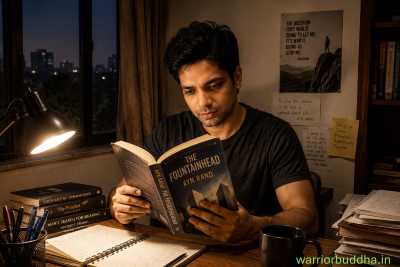
Howard Roark and the Gift of Validation
If I had to describe the greatest gift Ayn Rand gave me, it would not be a philosophy.
It would be validation.
Before reading The Fountainhead, I often found myself caught between two opposing forces. One came from within. It pushed me to question things, think independently, and follow my own understanding of life. The other came from the world around me. It reminded me that my views were often unpopular, that my choices were unconventional, and that many people seemed to think differently from me.
Over time, that tension created doubt.
And then I encountered Howard Roark. What struck me about him was not his brilliance. It was his integrity. He did not seek approval. He did not shape his life around other people’s expectations. He was willing to stand alone if necessary.
For someone who had spent years struggling with self-doubt, that was a powerful idea.
At times, it felt as though Ayn Rand was giving words to feelings and struggles that I had carried within myself for years but had never fully expressed.
Reading the book, I realized that being different did not automatically mean being wrong. Independence of thought no longer felt like something I needed to defend or apologize for. And slowly, I began to see that the very qualities I had spent years questioning within myself could also be sources of strength.
That realization brought a deep sense of relief.
I was not alone. There were others who questioned. Others who struggled. Others who chose difficult paths rather than betray their convictions.
Of course, I was not Howard Roark, nor did I aspire to become a fictional character. But through him, Rand showed me a possibility that I had not fully considered before: that a person could remain true to himself, even when the world disagreed.
And at that stage of my life, that was exactly what I needed to hear.
The Idea That Changed My Life
If there is one idea that stayed with me long after I finished Ayn Rand’s books, it is this:
Never betray your deepest convictions.
Again and again, her novels portrayed men and women who remained faithful to what they believed to be true, regardless of the consequences. They were willing to endure misunderstanding, criticism, rejection, loneliness, poverty, and sacrifice. They were willing to stand alone if necessary. What they were not willing to do was compromise their innermost truth simply to gain approval or acceptance.
That idea left a deep impression on me.
Looking back, I realize that it was not success that inspired me most about Ayn Rand’s heroes. It was integrity. Their commitment to themselves. Their refusal to live a life that felt false. Their determination to remain loyal to their own vision, even when doing so came at a cost.
One scene from The Fountainhead has stayed with me for years.
After refusing to compromise his architectural vision, Howard Roark finds himself working in a granite quarry as a common laborer. He accepts physical hardship and a life far below his abilities rather than surrender his convictions for the sake of comfort, recognition, or approval.
The quarry represented the willingness to pay the price for one’s values, to endure hardship rather than live a life that feels false, to lose everything except one’s self-respect.
There was something noble about that. Something deeply inspiring.
Even today, when I think of Howard Roark, that image is one of the first things that comes to mind.
Life, of course, is far more complicated than any novel. Human beings are imperfect. We make mistakes. We doubt ourselves. We change our minds. We grow. I certainly have.
But despite all the changes that have taken place in my life, one lesson from Ayn Rand has remained constant:
Listen carefully to your own inner voice. Think for yourself. And do not abandon what you genuinely believe to be true simply because it is unpopular.
Returning to Ayn Rand Again and Again
Over the years, I have returned to her books many times. In fact, some of the most meaningful readings happened long after my first encounter with them.
Whenever I entered a new phase of life, I often found myself returning to those books—sometimes because I was facing uncertainty, sometimes because I needed clarity, and sometimes because I simply wanted to revisit ideas and characters that have meant so much to me.
I rarely read the same book twice. But every time I read Rand, I felt like the words were the same, yet I was different.
As I grew older, changed careers, encountered new challenges, and accumulated new experiences, I found myself noticing things that I had missed during earlier readings. Certain passages resonated more deeply. Certain characters revealed new dimensions. Certain ideas acquired new meaning.
The books seemed to grow alongside me. Or perhaps it was I who was growing.
That, to me, is one of the marks of a truly great writer. Their work continues to reveal new layers because it continues to meet you at different stages of your life.
Over time, Ayn Rand became more than a writer whose books I admired. Her work became a recurring companion during different phases of my journey. And her books consistently reminded me of something I never wanted to forget:
The importance of living authentically. The importance of courage. And the importance of remaining faithful to oneself.
What I Later Discovered
As the years passed, my journey continued in directions I could not have anticipated when I first read Ayn Rand. Life taught me that human beings are rarely born as Howard Roark or John Galt.
Many of us begin with doubts, fears, wounds, insecurities, and inner conflicts. We struggle with ourselves before we can stand firmly in the world.
The more I lived, the more I became interested not only in the destination, but also in the journey. I wanted to understand the inner wars that shape a human being. I wanted to understand suffering, growth, fear, healing, and transformation.
And this curiosity gradually led me toward psychology, mythology, spirituality, and the wisdom traditions of the East. I found myself exploring the works of Carl Jung, reading about the Buddha, and becoming increasingly interested in the inner dimensions of human life.
These explorations did not diminish my appreciation for Ayn Rand. If anything, they helped me understand more clearly what she had given me.
Why My Admiration Remains
Today, when I look back on my journey, I see Ayn Rand differently than I did when I first encountered her as a young man in his mid twenties.
Time has expanded my perspective. Life has taught me lessons that no book alone could teach. My interests have evolved. My understanding of human nature has deepened. I have discovered ideas and traditions that have enriched my life in ways I could never have imagined.
Yet through all those changes, my admiration for Ayn Rand has only deepened.
Not because I agree with every idea she ever expressed. Not because I see her as infallible. And certainly not because I believe she had all the answers.
My admiration comes from something deeper than agreement.
I admire her courage. I admire her independence. I admire her willingness to stand by her convictions, regardless of whether they were popular or fashionable.
Whether one agrees with her philosophy or not, it is difficult not to respect the fearlessness with which she lived and defended her ideas.
Every person is shaped by many influences. Family, friends, experiences, books, successes, failures, and countless encounters along the way. My life is no different.
Like everyone else, I have made mistakes, stumbled, and gone through periods of uncertainty, failure, confusion, and doubt. But through it all, I have tried to remain honest with myself. I have tried not to betray my own soul.
And in that effort, I can still see her influence.
Ayn Rand occupies a special place in my life, not because she gave me all the answers, but because she gave me something I needed even more at the time.
The courage to begin searching for my own.
And for that, she will always have my admiration, my respect, and my gratitude.



Leave a Reply