
A strange question came to my mind recently.
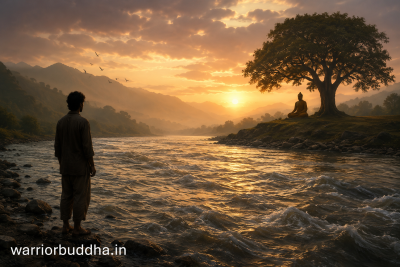
What if Buddha was crossing a river and the boat suddenly capsized?
What if he found himself struggling in the water, unable to reach the shore? What if, after fighting for a while, he realized there was no escape and death was inevitable?
What would happen in those final moments?
Would he be terrified like most people? Would he panic? Would he desperately cling to life?
Or would he meet death differently?
Of course, none of us can know the answer with certainty. We can only think about it based on the life he lived and the teachings he left behind. Yet I find the question fascinating because it eventually stops being a question about Buddha.
It becomes a question about us.
How do human beings meet death?
And what determines our state of mind when that moment finally arrives?
The River
Let us stay with the image for a moment.
The boat has capsized. The river is rough. The current is strong. Buddha is in the water.
I do not think he would simply close his eyes and surrender the moment he fell into the river.
He was human.
His body would react like any other human body. His survival instincts would activate. He would try to stay afloat. He would swim if there was a chance of reaching the shore. He would do whatever any person would naturally do in that situation.
The body wants to live.
There is nothing surprising about that. Every living creature carries within it the instinct to survive.
But the deeper question begins later.
What happens when every possibility of escape disappears? What happens when the body is exhausted and the mind finally realizes that death is no longer a possibility but a certainty?
This is where I suspect Buddha and most of us would part ways.
His body would still do what bodies do. It would struggle. It would search for air. It would try to survive.
But the mind is another matter.
The body may struggle. The mind may not.
Based on everything Buddha taught, it is difficult to imagine him meeting that moment in the same way that most people do. His entire life was devoted to understanding suffering, attachment, loss, change, and impermanence. If those teachings meant anything, they would matter most in a moment like this.
And that leads to an interesting realization.
The answer to how a person meets death is not found in the final few minutes.
It is shaped by the life that came before them.
The Fear Beneath the Fear
If we imagine ourselves in the same situation, the picture may look very different.
Of course, none of us knows exactly how we would actually react in our final moments. Human beings are unpredictable. Some people discover remarkable courage when facing death. Others struggle with fear. Many of us would probably experience a mixture of both.
Still, it is worth asking a deeper question.
What exactly are we afraid of when we fear death?
At first, the answer seems obvious. We are afraid of dying.
But the more I reflect on it, the less obvious it becomes.
Some people fear leaving behind those they love. Others fear pain, suffering, or the unknown. Some fear unfinished responsibilities. Others fear unfinished dreams.
Then there is another possibility.
Perhaps what we fear most is the end of the person we believe ourselves to be.
Throughout our lives, we build an identity. We collect memories, achievements, failures, beliefs, preferences, and experiences. Over time, they become part of our story. We become attached to that story and to the person we think we are.
Death threatens all of it.
It asks us to let go of everything familiar. Our plans. Our ambitions. Our possessions. Even our idea of ourselves.
And I also think that much of the fear comes from an unlived life.
Many people spend years chasing approval, status, money, power, or expectations that were never truly their own. There is nothing wrong with these things in themselves. The problem begins when they become substitutes for life itself.
Then death appears, and all the distractions fall away.
What remains are the questions we spent years postponing.
Did I truly live? Did I become the person I wanted to become? Did I spend my time on what genuinely mattered to me?
Life was not waiting for us somewhere in the future. It was happening all along.
And perhaps one reason death feels so frightening is that it forces us to see that truth all at once.
What Did Buddha Understand?
This brings us back to Buddha.
I do not think the difference between Buddha and most people was that he possessed some secret knowledge about death.
The difference was that he spent his life looking directly at realities that most of us spend our lives avoiding.
He looked deeply into suffering, loss, change, aging, and death. He asked questions that most people rarely ask and pursued them with extraordinary seriousness.
Most of us know that everything changes. We know people grow old. We know relationships end. We know death is inevitable.
Yet we rarely sit with these realities for very long. We acknowledge them intellectually and then move on.
Buddha did the opposite.
Instead of turning away from these questions, he moved toward them. He spent years observing the mind, examining suffering, and trying to understand the nature of human existence.
In that sense, I think he was far better prepared for death than most people.
There is another way of looking at it.
Most people encounter those realities only when they have no choice. Buddha chose to encounter them long before that.
Through contemplation. Through self-inquiry. Through years spent examining impermanence, loss, and change.
He did not spend his life preparing for death itself. He spent his life trying to understand life.
And perhaps that is what prepared him for death.
Death as a Mirror
The more I think about this thought experiment, the more I feel that death does not create our state of mind.
It reveals it.
A person who spends years avoiding difficult truths will probably carry that habit into difficult moments.
A person who spends years cultivating awareness, courage, acceptance, and understanding will carry those qualities as well.
Death is not separate from life. It is connected to it.
The way we live influences the way we die.
That does not mean we can predict exactly how anyone will react in their final moments. Human beings are too complex for that.
But it does mean that the habits of a lifetime matter.
The things we practice matter. The truths we avoid matter. The realities we choose to confront matter.
Death is the final mirror.
It shows us what we have been practicing all along.
Learning How to Live
I do not know exactly how Buddha would have met death if he were drowning in a river.
None of us do.
What I do know is that his life points toward a very different relationship with death than the one most people have.
He did not spend his life pretending death did not exist. He did not spend his life running from impermanence.
Rather he looked directly at realities that most of us prefer to keep at a distance.
That willingness to look may be one of the greatest lessons he left behind.
The river eventually comes for all of us.
For some, it will arrive through old age. For others, it may arrive unexpectedly. None of us knows when or how it will happen.
The question is not whether death is coming.
The question is how we choose to live before it arrives.
Contemplating death will not solve every problem in life. It is not the only thing that teaches us how to live. But it has a way of putting things into perspective. It reminds us that our time is limited. It forces us to think about what truly matters.
And perhaps that is why this strange thought experiment stayed with me.
It began with a question about Buddha. It ended with a question about life.
Because in the end, the purpose of contemplating death is not to learn how to die.
It is to learn how to live.



Leave a Reply