
The Human Hunger for Certainty
There is something in human nature that constantly seeks certainty.
We want to know that things will be okay. We want clarity about the future, stability in relationships, security in work, and some assurance that life is moving in the right direction. The mind always wants something solid to hold onto.
But life rarely works that way.
No matter how carefully we plan things, uncertainty always remains. A conversation can change everything. A loss can arrive unexpectedly. Plans can fail. People can leave. Life can suddenly move in a completely different direction.
And I think this uncertainty is one of the biggest sources of fear for most people.
I have struggled with it myself for a long time. My mind would often imagine worst-case scenarios and endlessly think about “what ifs.” Sometimes the fear was not even about something specific. It was simply the discomfort of not knowing what comes next.
Over time, I realized that this fear is deeply human. It affects almost everyone in different ways. People with difficult backgrounds may feel it more intensely because life has already shown them instability and unpredictability. But even those who seem successful, wealthy, or secure are not free from uncertainty. Deep down, every human being knows that life can change at any moment.
Why Uncertainty Scares Us
I think one of the reasons uncertainty affects us so deeply is because the mind naturally seeks safety and control.
The unknown makes us uncomfortable. We want reassurance that things will work out. And when life does not give us that reassurance, the mind starts filling the empty space.
That is when the “what ifs” begin.
What if things go wrong?
What if I fail?
What if I lose someone?
What if life never improves?
What if everything falls apart?
I have noticed that the mind rarely imagines positive possibilities with the same intensity. It usually moves toward the worst-case scenario. Uncertainty gets interpreted as danger, even when nothing bad has actually happened yet.
And for some people, this fear becomes even stronger because of their life experiences. Difficult childhoods, unstable environments, emotional pain, financial struggles, or unpredictable situations can make a person more guarded toward life. The nervous system becomes more alert, always trying to prepare for what could go wrong next.
But at the same time, uncertainty is not something that affects only those who have struggled. Even people who seem secure, successful, or wealthy are deeply affected by it. Because no amount of money, success, or power can remove the uncertainty that comes with being human.
Life can still change unexpectedly.
Loss can still arrive.
Death can still come.
And that is why uncertainty scares almost everyone in one way or another. Deep down, we all realize that no matter how much we try to control life, there will always be things beyond our control.
Acceptance of the Past
One thing I slowly realized is that a lot of our suffering comes from fighting with the past.
The mind keeps replaying old memories, old mistakes, painful experiences, regrets, and unfinished emotions. Somewhere deep inside, we wish things had happened differently. We revisit moments again and again, hoping to mentally change something that has already ended.
But the truth is, the past cannot be changed.
And acceptance does not mean forgetting the past or pretending that it did not hurt. It also does not mean becoming passive toward life. It simply means understanding that what has happened is already over.
For me, this realization brought a certain kind of calmness.
Instead of constantly resisting the past, I slowly started looking at it differently. I began trying to understand the lessons hidden inside my experiences — the painful ones as well as the beautiful ones. Over time, I realized that every phase of life leaves something behind: wisdom, maturity, clarity, strength, or self-understanding.
The memories remain, but the inner conflict slowly softens.
I think acceptance gives a kind of closure. Not because everything suddenly feels perfect, but because we stop arguing with reality. We stop carrying the impossible burden of trying to mentally rewrite what cannot be rewritten.
And perhaps healing begins there.
Acceptance of Death and the Future
If the past brings regret, the future often brings fear.
The mind keeps worrying about what might happen tomorrow. We want certainty about life, relationships, health, work, and the direction our future will take. But no matter how much we think, plan, or worry, the future always remains uncertain.
And strangely, one of the things that helped me deal with this uncertainty was thinking about death.
At first, this may sound uncomfortable. Most people avoid thinking about death completely. We try to push it away from our minds and live as if it is something distant. But the more I reflected on it, the more I realized that death is not separate from life. It is part of it.
Sometimes during meditation, I imagine that I only have a short amount of time left to live. That the half hour I am sitting there might be my final half hour, and after that, the world will end for me.
And in those moments, something interesting happens.
Most of the things I usually worry about suddenly lose their importance. The endless overthinking, the imagined fears, the small anxieties — they no longer feel as heavy.
Instead, what arises naturally is gratitude.
Gratitude for being alive. Gratitude for getting a chance to experience life in all its beauty and difficulty. Gratitude for the people I met, the lessons life taught me, the love, the pain, the growth, and even the uncertainty itself.
And slowly I realized that when death becomes real in your awareness, life also becomes more real.
Even Alexander the Great, who conquered much of the world, could not escape death. He died at the age of thirty-two. A man who conquered nations could not conquer mortality itself. And in a way, that realization is deeply humbling.
No matter who we are, uncertainty will always remain a part of life.
But maybe the answer is not to control everything. Maybe the answer is to live more consciously while we are here.
The Present Moment and Inner Grounding
I also realized that if we are not aware of our thoughts, the mind almost always keeps moving between the past and the future.
Either we regret what has already happened, or we worry about what might happen next. And somewhere in between, we slowly lose touch with the present moment.
For me, small daily practices helped a lot in dealing with this restlessness.
Meditation became one of them. Not because it magically removed all fear or uncertainty, but because it slowly made me more aware of my own thoughts. Instead of getting lost in every fear or every “what if,” I slowly learned to observe them with a little more distance and calmness.
Even simple things like evening walks helped me deeply.
Sometimes I would just walk quietly and reflect on life, my thoughts, my experiences, and the direction I was moving in. Those moments gave me space to slow down internally. Reading meaningful books, spending time in nature, sitting in silence, reflecting on life, and spending time with myself also became important parts of this process.
And I think these small practices matter more than we realize.
Because peace is usually not built through one big moment of transformation. It is built gradually, through small moments of awareness repeated again and again.
Life may still remain uncertain outside of us, but inwardly we begin to feel a little more grounded, a little more present, and a little less controlled by fear.
Solitude, Reflection, and Recalibration
I also feel that modern life moves so fast that many people never really get time to sit with themselves.
There is always something happening — work, responsibilities, noise, distractions, social media, endless thinking. And when life keeps moving constantly, we rarely stop to reflect on what we are feeling, where we are going, or what life is trying to teach us.
Sometimes, a pause becomes necessary.
In my own life, there were phases where I stepped away from everything for some time and chose solitude. Not because I hated life or wanted to escape the world, but because I needed space to reflect and understand myself more clearly.
And honestly, those periods taught me a lot.
Solitude gave me time to think deeply about my life, my fears, my patterns, my mistakes, and the direction I wanted to move in. It allowed me to process experiences that I had ignored while being constantly busy.
I know not everyone can leave their responsibilities and spend long periods alone, and that is completely understandable. But I still think even small moments of solitude matter — a quiet walk, sitting alone without distraction, a few minutes of silence, or simply giving yourself space to breathe and reflect.
Because sometimes clarity does not come when we are constantly running through life.
Sometimes it comes when we finally slow down enough to listen to ourselves.
The Hidden Beauty of Uncertainty
For a long time, I only looked at uncertainty as something negative.
The mind naturally does that. Whenever we face the unknown, we immediately start imagining what could go wrong. We think about failure, loss, pain, disappointment, and worst-case scenarios. The ego often sees uncertainty as danger.
I still struggle with this at times. My mind can still move toward ‘what if’ scenarios and imagine the worst possible outcomes. But over time, I have also noticed something interesting.
Most of those fears never actually happened.
I spent so much energy worrying about imagined futures, only to later realize that life unfolded very differently from what my mind had predicted. And even in situations where life did become difficult, I often discovered that I was far more capable of handling things than I had imagined.
That realization slowly changed the way I looked at uncertainty.
I understood that the mind often treats fear like prophecy, even though fear is usually only imagining possibilities, not reality.
And then another realization came to me: uncertainty is not only the source of fear. It is also the source of possibility.
Some of the most meaningful things in life are uncertain by nature. Love is uncertain. Relationships are uncertain. Creativity is uncertain. New beginnings are uncertain. Even hope exists because the future is uncertain.
And maybe that is what makes life feel alive.
If everything in life was completely predictable, fixed, and guaranteed, life would slowly lose its mystery. There would be no surprise, no adventure, no discovery, no transformation. Everything would feel mechanical.
Uncertainty is what allows new people to enter our lives. It allows unexpected opportunities, beautiful moments, personal growth, and experiences we never planned for.
Yes, uncertainty can bring pain. But it can also bring beauty.
And I think learning to live peacefully does not mean seeing uncertainty only as an enemy. It also means becoming open to the possibility that something meaningful can emerge from the unknown.
Acceptance Is Not Passivity
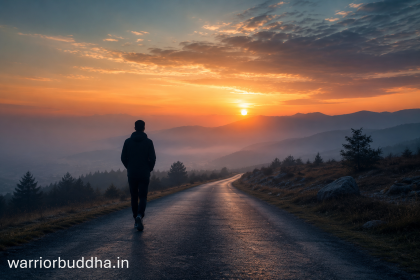
One thing I have also realized is that accepting uncertainty does not mean becoming passive toward life.
It does not mean giving up on your goals, avoiding responsibility, or simply leaving everything to fate. We still have to live, work, make decisions, build relationships, take care of ourselves, and move forward in life as consciously as we can.
But at the same time, we also need to understand that no matter how carefully we plan things, we cannot control everything.
And maybe a lot of our suffering begins when we expect life to give us guarantees that it was never meant to give.
I think there is a balance here.
We should prepare for the future, but not become consumed by fear. We should care about life, but not become psychologically destroyed by every uncertainty. We should act sincerely, while also accepting that many outcomes will always remain beyond our control.
I am still learning this, but slowly I have started realizing that acceptance is not always weakness. Sometimes it can be a form of inner strength too.
Because there is a certain peace that comes when you stop fighting the nature of life itself.
Life remains uncertain. Things may still go wrong sometimes. Pain, loss, and change are still part of being human. But instead of constantly trying to control everything, we slowly learn how to move with life a little more gracefully.
And perhaps that is part of the art of living.
Learning to Live with the Unknown
Life will never become completely certain.
No matter how much we plan, think, worry, or try to control things, there will always be unknowns ahead of us. There will always be change, unpredictability, endings, and new beginnings.
And maybe the real challenge is not to remove uncertainty from life, but to learn how to live alongside it without losing our inner balance.
I still have moments where fear and overthinking return. I still sometimes worry about the future or imagine worst-case scenarios. But now I also remind myself that life has always been uncertain, and yet somehow, I have continued moving forward through all its phases.
Slowly, I have learned that peace does not come from controlling life completely. It comes from accepting the nature of life a little more deeply.
Acceptance of the past brings closure.
Acceptance of death brings clarity.
Presence brings grounding.
And openness toward uncertainty brings life back its mystery and beauty.
Uncertainty is not only something we must tolerate.
It is also part of what makes life alive. Without uncertainty, there would be no mystery, no adventure, no transformation, and no new beginnings. Life would slowly lose its depth and beauty.
And maybe the art of living is not about eliminating uncertainty, but about learning how to move through it with more awareness, courage, gratitude, and peace.



Leave a Reply