
“What if everything you believed to be true was merely a shadow on the wall?”
A Glimpse into the Cave: The Prison You Don’t See
Imagine you’ve lived your entire life in a dimly lit cave, your wrists and ankles bound in heavy chains. You can only look at the wall in front of you. The darkness is suffocating, but then you begin to notice shadows dancing on the wall – distorted shapes of people, animals, and objects. You cannot see the source of the shapes, only their projections.
You and your fellow prisoners grow up naming them, debating them, believing in them.
“That’s a horse – see the legs?” one mutters.
“No, you fool, it’s a dog – I’d know,” another snaps.
“You’re both blind – it’s a wolf, and it’s hunting us,” a third growls, voice trembling.
The shadows become your entire reality. Because when shadows are all you’ve ever known, they don’t feel like illusions. They feel like truth. Your entire understanding of the world is built upon these flickering projections.
But you have no idea that behind you, a massive fire burns, casting these illusions. You don’t see the puppet masters holding crude figures before the flames, shaping the reality you argue over. And far beyond all this lies the entrance of the cave, where real sunlight pours in — a world you have never seen, and perhaps cannot even imagine.
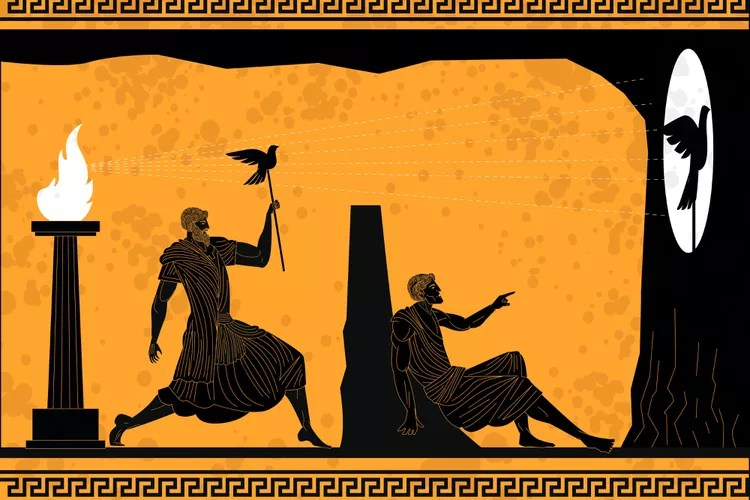
This is Plato’s Allegory of the Cave, a timeless metaphor for the human condition.
But what if we looked beyond the cave itself?
Beyond Plato: Why This Series Exists
This series is not merely about revisiting Plato’s allegory. It is about engaging with it more deeply — and going beyond it.
Plato gives us the structure, the framework through which illusion and truth can be understood. But the inner journey — the psychological, emotional, and existential dimensions of that transformation — is something each of us must confront for ourselves.
Together, we will move through the cave, not just as observers, but as participants. We will examine the nature of illusion, the forces that sustain it, and the subtle ways in which it shapes our perception of reality. More importantly, we will turn inward and begin to recognize the caves we inhabit in our own lives.
The Meaning of the Cave
In Plato’s allegory, the cave symbolizes a world of limitation — not merely physical, but mental and psychological. It represents a condition in which reality is filtered, shaped, and accepted without question.
This conditioning rarely feels imposed. It feels natural.
We inherit belief systems from family, culture, and religion. We form identities around ideas we never consciously chose. We absorb values, assumptions, and definitions of success without ever pausing to examine their origins.
Over time, this becomes our reality.
And what begins as conditioning eventually becomes comfort. The cave does not survive through force alone — it survives through familiarity.
The Shadows: The Deceptive Nature of Perceived Reality
The shadows on the wall are not outright lies. They are fragments of truth — incomplete reflections of reality that appear convincing precisely because they contain elements of what is real.
This is what makes them so compelling.
A man may mistake attention for respect, believing that visibility is the same as value. A student may confuse the accumulation of information with genuine understanding. A seeker may rely on borrowed ideas and call it wisdom, without ever experiencing truth directly.
The danger of the shadows lies not in their falsity, but in their partial truth. They resemble reality closely enough to be trusted, yet lack the depth required to truly understand it.
And over time, something even more subtle begins to happen — we do not merely observe these shadows, we begin to identify with them. We defend them, protect them, and resist anything that threatens to question them.
The Fire: The Illusion of Light
If the shadows represent what we perceive, the fire represents the source that makes those perceptions believable.
The fire is a subtle trap. It mimics illumination while keeping prisoners blind. It creates visibility, but not understanding. It offers a sense of clarity, while quietly restricting the depth of what can be seen. In this way, it does not obscure reality completely — it replaces it with something that feels sufficient.
It is the voice that reassures rather than challenges. The system that informs, but does not transform. The kind of knowledge that provides answers, but discourages deeper questioning.
In modern life, this can take many forms — the illusion of knowledge through surface-level information, the pursuit of success that promises fulfillment but often leaves an emptiness behind, or even forms of spirituality that comfort the mind without awakening it.
The fire does not reveal truth. It only sharpens the shadows.
The Puppet Masters: Architects of Illusion
Behind the fire stand those who influence what is seen and how it is interpreted.
These forces are not always visible, nor are they always intentionally deceptive. Yet their impact is undeniable.
Narratives are shaped. Perspectives are guided. Certain ideas are amplified, while others are quietly dismissed.
This influence can come through institutions, media, culture, authority figures, or even the collective beliefs of society itself.
Over time, these structures begin to feel unquestionable. Not because they are necessarily true, but because they are consistently reinforced.
The cave, in this sense, sustains itself not through control alone, but through participation. We become part of the very system that shapes our perception.
Why This Series Matters
At a certain point, this stops being a philosophical idea and becomes something far more personal.
Because the question is no longer about the cave as a concept, but about the ways in which it exists within our own lives.
What beliefs have we accepted without ever examining them?
What illusions have we mistaken for truth?
What aspects of our identity are shaped by forces we have never questioned?
And perhaps the most difficult question of all —
If we were given the opportunity to turn around, to see beyond what we have always known… would we have the courage to do so?
Next Chapter: The Escape to the Light
In the next part of this series, we will follow the journey of the prisoner who breaks free.
Who is he? A seeker, a rebel, or simply someone who can no longer accept the reality presented to him?
What compels him to turn — curiosity, suffering, an inner restlessness, or something deeper?
And how does this transformation take place?
The journey has begun.
The only question that remains is:
Are you ready to turn around?



Leave a Reply