
1. The Seduction of the Idea
There are some connections in life that feel too intense to be ordinary. They don’t arrive gently, and they don’t unfold slowly. They enter all at once—like something within you has recognized something it has been waiting for, even if you cannot explain why.
You meet a person, and suddenly, they don’t feel like just another human being. They feel different. Important. Almost… destined. As if this meeting was not accidental, as if there is something deeper at play, something beyond logic, beyond reason.
In spiritual circles, this feeling is often given a name—twin flames. The idea that somewhere out there exists a person who is not just compatible with you, but is actually a part of you. Your other half. The one who will complete you.
And when you experience a connection like this, it becomes almost impossible not to believe it. Because it does not feel like imagination. It feels real. It feels profound. It feels like truth.
But what if the truth is not what it appears to be?
What if the intensity you feel is real… but the meaning you have given to it is not?
What if the person you believe is your twin flame is not someone you are meant to find in the world, but something you are meant to discover within yourself?
2. What People Believe Twin Flames Are
The concept of twin flames has become widely popular in spiritual spaces, and for a good reason—it speaks directly to one of the deepest human desires: the longing to feel completely seen, understood, and united with another.
According to this idea, a twin flame is not just a partner or a compatible soul. It is believed to be your other half—your soul split into two bodies, destined to find each other again. A connection that goes beyond attraction and compatibility into something that feels almost sacred.
People who resonate with this idea often describe a familiar pattern. There is an immediate sense of recognition, as if you have known this person before, even if you have just met. The connection feels intense, magnetic, and difficult to explain in ordinary terms. It does not follow the usual pace of relationships. Instead, it accelerates, deepens, and begins to occupy your inner world in a way that feels both beautiful and overwhelming.
There is also a cycle that many associate with these dynamics—the coming together and falling apart. Periods of deep closeness followed by distance, confusion, or separation. And instead of seeing this instability as a problem, it is often interpreted as part of a larger spiritual process, something meant to facilitate growth and transformation.
And because of all this—the intensity, the emotional depth, the sense of meaning—people begin to believe that such a connection cannot be ordinary.
It must be special.
It must be destined.
It must be… a twin flame.
3. When I Thought I Found ‘The One’
I remember experiencing something like this in my own life when I was younger. It was a phase where I was already going through a lot internally—confusion, emotional pain, and a sense of instability that I did not fully understand at the time. My inner world was not at peace, and there were many wounds I was carrying, even if I did not yet have the language to describe them.
Around that time, I met a girl. We were not deeply connected in any conventional sense. We did not spend much time together, we did not have long conversations, and there was no real relationship that developed between us. But at some point, I came to know that she liked me.
And something shifted inside me.
It was not just attraction. It was not even ordinary affection. It was something far more intense. I began to see her in a way that was no longer grounded in reality. I placed her on a pedestal, almost as if she was something divine, something elevated, something beyond the ordinary.
She was no longer just a person.
She became an idea.
What I felt did not feel like ordinary love. It felt deeper—almost sacred, in a way I could not explain. Even though I barely knew her, my inner world became deeply attached to her presence. She occupied my thoughts, my emotions, and my imagination far more than the reality of our connection justified.
And this did not end when the contact faded. Even after we stopped talking, even after life moved on externally, something within me remained connected to her. I would still think about her, still feel that attachment, still experience that depth of emotion that had once taken over my inner world.
And what I felt was real. There was no doubt about that. The intensity, the longing, the emotional depth—it was all genuine.
But what I did not understand at the time was what exactly I was experiencing… and where it was really coming from.
4. When Reality Didn’t Match the Feeling
Over time, something began to feel… off. Not in a loud or obvious way, but subtly, in the background of my experience.
The feelings were still there. But the reality of the connection did not reflect the depth I was carrying within myself.
I found myself reaching out, trying to reconnect, trying to hold onto something that, in truth, was no longer present. The responses were minimal, sometimes absent. There was a clear imbalance—one side holding on, the other not participating in the same way.
And for the first time, a question began to arise:
If this connection is so deep, so meaningful, then why does it not exist in reality in the same way it exists within me?
That question did not bring immediate clarity, but it created a crack in the certainty I once had.
I began to notice that I did not really know her—not in the way one truly knows another human being. We had not shared enough experiences or understanding to justify the depth of emotion I was carrying. And when I looked at it more honestly, I could also see that we were different people, perhaps not even truly compatible in the long run.
And yet… the feeling remained.
That was the most confusing part.
If it wasn’t really about her, then what was it about?
5. Who Was I Really Loving?
That question stayed with me. It did not give me an immediate answer, but it pushed me inward.
Slowly, I began to see something I had completely missed before.
It was no longer, “Was this real?”
It became, “Where is this coming from?”
And that shift changed everything.
I began to understand that what I was experiencing was not something she had created. It was something that already existed within me, something that had been activated and given a form through her presence.
What I had been calling love for another person… was, in many ways, an encounter with a part of myself.
She was not the source.
She was the doorway.
And when I saw that clearly, the confusion began to dissolve.
It was about me.

6. What Twin Flames Actually Are
When I looked at my experience more honestly, something became clear—what I had been calling a “twin flame” was not a person I had met in the world. It was an experience unfolding within me.
The intensity, the longing, the depth—it did not come from her. It came from somewhere inside me that I had not fully known.
We experience something powerful internally, but instead of recognizing it as our own, we attach it to the person who triggered it. We begin to believe that they are the source, that they are the missing piece.
But in reality, what we are encountering is a part of ourselves we have been disconnected from.
For some, it feels like a longing for emotional warmth, for softness, for being seen. For others, it may feel like a longing for strength, direction, or grounding. These are not qualities that belong to someone else—they are parts of us waiting to be integrated.
Sometimes, these are described as the inner masculine and feminine—not as separate beings, but as dimensions of our own nature seeking balance.
The other person becomes a mirror. A trigger. A doorway.
But the source… is always within.
7. The Role of Childhood Wounds
When I reflected more deeply, I realized this was not just about the present—it was connected to something older.
At that stage of my life, I carried a deep, unspoken need—to be seen, to be valued, to be believed in.
And when I sensed that someone liked me, that small moment did not remain small. It expanded. It touched something that had been waiting for a long time.
It felt like recognition.
It felt like acceptance.
But what I did not realize was that this feeling was meeting a need that already existed within me.
This is why these connections feel so powerful. Not because the other person is our other half, but because they awaken something within us that has been waiting to be acknowledged.
Sometimes, what feels like home… is actually a wound being touched for the first time.
8. The Mirror & Projection
If we look closely at these kinds of connections, a pattern begins to emerge. It is not random, and it is not as mysterious as it first appears. There is a psychological process unfolding beneath the surface—one that we are often not aware of.
When we meet someone who seems to embody qualities we deeply resonate with—especially qualities we feel are missing within ourselves—the mind begins to project.
We start seeing more than what is actually there.
The person in front of us becomes a screen, and without realizing it, we begin to project our own desires, our own ideals, and our own unmet needs onto them. We don’t just see who they are—we see what they represent for us.
And because these projections come from a deep place within us, they carry intensity. They feel meaningful, almost sacred. It begins to feel as if this person is uniquely special, as if they understand us in a way no one else ever has.
But what we are often experiencing is not the depth of the other person—it is the depth of our own inner world being reflected back to us.
This is why the connection can feel so powerful even when there is very little real interaction. Because the experience is not being built through shared reality—it is being fueled internally.
We begin to believe that this person completes us, that they hold something essential that we do not have. And slowly, without realizing it, admiration turns into idealization, and idealization turns into dependency.
We stop seeing them as a human being. We start seeing them as something more.
But the truth is far simpler, and far more grounded.
We are not seeing them as they are.
We are seeing ourselves… reflected through them.
9. When Love Becomes Illusion
What begins as something beautiful can slowly turn into something confusing, and at times, deeply painful—especially when it is not clearly understood.
Once we become convinced that this person is our “twin flame,” we stop questioning the connection. We stop looking at it as it is, and begin to see it as it must be.
And that belief quietly distorts everything.
Distance becomes “part of the journey.”
Silence becomes “divine timing.”
Emotional unavailability becomes “growth.”
Instead of asking a simple question—Is this connection actually healthy?—we begin protecting the idea of it.
We may find ourselves waiting for someone who is not choosing us, holding on to someone who is not present, or trying to sustain something that does not exist outside our own inner world.
And the most dangerous part is—we don’t see it as suffering.
We see it as meaning.
We tell ourselves that the pain must have a purpose, that the confusion must be part of something deeper, that the intensity must be a sign that this is real.
But intensity, by itself, is not truth.
Sometimes, it is simply a reflection of how deeply our own unmet needs and projections have been activated.
And when we mistake that activation for destiny, we don’t just misunderstand the connection—
we slowly begin to lose touch with reality itself.
10. Spiritual Bypass
One of the most subtle, and at the same time most dangerous aspects of this dynamic is the way it can lead to spiritual bypassing.
Spiritual bypassing happens when we use spiritual ideas to avoid facing psychological truth—when we use higher concepts to escape deeper realities within ourselves.
And this is exactly what often happens here.
Instead of asking honest questions like, Why am I so attached? What is this revealing about me? Why does this feel so difficult and unbalanced?—we turn to spiritual explanations.
We say it is a twin flame journey.
We say it is meant to be difficult.
We say it is part of a higher process.
And in doing so, we stop looking at what is actually happening within us.
We stop seeing our wounds, our patterns of attachment, our unmet needs. We stop questioning the imbalance, the emotional dependency, the lack of mutuality.
Because now, everything has a spiritual justification.
Pain becomes purpose.
Confusion becomes growth.
Disconnection becomes destiny.
But not all pain is meaningful.
Not all suffering is a sign of something higher.
Sometimes, it is simply a sign that something within us needs attention, understanding, and healing.
True spiritual growth does not ask us to ignore our psychology—it asks us to understand it more deeply. It does not separate the inner and outer worlds—it brings them into alignment.
Because without psychological awareness, spirituality can easily become an escape.
And what we call a “twin flame journey” may not be a path of awakening at all—
it may simply be a beautifully packaged form of avoidance.
11. The Addiction Loop
Another reason why these connections can feel so powerful—and at times, almost impossible to let go of—is because they do not just operate on an emotional or spiritual level. They also create a psychological pattern that can feel addictive.
The experience often moves in cycles. There are moments of connection—attention, closeness, emotional intensity—and in those moments, everything feels right. There is a sense of relief, excitement, even a kind of emotional high.
And then, just as suddenly, there is distance. Silence. Confusion.
That contrast creates a strong internal pull. The moments of connection begin to feel more valuable precisely because they are not consistent, and the moments of absence begin to feel heavier, more difficult to sit with.
So a pattern forms.
We begin to crave the connection, not just for what it is, but for how it appears and disappears. We wait for the next message, the next moment, the next sign that the connection is still there. And when it comes, even briefly, it feels like confirmation—like proof that what we feel is real.
But over time, this can turn into a loop.
A loop of seeking, receiving, losing, and seeking again.
And in some cases, when the other person is inconsistent or emotionally manipulative, this attachment can be taken advantage of. When you are deeply invested in the idea that this connection is special or destined, it becomes easier to overlook what is actually happening.
You may continue to give, to wait, to interpret even the smallest signs as meaningful—while the other person remains distant, inconsistent, or only partially present.
Not because the connection is deep…
but because you are already emotionally hooked to what it represents.
What feels like destiny… can sometimes be dependency.
And what feels like a deep, spiritual bond… can, at times, be a cycle that keeps you attached without truly fulfilling you.
12. The Truth About Twin Flames
After looking at all of this more deeply, the idea of twin flames begins to shift—not as something to completely reject, but as something to understand more clearly.
Because there is something real in these experiences.
Some connections do feel unusually intense. Some people do enter our lives and awaken parts of us we had never consciously accessed before. They can challenge us, shake us, and bring us face to face with aspects of ourselves we may have avoided.
In that sense, these connections can be deeply transformative.
But the transformation does not come from the other person being our missing half. It comes from what the experience reveals within us.
The intensity is real.
The emotions are real.
The impact is real.
But the meaning we often attach to it—that this person is destined to complete us—is where the misunderstanding begins.
Because no one outside us holds a missing piece of our being.
What these experiences often do is not unite us with another person, but confront us with our own inner fragmentation—the parts of ourselves we have not yet fully seen or integrated.
And if we are willing to look honestly, these connections can become something valuable. Not because they lead to union with another, but because they invite us into a deeper relationship with ourselves.
They don’t complete us.
They reveal us.
13. The Shift
At some point, if we are willing to look honestly, a shift begins to happen.
The focus slowly moves away from the other person and begins to return to where it always belonged—within ourselves.
The question is no longer, “Will this connection work?” or “Will they come back?”
It becomes, “What is this experience showing me about myself?”
And that shift changes everything.
Because instead of chasing the person who seemed to hold something essential, we begin to recognize that what we were seeking was never truly outside us. It was something within us, waiting to be seen, understood, and integrated.
The qualities we admired, the depth we felt, the sense of connection we longed for—these were reflections of our own inner world.
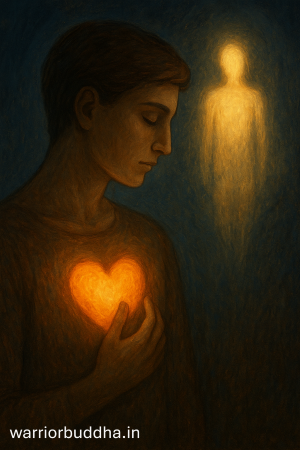
In that sense, what we often call a “twin flame” is not really about two flames trying to unite.
It is about one flame—our own—seeking to become whole within itself.
We stop chasing the mirror.
We begin to reclaim what we once projected.
And slowly, the longing that once felt directed outward… begins to settle within.
Not as absence, but as integration.
Not as dependency, but as wholeness.
14. Closing
Some people will come into your life and leave a mark that feels difficult to explain. They will stir something within you, awaken something you had not yet seen, and for a while, it may feel like they are the center of that experience.
But not everyone who awakens something within you is meant to stay.
And not everything that feels like destiny is meant to become a relationship.
Sometimes, the purpose of a connection is not to unite you with another person, but to bring you closer to yourself. To show you what you carry within you—your depth, your longing, your capacity to feel, and the parts of you that are still waiting to be understood.
And once that is seen clearly, something begins to change.
The connection you once held onto… becomes the experience that helped you understand yourself more deeply.
And the person you once believed was the answer… becomes the question that led you inward.



Leave a Reply