
Introduction: The God Who Defies Definition
There are gods who live in temples, gods who rule the heavens, and then there is Shiva—who dwells in the cremation ground, meditates in silence, and dances in storms. He is not a god you merely worship; he is a god you experience. He does not ask for rituals, he asks for awakening.
There are moments in life when words collapse—when explanations no longer comfort. That’s where Shiva begins. He doesn’t fit into logic or tradition; he flows through paradox. He is pure consciousness wearing the cloak of contradiction—both terrifying and tender, detached yet deeply compassionate.
In the modern world, we search for balance while living at the edges—overstimulated, restless, disconnected. Shiva’s wisdom, ancient yet alive, meets us right there. He invites us to pause, to dissolve the noise, and to rediscover the silence that lies beneath it all.
This journey is not about worship—it’s about awakening. It’s about seeing how Shiva’s timeless energy speaks through the chaos of our daily lives, through our struggles, and through our search for peace.
In this exploration, we’ll travel through three dimensions of Shiva:
- The Essence of Shiva — understanding his symbols, stories, and cosmic role.
- His Wisdom for Modern Life — how his philosophy can bring balance, clarity, and strength in today’s chaotic world.
- His Guidance Through Darkness — how his presence becomes a light for those who have suffered, who are rebuilding from ashes.
Because Shiva is not distant. He is the fire within us—the one that destroys illusions, the one that keeps us alive even when everything else seems broken.
1. The Essence of Shiva – Symbolism and Core Attributes
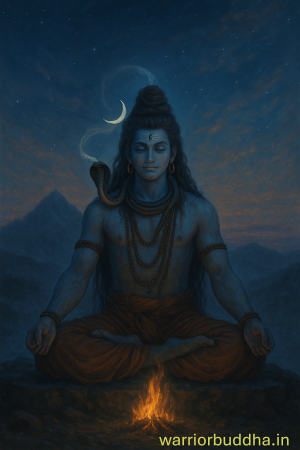
When I first began to look beyond the image of Shiva—the wild ascetic with matted locks, the serpent coiled around his neck, the crescent moon glowing faintly in his hair—I realized he wasn’t merely a god to be worshipped. He was a language. A living symbol of everything life holds: silence and storm, beauty and terror, creation and death.
The deeper I went, the more I understood why Shiva feels both familiar and foreign—because he reflects the hidden sides of our own being.
He is the still yogi who can destroy worlds with a single glance. The renunciate who loves with fierce devotion. The meditative silence that explodes into the thunder of the Tandava. To stand before him, even in thought, is to face every contradiction within yourself.
🌙The Three Currents of Existence
In Hindu philosophy, the universe flows through three forces—Sattva, Rajas, and Tamas.
- Sattva is clarity, wisdom, the still light of dawn.
- Rajas is fire—movement, desire, restlessness.
- Tamas is the night—heaviness, inertia, decay.
Most of us swing helplessly between these states, ruled by whichever current dominates the moment. But Shiva doesn’t sway. He stands at the center of all three, perfectly still.
In his meditation, he is pure Sattva—a calm so vast that even time seems to stop.
In his cosmic dance, the Rajas burns through him—he is movement itself, creation in motion.
And as Mahakaal, he embodies Tamas, the final stillness where all forms dissolve back into nothingness.
He is beyond all three. That’s why he’s called Trigunatita—the one who has transcended the play of nature itself.
And how often do we live a life tossed by these energies—moments of peace shattered by anxiety, ambition followed by exhaustion, clarity clouded by confusion. To meditate on Shiva is to slowly anchor ourselves beyond that tide—to become the witness, not the wave.
🌙The Fire That Destroys to Create
Shiva is often called the Destroyer, but the title is easily misunderstood. He does not destroy out of wrath. He destroys because everything that lives must one day transform. His destruction is purification.
The sages say that the universe breathes through Shiva—when he opens his eyes, creation begins; when he closes them, all dissolves.
That is what the Tandava, his cosmic dance, truly means: the rhythm of creation and dissolution. Each beat of his drum marks both a beginning and an ending.
In our lives, there are times when everything we know needs to burn too—identities, attachments, dreams. And in that fire, we begin to see what Shiva truly means: destruction as renewal.
🌙The Balance of Fire and Love
What makes Shiva extraordinary is his completeness. He is both the ascetic and the lover. The wild energy that dances through the universe also sits quietly beside Parvati, gentle and human.
Their union is not a love story in the romantic sense—it is the merging of opposites. Shiva is consciousness; Parvati, energy. Without her, he is static potential. Without him, she is uncontrolled motion. Together, they are the pulse of existence itself.
And within that union lives another truth—the Ardhanarishvara. Not merely a form of Shiva, but a mirror held up to our own inner world. Half Shiva, half Shakti—not as man and woman, but as the masculine and feminine currents that live within every human being. Logic and intuition, discipline and surrender, will and receptivity. It points to allowing both the inner masculine and the inner feminine to exist fully—without dominance, without suppression, in conscious harmony.
🌙The Lord of Shadows and Light
Another quality of Shiva that I find endlessly fascinating is his neutrality. He is loved by both gods and demons. Saints and sinners alike seek his blessing. Why? Because he doesn’t judge. He sees beyond labels—good and evil are both parts of the same whole.
But there’s a distinction. Shiva embraces those who carry darkness yet seek light. For those completely consumed by evil, who spread destruction without remorse, he becomes the destroyer—the fierce Rudra who burns corruption back to ash.
That’s what makes him the ultimate balance. He doesn’t deny the shadow; he integrates it. And that’s what gives him strength.
Because pure light, like pure steel, can be brittle. But when tempered with conscious darkness, it becomes unbreakable. Shiva is that tempered strength—the divine forged through both pain and purity.
🌙The Living Symbol
When you really look at Shiva—not just as a figure but as a metaphor—you begin to see how each element around him tells a story:
- The crescent moon on his head—time under control.
- The river Ganga flowing from his locks—wisdom descending from the heavens.
- The snake around his neck—mastery over fear and death.
- The ashes on his body—a reminder that all forms will one day fade.
Every aspect of him whispers the same truth: everything changes, everything dissolves, and only consciousness remains.
And maybe that’s why Shiva feels less like a god and more like a mirror. A mirror that shows what we are capable of when we stop running—from chaos, from pain, from ourselves.
In his silence, we learn what true strength feels like.
In his fire, we learn what surrender means.
And in his contradictions, we find the path back to wholeness.
2. Applying Shiva’s Wisdom in Modern Life
There’s a moment that comes to everyone walking the spiritual path—the moment when you realize philosophy alone is not enough. You can know all the stories, understand every symbol, but until Shiva’s wisdom begins to live through you, it remains a concept.
💫The Silent Rebel in a Noisy World
If there’s one thing this modern age cannot stand, it’s silence. We’ve traded stillness for stimulation, solitude for scrolling. We wake up to notifications instead of our own breath.
But Shiva, the eternal ascetic, teaches us the courage to disconnect—to sit in the silence we spend our lives avoiding. His meditation on Mount Kailash is not an escape from the world; it’s a declaration of independence from it.
In his stillness, there’s rebellion. Because when the world screams for attention, presence becomes an act of defiance.
That’s how Shiva’s meditation works. It’s not about sitting cross-legged in perfection—it’s about daring to meet yourself without distraction.
💫The Dance of Death and Rebirth
Modern life is filled with endings—relationships, careers, even versions of ourselves. But we treat endings as failures when they’re actually the most natural rhythm of existence.
When Shiva dances the Tandava, he is not merely destroying—he’s clearing space for creation. The same happens within us. Every heartbreak, every closed chapter is an inner Tandava—something old collapsing so something truer can rise.
And then we realize that death is not an event, but a process—small deaths happening all the time. The death of ego, of expectation, of who we thought we were. And every time something dies, a new awareness is born.
This is the art of Shiva’s way: don’t cling—flow.
💫The Sacred Union: Sexuality as Consciousness
There’s another layer of Shiva’s teaching that our world still struggles to grasp—his relationship with sexuality. In many cultures, desire is seen as a threat to spirituality. But Shiva never rejects it; he sanctifies it.
The Shiva Linga, often misunderstood, is not just a symbol—it’s the most beautiful metaphor for creation. The upward-reaching Linga represents pure consciousness (Shiva), while the circular base, the Yoni, represents creative energy (Shakti). Together, they form the universe itself—the dance of stillness and motion.
It is a reminder that desire, when approached with awareness, is sacred. What corrupts it is unconsciousness—when lust becomes escape instead of connection.
Even the temples of Khajuraho whisper this truth. On the outer walls, the erotic sculptures depict the world of passion, energy, life. But inside, in the innermost sanctum, sits Shiva—silent, meditating. It’s a journey from the outer world of senses to the inner world of consciousness.
Sex, in its deepest sense, is not just physical union—it’s a momentary glimpse of wholeness, of losing oneself to something larger. That’s why Shiva integrates it, not suppresses it.
💫Shiva and the Digital Age: The Art of Detachment
In a time where our worth is measured in likes, Shiva’s detachment feels like medicine. He owns nothing, seeks nothing, needs nothing—yet lacks nothing.
We, on the other hand, are constantly seeking—attention, approval, affirmation. But the more we seek, the emptier we feel. Shiva reverses that equation. He shows that peace doesn’t come from having more; it comes from wanting less.
Shiva’s path isn’t about renouncing the world—it’s about renouncing the noise within you that keeps you enslaved.
💫Shiva’s Presence in the Everyday
Sometimes, his lessons appear quietly. In the pause between thoughts. In the moment you let go when anger would be easier. In the courage to let something end gracefully. In the calm that follows chaos.
That’s Shiva—not distant in the Himalayas, but alive in the simplest acts of awareness.
Because the truth is, Shiva isn’t asking us to become monks or mystics. He’s asking us to remember who we are beneath the clutter—to return to the silent mountain within.
And when you find that mountain, even amidst chaos, you realize something profound:
You don’t have to escape the world to find peace. Because within all of us, there is an inner Kailash where Shiva is meditating.
3. Shiva’s Guidance for Survivors of Trauma and Narcissistic Abuse
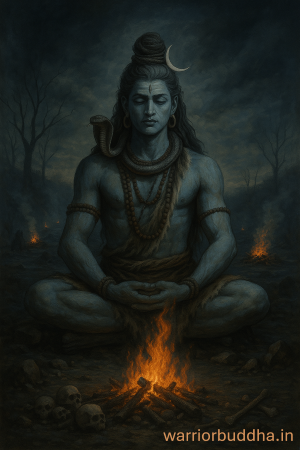
There are lives that look fine from the outside but inside are slow-burning cremation grounds. I know that world. I have lived there — in the shadows of control, manipulation, and emotional violence.
There were days when I felt hollow, like a shell that echoed everyone else’s voice but my own. In that darkness, I met Shiva not as a god, but as presence. And in that silence, I found Shiva sitting beside me — in that same cremation ground where my old self was burning.
And slowly, I understood: this is how he heals. He doesn’t remove your pain. He transforms it.
🌑How Shiva Drinks the Poison
When Shiva drank the cosmic poison to save the world, he didn’t swallow it — he held it in his throat. It turned him blue, but it didn’t touch his heart.
That is exactly what healing from abuse requires: to hold the poison without letting it define you. To say — Yes, this happened to me. But it will not live inside me.
Many a times we mistake suppression for strength. We believe that if we ignored the pain long enough, it would disappear. But real strength comes when we stop avoiding it — when we look at our own wounds without flinching.
Meditating on Shiva teaches us that awareness itself is the antidote. When you hold your suffering in the light of consciousness, it begins to lose its power.
🌑Shiva’s Relationship with Darkness
Shiva is not afraid of the dark — he sits right in it. He lives in cremation grounds, covered in ash, surrounded by ghosts and demons. He has no fear of what most of us run from.
Many of us would ask — Why would a god choose to live among the dead?
Because he transforms what others abandon. He turns ghosts into companions, ashes into wisdom, endings into beginnings.
When you’ve lived through narcissistic abuse or deep trauma, you begin to understand this aspect of Shiva intimately. He doesn’t say, “Forget the darkness.” He says, “Bring light into it.”
The more we sit with our pain, the more we realize it isn’t our enemy. It is our teacher — demanding honesty, forcing surrender, showing us where we are still clinging.
That’s how Shiva transforms suffering — not by removing it, but by helping you integrate it.
🌑Meditating with the Destroyer
Meditating on Shiva is not always peaceful. Sometimes it feels like being stripped bare — layer by layer, illusion by illusion.
But in that stripping away lies liberation.
The world becomes quiet. And in that shared stillness, we could finally see the truth.
Meditation became less about escaping the pain and more about becoming vast enough to hold it.
That’s what Shiva teaches — to become the sky, not the storm.
And if you’ve ever been broken by someone’s cruelty, remember: your heart is not fragile — it’s infinite. It only breaks when it forgets its own immensity.
🌑The Fierce Protector Within
Shiva as Rudra is the fierce, unyielding aspect of consciousness — the destroyer of deceit and falsehood. Rudra is the symbol of sacred boundaries.
Survivors of abuse often struggle to say “no.” They confuse kindness with self-erasure. But Rudra teaches that compassion without boundaries is self-harm.
To embody Shiva is to draw the line — not in anger, but in clarity. To walk away not with bitterness, but with strength. To say, I am no longer available for what diminishes me.
That’s sacred anger — the kind that cleanses without hate.
🌑The Rebirth of the Self
Healing isn’t about returning to the past. It’s about discovering who you are after everything false has fallen away.
Shiva’s ashes symbolize this perfectly. They’re what remains after every illusion has burned — what cannot be destroyed. That’s the essence of our being.
And when you rise from that ash, you realize you haven’t lost yourself. You’ve simply lost your prison.
And then you begin to live lighter — not because life became easy, but because you stopped resisting its impermanence.
Pain no longer frightens then. It becomes a proof that you are alive, awake, evolving.
🌑The Journey from Darkness to Light
If you’ve ever walked through your own hell, know this — Shiva walks with you.
He doesn’t promise to shield you from the fire. He teaches you to become it.
When you meditate on him, you begin to recognize that your suffering isn’t punishment — it’s purification. That your pain isn’t a curse — it’s initiation.
And somewhere along the way, you stop asking for the light to return. Because you realize you’ve become it.
Shiva doesn’t rescue you. He awakens you. He shows you that the very darkness that tried to bury you has been your teacher all along.
So to anyone who’s still in the shadows, remember this:
You are not broken. You are becoming.
And when everything false has burned away, what will remain is what always was — consciousness, awareness, freedom.
That’s where Shiva lives.
Not in the heavens, not in the scriptures,
but in the human heart that dares to rise from its own ashes.
Epilogue: Becoming the Stillness in the Storm
The more I’ve walked with Shiva, the more I’ve realized that understanding him isn’t about collecting knowledge — it’s about dissolving. Every time I thought I understood him, he revealed another layer, another paradox, another silence.
He is not a god you can fully define, only one you can feel.
Shiva is not a figure of the past — he is the pulse of the present. You can find him in the pause between two thoughts, in the acceptance that follows heartbreak, in the peace that comes when you finally stop running from yourself.
He does not demand belief; he invites experience. He asks one simple question: Can you face your own truth and still remain still?
Because to live like Shiva is not to escape the world — it’s to move through it with awareness. It’s to hold the poison but not become it. It’s to love without losing yourself, to destroy without hatred, to create without attachment.
And maybe that’s the quiet miracle of his path — not that he lifts you out of your storms, but that he teaches you to dance in their center.
Om Namah Shivaya.🕉️


 Musings of a Warrior Buddha
Leave a reply to K Y Cancel reply