
“What if everything you believed to be true was merely a shadow on the wall?”
A Glimpse into the Cave: The Prison You Don’t See
Imagine you’ve lived your entire life in a dimly lit cave, your wrists and ankles bound in heavy chains. You can only look at the wall in front of you. The darkness is suffocating, but then you notice shadows dancing on the wall – distorted shapes of people, animals, and objects. You cannot see the source of the shapes, only their shadows.
You and your fellow prisoners grow up naming them, debating them, believing in them.
“That’s a horse – see the legs?” one mutters.
“No, you fool, it’s a dog – I’d know,” another snaps.
“You’re both blind – it’s a wolf, and it’s hunting us,” a third growls, voice trembling.
The shadows become your entire reality. Because when shadows are all you’ve ever known, they don’t feel like illusions. They feel like truth. You form your entire worldview based on these flickering shadows.
But you have no idea that behind you, a massive fire burns, casting these illusions. You don’t see the puppet masters holding crude figures before the flames, shaping the reality you argue over. And beyond all this lies the cave’s entrance, where real sunlight pours in — a world you’ve never seen, never imagined.
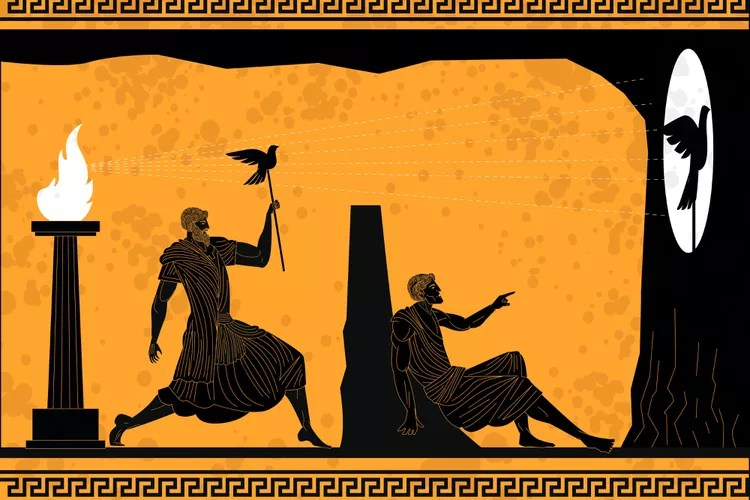
This is Plato’s Allegory of the Cave, a timeless metaphor for the human condition.
But what if we looked beyond the cave itself?
Beyond Plato: Why This Series Exists
This series is not merely about revisiting Plato’s allegory.
It is about deconstructing it — and then going further.
Plato gives us the structure.
But he leaves much of the inner journey untouched
Together, we’ll journey through the cave, unravel its deeper meanings, and confront the illusions shaping our own existence. We’ll examine its machinery, its psychology, and its grip on the human mind. And more importantly, we’ll confront the caves we inhabit in our own lives.
Over the course of this series, we will explore:
The Anatomy of Illusion: The cave, the fire, the shadows, and the unseen hands that script our lives
The Lightbearers: those rare souls who break free and dare to see beyond appearances.
The Truth and the Sun: what lies beyond the cave, and whether freedom is worth its cost.
The Return: what happens when the awakened come back to the cave. Are they met with rejection, ridicule, or reverence?
The Prisoners and the puppet masters: why most reject freedom willingly, and the strange bond between the enslaved and those who rule them.
And finally, we explore the three destinies of Lightbearers —
those who sacrifice themselves for love and compassion like Jesus,
those who stand for cosmic duty and the restructuring of illusion like Krishna,
and the Fallen Lightbearer — the one who glimpsed truth, but turned back, choosing power over freedom.
This is not merely a philosophical exploration. It is a journey inward, confronting the caves we inhabit and the illusions we mistake for truth.
The Meaning of the Cave
In Plato’s allegory, the cave symbolizes the world of illusion and ignorance, where people only see distorted reflections of reality. The shadows symbolize false beliefs, superficial perceptions, and misinformation. The fire, which might seem like a source of light, is in fact part of the machinery of deception. It is the limited and distorted knowledge that creates false realities.
And the prisoners signify humanity itself: conditioned, constrained, and largely unaware.
In today’s world, the cave can take many forms:
Inherited belief systems from family, culture, or religion that shape our worldview without question.
The identities we cling to, never realizing they are masks, not our true selves.
The opinions of others that quietly shape our sense of worth.
Comfortable Illusions — consumerism, entertainment, or blind faith in authority.
Institutions of conformity – educational systems that prioritize memorization over critical thinking.
The cave survives not through force alone, but through familiarity.
The Shadows: The Deceptive Reality
The shadows on the wall are not outright lies.
They are partial truths — fragments of reality stripped of depth and context.
This is what makes them dangerous.
In our world, shadows could be:
Clickbait news and half-truths that simplify complex issues — offering partial facts but lacking full context.
Advertisements selling fleeting happiness as a product.
Social validation – likes, comments, and followers creating the illusion of self-worth.
Distorted education – where degrees symbolize intelligence without cultivating wisdom.
The most dangerous shadows are not the ones imposed on us —
but the ones we learn to protect.
The Fire: The Illusion of Light
The fire is a subtle trap. It mimics illumination while keeping prisoners blind. It creates visibility without understanding.
In modern life, the fire takes many forms:
The illusion of knowledge through rote learning, half-truths, and misinformation.
The promise of freedom through material wealth, status or superficial success.
False enlightenment – spirituality that soothes but never transforms.
Illusions of happiness – the belief that fulfillment lies in relationships, careers, or possessions.
The fire does not reveal truth.
It only sharpens the shadows.
The Puppet Masters: Architects of Illusion
Behind the fire stand the puppet masters — unseen, influential, shaping what the prisoners perceive as reality.
Today, they appear as:
Media corporations controlling narratives.
Political regimes thriving on half-truths and fear.
False gurus and influencers selling hollow enlightenment.
Dogmatic institutions enforcing rigid belief systems.
Charismatic leaders preaching virtue while living double lives.
Why This Series Matters
This series is not merely an analysis of an old allegory.
It is a mirror held up to our own existence.
It asks uncomfortable questions:
- Do you recognize the cave you are living in?
- What shadows do you mistake for truth?
- What chains keep you facing the wall?
- Do you have the courage to turn around — even if it hurts?
- And once you reach the light, will you return to the cave… or remain free?
Through this series, we will unravel these questions – one chapter at a time.
Next Chapter: The Escape to the Light
In the next part, we’ll meet the prisoner who breaks free.
Who is he?
A seeker? A rebel? A misfit?
Or simply someone who can no longer accept the shadows?
Why does he escape — Is it curiosity, suffering, an innate thirst for truth, or divine intervention?
And how does he do it — Through reason, intuition, awakening, or the influence of those who escaped before him?
The journey has begun.
The only question is:
Are you ready to turn around?

 Musings of a Warrior Buddha
Leave a comment