
The Reaction Problem
I didn’t start thinking about patriarchy because I was deeply interested in it.
It started very casually. Scrolling through Instagram, I kept seeing the same kind of posts again and again—“smash patriarchy,” “f*** patriarchy,” strong opinions, strong reactions. What caught my attention wasn’t just the posts, but the fact that many of my own friends—people I know personally—were engaging with them.
At first, I ignored it. It’s common now. Almost normal.
But after a point, it started bothering me. Not because I disagreed, but because something felt… off.
So one day, out of curiosity, I asked one of my friends a simple question:
“Why do you hate patriarchy?”
Her answer came instantly.
“Because women are oppressed in it.”
It sounded right. Familiar. Almost rehearsed.
But when I asked what the alternative was — whether a different system would actually solve the problem — there was no clear answer.
Just a pause.
That moment stayed with me.
Because it made me realize something uncomfortable: a lot of us are not really thinking about patriarchy — we are reacting to it.
The word itself has become loaded, emotional, almost like a trigger. And when something becomes a trigger, we stop trying to understand it. We don’t ask what it is, how it came into being, or why it exists. We respond to what we believe it represents.
That’s where this began for me.
Not from a place of defending patriarchy. Not from a place of attacking it.
But from a simple question: do we actually understand patriarchy… or have we just learned to hate it?
How Patriarchy Actually Emerged
Before deciding whether patriarchy is right or wrong, there’s a more basic question we tend to ignore: where did it come from?
Because systems don’t appear out of nowhere. They emerge from reality.
In earlier societies, life was uncertain and physically demanding. Survival depended on strength, risk-taking, protection, and stability. Roles weren’t assigned based on ideology — they were shaped by necessity.
Men, generally being physically stronger, took on external risks — hunting, protection, survival outside. Women, carrying the responsibility of childbirth and nurturing, took on roles that were just as essential, but different in nature.
Over time, these patterns became structure.
And that structure is what we now call patriarchy.
But reducing it to “men dominating women” misses something important.
Patriarchy was not created by men alone. It wasn’t a secret plan where men decided to dominate and women simply accepted it. Rather, it evolved through a mix of needs, expectations, and mutual dependencies. Women were not just passive participants — they also shaped families, traditions, and social norms within the realities of that time.
This doesn’t make the system perfect. It makes it understandable.
And there’s another layer we often ignore.
Patriarchy was not just about power. It was also about responsibility. The same system that gave men authority also demanded that they provide, protect, endure, and often sacrifice.
Power and pressure came together.
If we ignore this, we don’t really understand patriarchy — we simplify it.
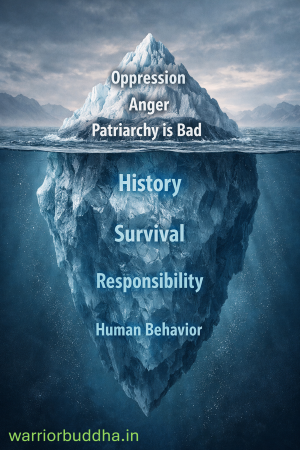
“Men Are Wired to Oppress”
A common assumption in these conversations is that men are naturally wired to dominate women — that given power, oppression is almost inevitable.
It sounds convincing, because there are examples.
But we often take patterns and turn them into permanent truths.
Because if you look honestly, the tendency to misuse power is not limited to men. It shows up wherever power exists—across genders, cultures, and systems.
Power doesn’t create this tendency. It reveals it.
Yes, men may be more drawn toward hierarchy, competition, and control. But the same drive can become leadership, responsibility, and creation.
So the question is not whether men have the capacity to dominate. They do. But so do human beings in general.
The real question is what happens when power meets a lack of awareness.
Because that is where domination begins — not in gender, but in behavior.
Systems and Human Behavior
Once a system is in place, it begins to shape how people think and behave. Over time, roles feel natural, expectations become familiar, and what was once shaped by conditions starts to feel unquestionable.
But this influence is not one-sided.
The same system that may limit certain choices can also provide structure, stability, and direction. Within such frameworks, many individuals — both men and women — have built meaningful lives and taken on responsibilities that gave their lives purpose.
At the same time, when the structure becomes rigid, it can begin to restrict growth.
So the impact of a system is never fixed. It depends on how it is lived.
People are shaped by systems, but they also continue to shape those systems through their actions and beliefs. It is a continuous process.
Which is why reducing the conversation to simple blame — misses what is actually happening.
Where Patriarchy Falls Short
Understanding patriarchy doesn’t mean ignoring where it has failed.
Problems begin when a system stops evolving. What once emerged from necessity becomes expectation. Roles become fixed, and individuals are expected to fit into them, whether they choose to or not.
That is where friction begins.
A woman denied education. A man crushed by the weight of being the sole provider. A daughter whose voice was never asked for. These are not abstractions. They are real lives.
Another issue appears when power disconnects from responsibility. When authority remains, but accountability weakens, imbalance follows.
That is where structure turns into control.
But the problem is not in recognizing these failures. The problem is stopping there.
Because when criticism turns into blanket rejection, without understanding how and why things went wrong, it doesn’t lead to clarity—it leads to another simplified narrative.
And we end up replacing one shallow understanding with another, or one flawed system with another.
Beyond Reaction
When I now come across those same posts on Instagram, I notice something has changed.
Not in them. In me.
Earlier, I felt the need to agree or disagree, to take a side. Now, the reaction is quieter. More neutral.
Because I’ve realized that things are rarely as simple as they are being presented.
Not every structure is pure oppression. Not every criticism is complete truth.
What I see now is not just a system being criticized, but a pattern — of reacting without understanding, of reducing something complex into something easy to reject.
And maybe that’s the real issue. Not patriarchy itself. But how quickly we turn ideas into labels — and labels into conclusions.
Because no system will ever be perfect. And no system is beyond change either.
The real question is not whether patriarchy is good or bad.
The real question is: are we willing to understand it before we decide what to do with it?

 Musings of a Warrior Buddha
Leave a comment