
The Return
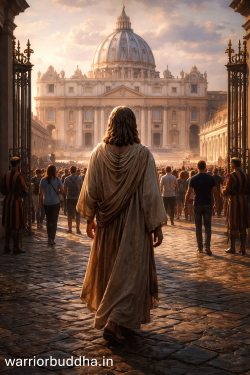
He arrives without announcement. No trumpet, no spectacle, no voice from the sky declaring his return. Just a man walking quietly through the crowd at the entrance of Vatican City.
People pass by him without a second glance. Tourists are busy taking pictures. Guards stand at the gates, checking access, maintaining order. Everything feels familiar, exactly as it should be.
He pauses for a moment and looks up at the towering structure in front of him—a place built in his name, where thousands gather every day searching for him.
He takes a step forward, but a guard stops him.
“Access is restricted.”
There is a brief silence. He looks at the guard— with compassion and quiet understanding. Then he nods and steps back.
No one notices. No one asks who he is. Inside, prayers continue, candles burn, and his name is spoken again and again.
Outside, he walks away.
Unrecognized.
The Disruption
He doesn’t leave immediately. He lingers, watching people enter and exit the place built in his name. There is sincerity in their gestures, a genuine longing in the way they pray.
And yet, something feels distant—as if what they are reaching for is no longer alive.
After some time, he begins to speak, not to a crowd, but to those who are willing to pause.
He does not offer any doctrines. Instead, he asks simple questions.
“Why do you come here?”
Some say, “To find God.”
He looks at them gently and asks, “And where have you looked before coming here?”
There is no accusation in his voice, but there is no comfort either.
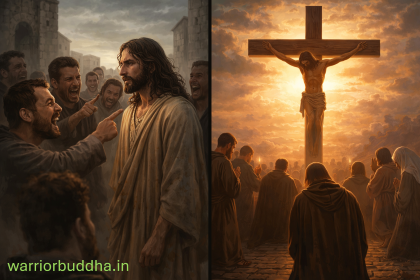
A small crowd gathers, drawn by curiosity. Someone asks if he is a priest. He smiles and says no. Another voice asks who he is to question this place.
He pauses and looks around—the walls, the symbols, the rituals repeated for generations.
“I am not questioning the place,” he says quietly. “I am questioning what you have made of it.”
The words unsettle more than they offend. A few feel something deeper—something they cannot quite name.
“This place was meant to remind you,” he continues, “not to take the place of what can only be experienced within.”
And that is where the discomfort begins—not because anything is being attacked, but because something is being revealed.
The Pattern
There is something quietly consistent in all of this.
An awakened person stands for something alive, immediate, deeply personal. Over time, his truth is remembered, refined, and gradually turned into something predictable.
Not because anyone plans it that way—but because it is easier to hold.
Jesus did not speak in order to create a system. He pointed toward something that had to be experienced directly.
But experience is personal. It doesn’t fit into something that can be repeated the same way every time.
So we do what we always do with something uncertain: we give it form.
Teachings become structure. Structure becomes tradition. And tradition, over time, becomes authority.
Nothing is lost on the surface. The words remain. The symbols remain.
But something subtle changes.
What was once alive becomes predictable.
What was once discovered becomes inherited.
And slowly, without anyone deciding it, truth becomes something you follow… instead of something you encounter.
Why We Do This
It is tempting to see this as a failure of religion.
It is not.
It is a reflection of us.
Because most of us are not really searching for truth—we are searching for stability.
Something that doesn’t disturb the life we’ve already built. Something that does not ask us to question too much, change too deeply, or step into the unknown.
So when something real appears, we don’t reject it—we reshape it.
We interpret it in a way that suits us. We keep what feels right and quietly ignore what doesn’t.
Over time, that adjustment becomes the norm.
And the original intensity—the part that demanded something from us—fades away.
A living truth is not easy to stay with. It does not let you remain the same.
That is precisely why we move away from it… and toward something more manageable.
Living Truth vs Dead Truth
At some point, something shifts.
Truth is no longer something we encounter. It becomes something we inherit—already defined, already explained.
Living truth requires our participation. Dead truth requires only our agreement.
It offers words to repeat, rituals to follow, and beliefs to hold on to.
And in that certainty, there is comfort.
Nothing is at risk anymore.
We don’t have to question ourselves. We don’t have to change. We don’t even have to understand.
We just have to believe.
And that is where something essential is lost—not in the teachings, but in the way they are lived.
Because truth was never meant to be safe. It was meant to wake us.
And we don’t resist truth because it is false.
We resist it because it asks something real from us.
The Church Within
It is easy to see this pattern in the world.
But the same pattern exists much closer—in the way we think, in what we believe, in how we respond when something challenges us.
The “church” is not just a place. It is a structure we carry within—a set of beliefs and identities that feel certain and safe.
And we protect it.
We defend it when it is questioned. We avoid what unsettles it. We resist anything that asks us to change too much.
So when something real enters our life—something that does not come with a label—we don’t always recognize it.
We explain it too quickly. We fit it into what we already believe. We accept what feels right and ignore what doesn’t.
And if it asks for too much—if it unsettles the way we see ourselves—we step away.
Not because it is wrong.
But because it leaves us with no place to hide.
The Return is Already Happening
The question was never whether Jesus would return.
Or whether someone like him would walk the earth again.
The real question is whether it would even matter if he did.
Because the problem was never absence.
It was recognition.
We keep waiting—for the right teacher, the right moment, something extraordinary. Something that arrives with certainty, with authority, with a sign that tells us: this is it.
But truth rarely comes that way.
It arrives quietly. Without announcement. Without identity. Without asking to be believed.
And because it does not look the way we expect it to, we overlook it.
Or doubt it.
Or reduce it into something we can quickly understand and move past.
And only later—when it is gone, when it no longer disturbs us, when it has been turned into something we can explain—we begin to recognize it.
We give it a name.
A story.
A place.
And then… we accept it.

 Musings of a Warrior Buddha
Leave a comment