
There is a battlefield inside each of us.
Not made of swords or arrows, but of questions, decisions, impulses, and doubts. Every day we are pulled between the urge to act and the fear of getting it wrong. Between ambition and stillness. Between doing and simply being.
At times we feel like warriors — carrying responsibilities, chasing goals, trying to carve a path through the chaos of life. At other times we long for clarity, for someone to hold the reins and show us the way.
This tension is not a flaw. It is part of being human.
And few stories capture it more beautifully than the ancient dialogue of the Bhagavad Gita, where two timeless figures — Arjuna and Krishna — stand together in the middle of a battlefield.
But the real battlefield was never only Kurukshetra.
It has always been within us.
What if Arjuna and Krishna are not just mythological characters, but archetypes living inside every human being? One representing the part of us that acts and struggles. The other representing the part that sees clearly.
If so, an important question arises:
Who should lead our lives — the warrior or the charioteer?
Arjuna: The Warrior Within Us
Arjuna is the part of us that wakes up each morning with a to-do list and a question mark in the heart.
He is the doer, the fighter, the part of our personality that engages with the world. The one who carries our ambitions, responsibilities, fears, and hopes. He wants to achieve something, build something, become something.
Arjuna is not weak. He is skilled, courageous, and passionate. Yet he is also deeply human. Like all of us, he can be overwhelmed by doubt, confusion, and the weight of difficult decisions.
On the battlefield of the Gita, Arjuna drops his bow. Not because he lacks strength, but because he suddenly sees the complexity of life — and does not know which way to turn.
Inside each of us, Arjuna represents the ego in its most sincere form: the part that wants to act, but does not always know the right direction.
Arjuna is powerful. But power without clarity can easily become confusion.
And that is why the warrior needs a guide.
Krishna: The Charioteer Within Us
If Arjuna represents the warrior within, Krishna represents something deeper.
Krishna is the quiet intelligence that sees beyond fear, beyond ego, beyond the noise of the world. He does not panic. He does not rush. He simply understands.
Instead of fighting the war himself, Krishna chooses the role of the charioteer, holding the reins of the chariot while guiding Arjuna through the battlefield.
Symbolically, Krishna represents the deeper awareness within us — the inner compass that can see the larger picture when the mind is lost in confusion. In many traditions, this deeper presence is described as the soul, or the higher self.
Unlike the restless ego, this deeper presence is calm and steady. It is less concerned with winning or losing and more concerned with alignment and truth.
Yet Krishna never forces Arjuna to obey. He explains, questions, and guides — but the final choice always remains Arjuna’s.
And perhaps that is the quiet lesson hidden in the story:
Wisdom is always available — but we must choose to listen.
When Only Arjuna Leads
When the warrior acts without the guidance of the charioteer, life can become exhausting.
The ego is naturally restless. It seeks achievement, recognition, security, validation. It compares itself with others and constantly worries about outcomes.
When Arjuna leads alone, life becomes a race of endless striving.
We chase goals, but rarely feel satisfied. We overthink decisions. We attach our sense of worth to success or failure. Even our victories sometimes feel strangely hollow.
The warrior knows how to fight — but he forgets why he is fighting.
In the modern world, this state is everywhere. Burnout, anxiety, and identity crises often arise when the ego is left to navigate life without deeper guidance.
Arjuna has strength. But without Krishna, strength can easily lose its direction.
When Only Krishna Leads
At the other extreme lies another possibility: a life led entirely by Krishna — by the soul alone.
In such a life, ambition fades. The need to prove oneself dissolves. One begins to experience a quiet peace that does not depend on achievements or recognition.
Mystics and sages throughout history have described such states — moments when life is no longer a struggle but a witnessing. When the individual self feels connected to something larger.
Without the noise of ego, there can be great clarity, compassion, and freedom from constant striving.
But this path also has its challenges.
The soul does not crave competition, success, or recognition. Left entirely on its own, it may drift toward detachment from ordinary life.
Many mystics withdraw from society for this reason. The ambitions and conflicts that dominate human life no longer hold their attention.
Yet the world still needs people who act, build, create, and engage.
The battlefield of life does not disappear. And someone must step onto it.
The Warrior and the Charioteer
The deeper wisdom of the Bhagavad Gita is not about choosing between Arjuna and Krishna.
It is about their partnership.
Krishna does not pick up the bow and fight the war himself. And Arjuna is not asked to abandon the battlefield.
Instead, Krishna holds the reins of the chariot while Arjuna stands ready with his bow.
One sees clearly.
The other acts courageously.
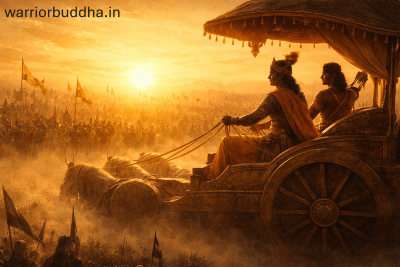
When Arjuna listens to Krishna, something remarkable happens. The ego does not disappear — it becomes aligned with deeper wisdom.
Action continues. Effort continues. But the inner atmosphere changes.
The warrior still fights, but without anxiety.
He works hard, but without the desperation to prove himself.
He acts with intensity, yet remains inwardly calm.
The ego becomes an instrument, not the master.
Perhaps this is the real art of living:
to act in the world with the strength of Arjuna,
while being guided by the wisdom of Krishna.
Conclusion: Looking for the Warrior and the Charioteer
The story of Arjuna and Krishna is not only an ancient dialogue from a distant battlefield.
It is a mirror.
Because if we look closely enough, we may begin to recognize both of them within ourselves.
There is an Arjuna in us — the one who worries about the future, who struggles with decisions, who carries responsibilities and sometimes feels overwhelmed by the complexity of life.
And there is also a Krishna within us — the quieter presence that occasionally whispers when we are still enough to listen.
The real question is not whether these two forces exist within us.
The real question is how they relate to each other in our lives.
When you make an important decision, which voice usually leads?
The restless urgency of the warrior?
Or the deeper clarity of the charioteer?
When you chase a goal, are you running blindly — or are you guided by something deeper?
When life becomes confusing, do you silence the inner guide… or do you listen?
And every human life is, in its own way, a journey toward bringing these two forces into harmony.
A warrior who learns to listen.
A charioteer who patiently guides.
And maybe the next time you find yourself standing on your own inner battlefield, you might pause for a moment and ask:
Who is holding the reins of my chariot today?
{If you enjoyed this reflection, I have written another essay exploring a similar idea from a different angle. In that piece, I look at the relationship between ego and awareness through the metaphor of the rider and the horse.}
You can read it here: https://warriorbuddha.in/2026/03/09/what-if-the-ego-is-not-the-enemy/

 Musings of a Warrior Buddha
Leave a comment