
In the second part of this series, we explored a very human phase of Siddhartha’s journey—the period when he stepped fully into the world of pleasure, ambition, and success. What began as curiosity slowly became habit, and over time the excitement of worldly life faded into a quiet sense of emptiness. Siddhartha realized that comfort and achievement, though attractive, could not satisfy the deeper longing that had once set him on his path.
Eventually, he walked away from the life he had built, not as an enlightened man but as someone who had learned an important lesson: sometimes we must lose ourselves in the noise of the world before we can begin to hear the deeper voice within.
It is from this place of exhaustion and honesty that the final stage of his journey begins.
When the Search Finally Grows Quiet
When Siddhartha leaves the city behind, he carries very little with him—no wealth, no possessions, no clear destination. Yet what weighs on him most is not what he has lost, but what he has learned. The years he spent chasing pleasure and success have left him with a deep weariness. The world that once fascinated him now feels strangely empty.
For the first time in a long while, Siddhartha is forced to face himself without distraction. The ambitions, games, and comforts that once filled his days are gone. What remains is the quiet awareness that the life he lived in the city had slowly taken him away from the deeper questions that once guided him.
This realization does not immediately bring answers. Instead, it brings stillness. The restless search that once pushed him from teacher to teacher begins to lose its urgency. Siddhartha has tried discipline, renunciation, and worldly indulgence. Each path has taught him something, yet none has delivered the final truth he once believed must exist.
Slowly, something inside him begins to change. The effort to find truth gives way to a willingness to listen. The search itself becomes quieter, more patient.
Sometimes wisdom begins not when we push harder, but when we finally become quiet enough to hear what life has been saying all along.
And it is in this quiet space that Siddhartha encounters a teacher unlike any he has known before.
The River and Vasudeva — Learning to Listen
Soon after leaving the city, Siddhartha finds himself once again beside a river he had crossed years earlier during the early days of his wandering. At that time, it had seemed like just another place along the road. Now, after everything he has experienced, the river appears different—or perhaps Siddhartha himself has changed.
The ferryman who lives beside the river, Vasudeva, welcomes him with quiet kindness. There is nothing outwardly extraordinary about this man. He does not speak in philosophical language or claim spiritual authority. He simply lives beside the river, ferrying travelers from one shore to the other.
Yet Siddhartha notices something unusual about him: Vasudeva listens.
When Siddhartha shares the long story of his life—the years of seeking, the fall into worldly pleasures, and the exhaustion that followed—Vasudeva listens patiently without interruption. When Siddhartha finishes, the ferryman offers no elaborate advice. Instead, he suggests something simple: that Siddhartha learn to listen to the river.
At first this idea seems almost too simple to carry meaning. Siddhartha has spent years searching for truth through teachers, practices, and experiences. How could a river possibly teach him anything?
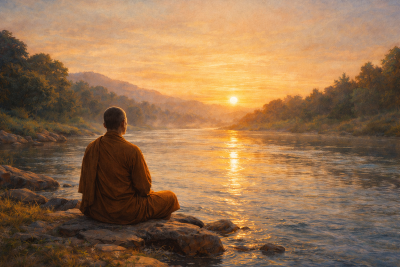
Yet as he begins to sit quietly beside it, he starts to notice something remarkable. The river is always moving, yet it remains the same. Its waters flow endlessly, changing every moment, and yet the river itself endures.
Listening carefully, Siddhartha begins to hear something within its flow—many voices at once. Joy and sorrow, laughter and grief, beginnings and endings. It seems as though the entire movement of life is contained within its waters.
Vasudeva does not explain these things. He simply encourages Siddhartha to observe and to listen.
For the first time in many years, Siddhartha stops trying to force answers. Instead, he begins to listen—to the river, to the silence around him, and to the deeper rhythms of life itself.
The Great Realization — Time Is an Illusion
As Siddhartha spends more time beside the river, a new understanding slowly begins to take shape.
At first, the river sounds like nothing more than flowing water. But as he listens with patience, he begins to hear something deeper. The river carries many voices within it—the laughter of children, the cries of sorrow, the sounds of birth and death. All these voices flow together in a single movement.
Gradually, Siddhartha notices something curious. The river is constantly changing, yet it is always present. The water that passes in one moment is gone the next, and yet the river itself remains.
From this simple observation, a profound realization begins to unfold.
Perhaps time itself is not what we imagine it to be.
Until now, Siddhartha had believed that life moves forward step by step—past leading to present, present leading to future. But the river reveals another perspective.
In the river, the source in the mountains, the flowing water beside Siddhartha, and the distant ocean where it will arrive all exist together. The river is not simply traveling toward its destination; it already contains every part of its journey.
Listening to the river, Siddhartha begins to sense that life may be the same.
The struggles of his past, the pleasures he once pursued, the mistakes he believed he had made—all of them belong to the same unfolding movement of life.
And in that realization, a quiet peace begins to emerge.
The Pain of Love — Siddhartha as a Father
For many years Siddhartha lives peacefully beside the river with Vasudeva. The restless wanderer who once moved constantly from place to place has finally found a rhythm of quiet living.
Then one day the past returns in an unexpected way.
Kamala arrives near the river during a pilgrimage, traveling with a young boy—Siddhartha’s son. Their reunion is brief. Kamala is bitten by a snake and dies soon afterward, leaving the boy behind.
Suddenly Siddhartha finds himself facing something entirely new: fatherhood.
At first the presence of his son fills him with tenderness. Yet the boy has grown up in the comfort of the city and does not easily accept the quiet life beside the river. He grows restless, resentful, and distant.
Siddhartha loves him deeply and hopes to guide him toward a wiser life. But the more he tries to hold on, the more the boy resists.
Eventually the boy runs away.
The loss wounds Siddhartha deeply. For days he searches for his son along the riverbank, hoping to bring him back. But slowly he begins to understand something painful and unavoidable.
Just as he once left his own father in search of his path, his son must now walk his own journey.
No one can live another person’s life for them.
Through this loss Siddhartha finally understands the sorrow he once caused his own father long ago. This realization opens his heart in a new way, filling him with compassion.
Some truths, he now realizes, can only be learned through love—and through the suffering that sometimes follows love.
The Wisdom of Acceptance
After his son’s departure, Siddhartha carries a deep sadness within him. Yet over time the river helps him see his life differently.
For the first time, he stops judging his own past.
The years of spiritual discipline, the temptations of the city, the joy and pain of fatherhood—none of it appears as a mistake anymore. Each experience has been part of the journey that brought him to this moment.
For most of his life Siddhartha believed enlightenment meant escaping the world. Now he understands something simpler and deeper.
Peace does not come from turning away from life.
It comes from accepting it.
Every joy and every sorrow, every success and every loss belongs to the same human experience. When we stop resisting these experiences and allow them to exist as they are, something within us begins to soften.
In that quiet acceptance, Siddhartha finally begins to feel at peace.
Govinda’s Final Visit — Enlightenment Revealed
Many years later, Siddhartha meets his old friend Govinda again.
Govinda has spent his life faithfully following the teachings of the Buddha, yet he still feels that enlightenment remains just beyond his reach. When he meets Siddhartha beside the river, he senses a calm presence in his friend but struggles to understand its source.
Siddhartha does not offer complicated teachings. Instead, he gently explains that wisdom cannot truly be transferred through words. Teachings may guide us, but the deeper understanding of life must arise from our own experience.
Still searching, Govinda asks Siddhartha for guidance.
Siddhartha invites him to come closer.
As Govinda looks into his friend’s face, something extraordinary happens. For a moment he sees countless expressions within Siddhartha’s peaceful smile—joy and sorrow, youth and old age, birth and death. It is as if the entire movement of life appears within a single human presence.
In that moment, Govinda glimpses the understanding Siddhartha has reached.
Life, in all its contradictions, is one.
And he bows before his friend with quiet reverence.
A Moment to Reflect
Siddhartha’s journey is not only the story of one man seeking enlightenment. It also reflects the many phases we experience in our own lives.
There are times when we search intensely for answers. There are times when we lose ourselves in the distractions of the world. And there are moments when life quietly invites us to pause and see our experiences with new understanding.
Siddhartha’s journey reminds us that wisdom does not come from escaping life, but from learning through everything it offers.
Perhaps the deeper question is not whether our lives follow the perfect path, but whether we are truly paying attention to what life is trying to teach us.
At moments like this, it may be helpful to pause and reflect:
- Are there experiences in our lives that we once saw as mistakes but that may have shaped us in important ways?
- What parts of our lives are we still resisting instead of accepting?
- When was the last time we slowed down enough to truly listen—to the world around us or to our own inner voice?
- What might change if we began to see our lives not as separate struggles, but as one continuous journey of learning?
Sometimes these questions themselves are enough to begin a new kind of understanding.
Closing — The Quiet Wisdom of the River
By the end of Hermann Hesse’s Siddhartha, the restless seeker who once wandered through forests, temples, cities, and pleasures finally discovers something he had been searching for all along.
Not a doctrine.
Not a system.
Not even a final answer.
What he discovers instead is a different way of seeing life.
Wisdom cannot be forced, and it cannot simply be borrowed from another person’s teachings. It grows slowly through experience—through every joy and every sorrow, through every step that shapes our lives.
The river becomes a symbol of this understanding. It flows endlessly, carrying every sound of life within it, yet it remains whole.

Perhaps our lives are not so different.
We move through many stages—seeking, losing, learning, loving—and sometimes it feels as though we have wandered far from where we began. But if we look carefully, we may see that every experience has been part of the same unfolding journey.
Siddhartha’s story ends quietly, with a man who has learned to listen—to life, to the world around him, and to the deeper rhythm flowing through it all.
And perhaps that is the most beautiful lesson the book offers.
Sometimes wisdom does not arrive as a sudden answer.
Sometimes it appears when we learn to sit beside the river of life… and simply listen.

 Musings of a Warrior Buddha
Leave a comment