
The Three Destinies of the Lightbearer
There comes a point in every journey where the mirror must finally turn inward.
Over the last chapters, we have walked through the darkness of the cave, witnessed the painful struggle of breaking chains, followed the Lightbearer into the brilliance of the sun, and then watched him return to the shadows he once escaped. We explored the hearts of those who remain inside, the minds of those who rule it, and the fragile tension that holds the entire system together.
But a single question has always quietly lingered behind everything:
What happens to the soul that has glimpsed truth in a world still governed by illusion?
There is no single destiny for such a being. Truth does not create one path; it creates possibilities. And different Lightbearers respond to truth in profoundly different ways. Not because one is “right” and the other “wrong,” but because each represents a deep psychological and spiritual response to the burden of seeing more than others.
This chapter is not about philosophy alone.
It is about human fate.
Three Roads of the Lightbearer
Not every awakened soul returns alike. Not every Lightbearer responds to darkness in the same way.
Some respond with love. Some respond with clarity and power. Some break under the weight of what they carry.
In this final part, we journey through three powerful archetypes:
- The Lightbearer of Sacrifice — the archetype of compassion and sacrifice.
- The Lightbearer of Dharma — the archetype of strength, action, and necessary destruction.
- The Fallen Lightbearer — the archetype that saw glimpses of the light… but succumbed to the darkness of the cave.
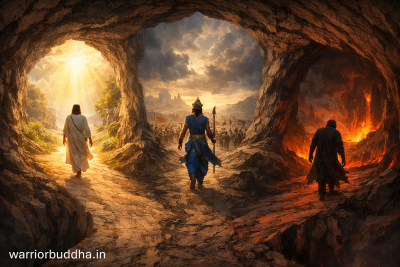
Three destinies.
Three reflections of the human spirit.
Three answers to the same eternal question:
“What do you do with the light once you’ve seen it?”
The Lightbearer of Sacrifice — The Path of Love
There are some who, upon seeing the truth, return to the cave not with anger or authority, but with tenderness. They understand the fear of the cave dwellers because they once trembled too. They recognize the fragility of human faith, the terror of stepping into the unknown, and they choose compassion over confrontation.
This is the archetype symbolized by Jesus — not necessarily in religious doctrine, but in spirit.
Here stands a Lightbearer who believes that hearts are not changed through force, but through love. He does not attempt to break chains by violence; he softens them through presence. He speaks gently. He embraces ridicule. He stands firm in truth, yet refuses to hate those who cannot yet receive it.
He sacrifices comfort.
He sacrifices acceptance.
Sometimes he sacrifices his very life.
Socrates did this when Athens turned against him.
Martin Luther King Jr. did this when he stood unarmed before hatred.
Gandhi did this when he chose non-violence even in the face of brutality.
Their path is often misunderstood as weakness. But this is not resignation. This is courage in its most vulnerable form — the willingness to suffer rather than poison truth with violence. Their blood does not silence light. It ignites it. Even when the body falls, the message survives, echoing long after their voices are gone.
Because while systems collapse and regimes fade, compassion endures. These Lightbearers may not dismantle the cave themselves, but they fracture something within it. They plant seeds of conscience. They awaken tenderness where only fear once lived. Their sacrifice becomes a moral earthquake — shaking consciousness silently, deeply, irreversibly.
The Lightbearer of Dharma — The Path of Clarity and Power
Transformation is rarely calm. Truth is rarely polite.
And sometimes, light must carry a sword.
If the Jesus-archetype represents compassion that absorbs suffering, this Krishna-archetype represents consciousness that refuses to allow injustice to thrive. Where one heals through sacrifice, the other restores balance through action. This archetype does not merely endure the darkness of the cave — it challenges it, confronts it, and when necessary, dismantles it completely.
Krishna does not walk into the cave to be crucified.
He walks in to change the destiny of the cave itself.
This Lightbearer understands something profound — that illusion does not merely deceive individuals; it builds systems. It shapes politics, culture, religion, morality, power structures, social psychology — and sometimes these systems become so corrupt, so entangled in manipulation and fear, that compassion alone is not enough to redeem them. There are moments in history when darkness is too organized, too institutionalized, too deeply rooted for silence, martyrdom, or suffering to transform it.
In such moments, this archetype steps forward.
This Lightbearer is not “gentle” in the simplistic sense. He is compassionate yet detached, deeply humane yet fiercely committed to Dharma — to alignment with truth, justice, and moral order. He is willing to speak uncomfortable truths. He is willing to disrupt the peace of the cave. And when persuasion fails, when dialogue collapses, when illusion weaponizes itself against truth, he does not hesitate to confront it — even if confrontation demands conflict.
And yet, this path carries its own peril. When one fights darkness with force, there is always the risk of absorbing its poison. It demands a level of psychological clarity and spiritual maturity that only extremely rare souls ever reach. To hold compassion in one hand and righteous force in the other… to meditate in silence and yet step into the storm when Dharma requires… this is not brutality, nor blind rage. This is conscious power — restrained, deliberate, inwardly serene.
And perhaps that makes this archetype one of the most misunderstood and most heroic. Because it walks the most dangerous edge: confronting darkness without becoming darkness, using force without being consumed by it.
We see glimpses of this archetype in leaders who dismantled oppressive systems, reformers who refused compromise, thinkers who shattered norms even when it cost them love and acceptance. These are the figures who refuse to romanticize suffering, who refuse to glorify submission, who don’t equate spirituality with weakness or politeness.
This archetype also knows that the cave can become a prison not because evil is strong, but because good remains passive. And so he chooses the harder path — not the path of sentimental righteousness, but of mature moral courage. He is willing to be feared, misunderstood, even hated — and he will not apologize for it.
The Krishna archetype does not exist to console the cave.
He exists to challenge it — and if needed, to rebuild it from ash.
The Fallen Lightbearer — The Path of Fracture
If the Jesus archetype represents compassionate surrender, and the Krishna archetype represents conscious dismantling of illusion, then the Fallen Lightbearer embodies a far more fragile and unsettling human destiny — the journey of a soul that once turned toward the light, yet could not complete the passage. These figures are not ordinary cave dwellers trapped in ignorance, nor are they naïve followers of illusion. They are the ones who once questioned, once loosened their chains, once felt the tremor of something greater than shadows — but for reasons deeply human, they did not cross fully into freedom.
Awakening demands more from a person than philosophy often admits. It requires courage, solitude, inner strength, and at times a willingness to risk exile, humiliation, imprisonment, even death. Not everyone who reaches this threshold finds the strength to cross it. Some are overwhelmed by the inner storm of self-confrontation. Others are crushed by external pressures: social hostility, political persecution, ridicule, betrayal, or the possibility of annihilation. They do not return to the cave out of ignorance, but out of exhaustion, fear, pain, and sometimes sheer survival. And when they turn back, something has already fractured within them.
They return carrying a wound.
They return with a glimpse of light, but without the peace that comes from embracing it fully. They return with knowledge that cannot be forgotten, yet without the inner grounding to live with it. They are no longer innocent participants in illusion, rather they start manipulating the cave itself. They exist in a painful liminal state: too aware to be ignorant, too afraid to be free, and too wounded to be at peace.
Over time, this unresolved fracture begins to harden into resentment — resentment towards the cave for trapping them, resentment towards themselves for failing, and most painfully, resentment towards those rare Lightbearers who succeeded where they did not. Because in the true Lightbearer, they see everything they abandoned: courage, conviction, strength, and the life they could have lived but did not. And when resentment combines with intelligence, charisma, and ambition, it can evolve into something deeply dangerous.
It is from this tension that some of the world’s most dangerous leaders are born.
Think of Hitler.
Think of Stalin.
Think of fanatic cult leaders and ideological extremists.
Unlike ordinary tyrants, their hunger for control was not born merely from ambition or cruelty, but from unhealed wounds, unresolved fear, and a desperate need to dominate the world that once exposed their vulnerability. They understand doubt because they lived in it; they understand fear because it consumed them; they understand rebellion because they once desired it. And slowly, what began as a journey toward light transforms into a quest for power, certainty, and control.
Their charisma is real. Their intelligence is undeniable. Their understanding of human weakness is frighteningly accurate. But their light never fully bloomed; it calcified into control. Instead of freeing people from the cave, they build tighter chains. Instead of guiding toward truth, they manufacture a false “light,” shaped not by clarity but by rage, insecurity, and the hunger to never feel powerless again.
This archetype is complex, tragic, and deeply human. They are not born monsters. And perhaps that is why it is so important to understand — not to justify their actions, but to comprehend how fragile the human spirit truly is.
Yet, it is important to say this clearly — not everyone who glimpses the light and turns back becomes destructive or power-hungry. Many simply return to the cave and live quietly, carrying a fragment of light within them — kinder, more reflective, sometimes wounded but not corrupted. Only a few, under extraordinary pressure, fear, humiliation, or rage, harden into the dangerous figures we call Fallen Lightbearers.
The Cave Does Not Decide. The Lightbearer Does.
If there is one truth that quietly emerges from this entire journey through the cave, it is this: the cave does not create destiny. It does not decide who becomes saint, who becomes warrior, who remains a passive spectator and who turns into tyrant. The light does not promise salvation either. Awakening does not guarantee greatness. Truth does not automatically purify the soul. They simply reveal — and what happens after that revelation depends entirely on the one who receives it.
It is tempting to blame systems, circumstances, and history. It is tempting to say, “If only society were kinder… if only the masses were wiser… if only power structures were not so ruthless… things would have been different.” And there is some truth in that. Environments do shape us. Context matters. History leaves scars.
But still, at the core, a choice remains.
A choice about what to do with knowledge.
A choice about how to hold power.
A choice about whether to open the heart or harden it.
A choice between compassion, duty, and domination.
That is why this journey is not merely philosophical — it is profoundly moral, psychological, and spiritual. Because every Lightbearer confronts not just the cave outside, but the cave within. The cave of unresolved wounds. The cave of ego. The cave of fear. The cave of longing to be seen, validated, loved, obeyed, or remembered. Light does not dissolve these shadows automatically. Sometimes it intensifies them.
And perhaps that is the deepest tragedy and the deepest hope of the human condition: awakening is not the end of the story — it is the beginning of the most difficult part. What a soul does after waking up decides everything.
The cave does not force any path. Truth does not dictate it. Human beings do.
And somewhere between the paths we choose — humanity writes its fate.
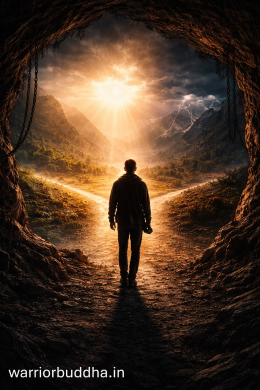
Closing Reflection – The Mirror Turns Toward Us
Perhaps the greatest realization of this entire journey is that the cave was never just Plato’s metaphor — it is our lived reality. The shadows are not merely political systems, religions, ideologies, or institutions. They are also within us. They are our fears, our comforts, our carefully constructed identities, and the illusions we willingly cling to because they feel safe.
Every one of us lives somewhere between darkness and light.
We are all cave dwellers when we choose comfort over truth, familiarity over growth, validation over honesty.
We are all Lightbearers when we dare to question, when we choose integrity, when we risk being misunderstood in order to remain authentic.
And at times, we even flirt with becoming puppet masters, when we manipulate narratives, when we control, when we benefit from others’ blindness.
The line does not run between “good people” and “bad people,” “the enlightened” and “the ignorant,” “leaders” and “masses.”
That line runs right through the human heart.
This is why the journey of the Lightbearer is not about a mythical hero out there. It is about us — about what happens when we glimpse truth. Because in life, each of us, at some point, encounters our own “sun moments”: moments of clarity, painful realizations, awakenings that show us something raw and undeniable about existence, society, or ourselves.
And when that happens, the question is no longer philosophical. It becomes deeply personal:
What do we do with what we have seen?
There is no easy answer. No neatly wrapped moral conclusion. Only an invitation… and a responsibility.
Because the cave is not merely outside us.
It breathes within us.
And so does the Light.
And perhaps the real question — the one that matters long after this series ends — is this:
If someday you glimpse the light…
If someday truth brushes past your soul…
Who will you choose to become?
⭐ Final Note
When I first encountered Plato’s Cave earlier this year, I didn’t just find a philosophical metaphor — I found a mirror into life, humanity, and myself. This series took nine months to write, but the journey it stirred within me will probably continue for years. Much of what you’ve read wasn’t constructed from theory; it was sculpted from personal experience, from moments of confusion and clarity, from losses, awakenings, and choices that shaped me. This series also became a part of my becoming. And if it has touched something living within you too, then perhaps that’s where philosophy stops being an idea… and quietly turns into life.

 Musings of a Warrior Buddha
Leave a comment