
Inside the Cave: Masses, Puppet Masters, and the Psychology of Illusion
In the previous chapter, we walked with the Lightbearer who returned to the cave — a soul who had seen the brilliance of truth yet chose to step again into darkness, knowing well the cost he might have to pay. But the Lightbearer alone does not shape the fate of the cave. The cave is sustained by those who remain inside it, those who benefit from it, and those who silently question it. To understand the destiny of the Lightbearer and the fate of truth itself, we must first understand the intricate structure of the cave, the psychology of those who dwell within it, and the power dynamics that keep the illusion alive.
This chapter is not about the hero. It is about the world he returns to.
The Cave Dwellers: Not Always Unaware, Often Just Afraid
It is easy, almost comforting, to think of the cave dwellers as ignorant fools who simply “do not know better.” But the reality is far more complex, far more human, and often quite tragic. Many of them are not incapable of understanding truth. They simply lack the courage to face it.
For someone who has lived in darkness all their life, shadows offer familiarity. Illusion offers stability. The cave offers identity, belonging, and the comforting assurance that one does not need to question too deeply. Truth, on the other hand, is disruptive. It demands the dismantling of beliefs, the abandonment of borrowed identities, and the willingness to step into uncertainty. While some cave dwellers are indeed intellectually lazy or blindly conformist, many others are just terrified of the emotional chaos that awakening might bring.
Fear, therefore, becomes the first and fiercest guardian of the cave. Fear of losing certainty. Fear of isolation. Fear of personal responsibility. And when fear dominates, resentment naturally follows. The Lightbearer becomes intolerable not simply because he is different, but because his very existence raises a painful question:
“If he could walk out… why didn’t I?”
That question burns. So instead of confronting it, many turn their discomfort into hostility. They mock the Lightbearer to preserve their self-respect. They ridicule him to avoid confronting their own lack of courage. They prefer the comfort of darkness over the terror of truth.
And historically, this is exactly how societies have behaved.
The Puppet Masters: Those Who Control the Shadows
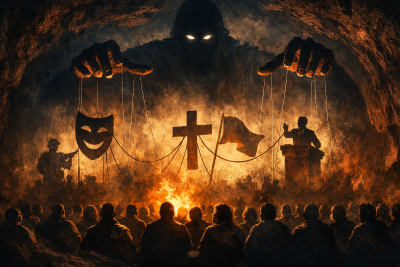
If fear sustains the cave emotionally, the puppet masters sustain it structurally. They are the architects of illusion — those who control narratives, shape perception, and benefit from the blindness of others. They stand behind the fire, projecting shadows and convincing the masses that these shadows are reality.
But puppet masters are not always external tyrants. Often, they begin as ordinary individuals who simply discovered how power works inside the cave. They were once cave dwellers themselves. Some may even have briefly glimpsed the possibility of light, but instead of walking toward it, they chose influence, authority, and control. Power becomes their version of “truth.”
Their rule does not always depend on brutality. Often, it survives through validation, comfort, identity reinforcement, and fear-mongering. They tell the cave dwellers that they are safe here, that questioning is dangerous, that stepping outside would destroy everything they love. They promise security in exchange for obedience. And the cave dwellers, already afraid, accept.
Thus forms a deeply psychological and symbiotic relationship.
The puppet masters justify their dominance by claiming they are protecting the masses. The cave dwellers justify their submission by believing that obedience keeps them safe. Both validate each other, strengthening the illusion further.
History is full of painful reflections of this reality. Nazi Germany remains one of the most haunting examples. Hitler did not rise to power alone; he was sustained by an entire ecosystem that included devoted bureaucrats, emotional followers, intellectual cowards, opportunistic politicians, and ordinary citizens who either agreed, remained silent, or simply chose not to see. Jewish persecution was not carried out only by one dictator — it was fueled by a society willing to believe the narrative they were given, no matter how immoral it was. And when entire societies choose illusion, darkness stops being accidental — it becomes a collective choice. The cave did not merely exist; it was actively sustained.
In the cave, ignorance and power feed each other. And truth becomes a threat.
The Cave is Not Evil. It is Human.
If there is one painful realization about the cave, it is this — it is not sustained merely by cruelty. It is sustained by deeply human tendencies: fear, insecurity, dependency, longing for stability, and the temptation of power. The masses are not always wicked. The puppet masters are not always born monsters. Each is trapped in their own way.
And yet, from time to time, a Lightbearer appears. He may be ridiculed, resisted, or destroyed. But he leaves an imprint nonetheless.
A question in one mind. A disturbance in one heart. A fracture in one chain. And sometimes, that is enough.
In the Next Chapter…
This journey now leads to perhaps the most important reflection of this entire series — the destiny of those who walk with light.
Because Lightbearers are not a single archetype.
There is the Lightbearer of Sacrifice, like Jesus, who embraces suffering out of compassion.
There is the Lightbearer of Dharma, like Krishna, who is willing to dismantle entire structures for the sake of truth.
And there is the Fallen Lightbearer, the most complex of all — the one who once walked toward light, but eventually chose power.
Three destinies.
Three reflections of the human spirit.
Three possibilities for every soul who dares to walk toward the sun.

 Musings of a Warrior Buddha
Leave a comment