
✨Introduction: The Question That Lives Inside Us
For a long time, I carried a quiet confusion inside me —
What does it mean to be moral?
Everyone around me seemed so certain. Society had its rules. Religion had its commandments. Family had its expectations. Culture had its do’s and don’ts. And for most of my life, I assumed morality was something you simply followed, like a map handed down through generations.
But as I grew older, something inside me began to rebel — not in behavior, but in awareness.
I started noticing contradictions. Things the world called “moral” didn’t always feel right. And things society condemned didn’t always feel wrong. Most people behaved morally only when someone was watching. Guilt and fear were used as tools to keep people obedient. And morality often seemed more like a social performance than an inner truth.
Then another layer revealed itself:
I noticed how many people preached morality not from wisdom, but from repression — especially around sexuality, freedom, and individuality. I saw how whole cultures used “values” to protect themselves from feelings of inferiority. And I realised that a lot of what we call morality is simply unexamined fear, shame, or envy wearing the mask of virtue.
Slowly, a question took shape — a question too heavy to ignore:
Is morality something the world decides for us, or something we must discover within ourselves?
This question stayed with me through books, conversations, periods of solitude, and the inner storms of personal choices. I realised that morality isn’t just about right and wrong — it is a journey inward, a confrontation with our shadow, our conditioning, and our deepest clarity.
This essay is my attempt to explore that journey —
not to preach, not to give commandments, but to understand.
To understand:
- outer morality and its hypocrisy
- inner morality and its courage
- the psychology of obedience
- the cost of authenticity
- the shadow beneath moral preaching
- how cultures convert wounds into virtues
- how philosophers, mystics, and rebels saw morality
- and how each of us must eventually build our own moral center
If you’ve ever felt confused, guilty, pressured, or torn about what is “right,” then this journey is for you.
Because in the end, morality isn’t about obeying the world.
It’s about discovering your own truth — and having the courage to live by it.
🌑The Outer Morality: How Society Programs Us
Most people never question where their sense of right and wrong comes from. They grow up absorbing rules from parents, teachers, religion, culture, and authority figures, and assume that whatever they’ve been taught must be the truth. Morality becomes a kind of inheritance — like an old piece of furniture passed down through generations, kept not because it’s useful but because “that’s what our family has always had.”
From childhood, we are told what to do and what not to do. We’re taught how to behave, what to believe, which desires are acceptable, which thoughts are sinful, what is honorable, and what is shameful. And we follow these rules because we fear punishment, judgment, gossip, or even divine wrath.
Outer morality survives on fear, not awareness.
This is why so many people appear moral only when the camera is on them. Take that camera away… take the police away… take society’s eyes away… and suddenly their moral mask falls off. A man is “loyal” to his wife only because he fears being caught. A bureaucrat may avoid taking bribes only because he fears losing his job. A politician may behave saintly on stage, but is a monster inside his home. This isn’t morality. It’s fear management. It’s social survival. The real test of morality is not behavior under surveillance; it is behavior in solitude.
The danger of outer morality becomes most visible when people stop thinking for themselves entirely. When morality is defined by authority, anything can be justified — even cruelty. History is full of examples of this, but perhaps none as horrifying as Nazi Germany. Ordinary men and women participated in the systematic murder of millions, believing they were doing their “duty,” following “orders,” or upholding a “moral vision” of racial purity. Soldiers, officers, bureaucrats — many of them were not born monsters. They became instruments of horror because they surrendered their inner conscience to outer authority.
If they had paused and asked, “Is this right in my heart?” history might have taken a different turn. But that’s precisely what outer morality does: it shuts down your inner voice and replaces it with slogans of obedience.
And this isn’t just about the past. Outer morality continues to justify harm today — in the name of religion, culture, honor, purity, and tradition. Honor killings are committed because families believe they are protecting their “moral reputation.” Communities police women’s clothing, sexuality, and freedom under the banner of “virtue.” Social media mobs destroy lives in the name of “moral outrage.” And individuals quietly suffer under the weight of judgments and expectations that were never their own.
And Outer morality is easy because it doesn’t require thinking. There is no need to question, to reflect, to understand. You just need to obey. And society rewards such people. They’re called “good boys,” “good girls”. They fit in. They are predictable. They make life easier for authority structures.
Such a society may look orderly on the surface, but beneath it lies fear, repression, and the quiet death of thought.
This does not mean that all outer morality is false or unnecessary. Shared values and social rules can help societies function — but only when they arise from inner conscience, not blind obedience. When outer morality aligns with inner truth, it supports human dignity. When it replaces inner conscience, it becomes a tool of control.
Real morality begins only when a person steps away from the noise and asks, “Does this feel right to me?” That simple question has the power to expose centuries of conditioning. It is the first crack in the shell of outer morality — and the beginning of inner truth.
🕯️Inner Morality: The Voice Beneath the Noise
If outer morality is loud, inner morality is quiet. It doesn’t shout, it doesn’t threaten, it doesn’t demand obedience. It whispers. And most people never hear it because their lives are too noisy, too crowded with other people’s opinions, too filled with fear, guilt, and conditioning.
Inner morality awakens when you begin to realize that the world has its rules, but you have your own understanding. There’s a difference between “I must do this” and “I feel this is right.” That difference is the birth of your own moral compass.
When nobody is watching, when there is no law to punish you, when the social mask falls, what you choose in that moment says more about your morals than every religious ritual, every public behaviour, every carefully maintained image. Inner morality is who you are behind closed doors.
And it comes from a deeper place — awareness. Awareness of your thoughts. Awareness of your impulses. Awareness of what your actions do to others. Awareness of what they do to you.
Inner morality is not built out of fear. It is built out of clarity.
For example, if you choose not to cheat or lie or indulge in something harmful, not because you fear being caught but because it doesn’t feel right in your soul — that is inner morality. You are not avoiding the act; you are rejecting the person you might become if you do it.
Inner morality doesn’t come from commandments, from elders, from priests, or from traditions. It grows out of your own lived experience. You feel what causes suffering and what creates peace. You understand what breaks trust and what strengthens it. You see what creates inner fragmentation and what brings inner alignment.
This alignment is the key. There is a particular peace that comes when your actions match your deepest values. And there is a particular restlessness, a quiet guilt, when they don’t. Not the guilt others impose on you — but the guilt that comes from self-betrayal.
That is your conscience speaking.
Inner morality requires solitude. It needs silence. It needs space away from the crowd, because the crowd is always noisy, always imposing, always trying to define who you should be. Only in solitude can you hear the small, steady voice that says, “This is right for you.”
Many people never develop inner morality because they never step away from the world long enough to confront themselves. They live as extensions of their families, their religions, their communities. They behave well, but they do not know themselves. And without self-knowledge, morality becomes imitation.
Inner morality is born the day you stop asking, “What will people say?” and start asking, “What does my conscience say?” The day you stop being afraid of society and start being afraid of betraying your own truth.
That is the turning point.
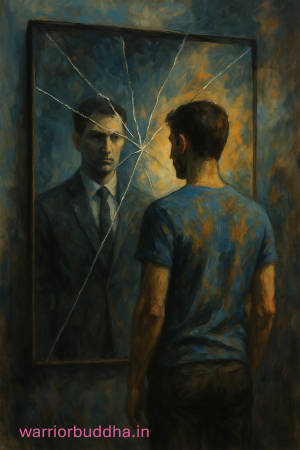
🧠The Psychology of Obedience
If outer morality survives on fear, obedience is the mechanism through which fear works. Most human beings grow up in a psychological environment designed to reward obedience and punish independent thinking. From the time we are children, we learn very quickly that life becomes easier when we follow the rules, and difficult when we question them.
Obedience feels safe. It promises approval. It protects us from conflict. It gives us a sense of belonging — even if it means betraying our truth. This is why so many people follow external morality without ever asking whether the rules they obey actually make sense.
A child behaves well not because they understand ethics, but because they are praised when they obey and scolded when they do not. Over time, this reward–punishment system becomes internalized. What was once external discipline slowly becomes an inner voice that says, “Don’t question. Don’t think. Just do what is expected.” Most adults carry this childhood programming into their relationships, workplaces, and even spiritual life.
It becomes clearer through real-life situations. Consider a student who knows an exam is unfair but stays silent because speaking up might attract trouble. Or an employee who watches a colleague being mistreated but doesn’t intervene because they fear risking their job. Or someone who witnesses wrongdoing in their family but chooses to ignore it because “family honor” matters more. These situations show us something uncomfortable: it allows people to commit immoral acts while believing they are moral.
The truth is, obedience is easy. It doesn’t require courage, clarity, or conscience. It only requires that you surrender your judgment to someone else. And this surrender can be dangerous, because once you hand over your moral responsibility to an external authority — a leader, a religious guru, a belief system, a family tradition — you can be manipulated into anything.
This is exactly how ordinary people end up participating in extraordinary wrongdoing. Most horrors in human history were not carried out by psychopaths, but by obedient, “normal” people who believed they were doing the right thing simply because someone in power told them so. When obedience replaces conscience, morality becomes hollow.
The psychology behind this is simple: people fear rejection more than they fear doing wrong. They fear conflict more than they fear betraying themselves. And they fear disobedience more than they fear the consequences of blind conformity. This fear-based morality may keep the surface of society smooth, but underneath, it kills authenticity and awareness.
True morality demands the opposite: it asks you to think, to question, to feel, to understand. It asks you to stand alone if necessary. It asks you to listen to your inner voice even when the world pressures you to silence it. That’s why real morality is rare — because it does not come from obedience, but from awakening.
🔥Moral Rebellion: When the Soul Says No
There comes a moment in every honest person’s life when the outer voice of society and the inner voice of conscience collide. That moment is often uncomfortable, confusing, even frightening. But it is also the beginning of something sacred — moral rebellion. But only a rare few even feel this inner contradiction. And out of those rare few, an even smaller number have the strength to act on it.
Moral rebellion is not the same as teenage rebellion or impulsive defiance. It’s not the desire to shock people or break rules just for excitement. Real moral rebellion is quiet, dignified, and deeply personal. It begins when you simply cannot ignore your own truth anymore.
You see something unjust happening, and something in you refuses to remain silent. You feel pressured to follow a tradition, but your heart whispers that it doesn’t feel right. You notice cruelty being justified in the name of culture, religion, or family honor, and a part of you aches because it goes against your humanity.
This “ache” is the soul waking up.
Most societies do not like this awakening, because awakened individuals are harder to control. They don’t blindly obey. They don’t accept harmful traditions. They don’t surrender their conscience. They ask questions — and questions threaten the entire structure of borrowed morality.
This is why moral rebels throughout history were often misunderstood or attacked. Socrates was accused of corrupting the youth. Jesus was crucified for challenging religious authorities. Buddha walked away from the roles society assigned him. Osho was demonized for questioning collective hypocrisy. Ayn Rand was mocked because she believed the individual had the right to think for himself.
These people weren’t rebelling against morality. They were rebelling against false morality — the kind that prioritizes obedience over truth.
And this pattern repeats even today in simpler forms. A girl who speaks up against an unfair family rule is called disrespectful. Someone who leaves a toxic marriage is labeled immoral. A young person who chooses their passion over a conventional career is told they’re irresponsible. Anyone who refuses to bend to collective expectations is subtly punished.
You can see how deeply societal morality fears independence. Because the moment you say, “I will think for myself,” the system begins to lose its grip on you.
But moral rebellion is not just about saying no to the world. It is also about saying yes to yourself — yes to clarity, yes to awareness, yes to inner alignment. It is choosing personal truth over social comfort. It is choosing conscience over conformity. It is choosing integrity over approval.
This path is not easy. Moral rebels often walk alone. Their choices confuse people because most people have never listened to their own conscience long enough to understand someone else’s. But that loneliness is the price of freedom. And freedom is the birthplace of true morality.
🧩The Cost of Authenticity
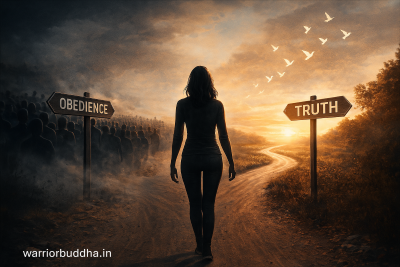
Choosing your own morality sounds noble in theory, but in reality, it comes with a price — and not a small one. Authenticity demands courage, not just to stand for your truth, but to stand alone when necessary. Because the moment you stop obeying borrowed morality, you step outside the safety of the herd.
People admire individuality from a distance, but when they see it up close, they feel threatened. They call it arrogance, rebellion, selfishness, or foolishness. The truth is simpler: your authenticity exposes their imitation. And people don’t appreciate being reminded of the truth they avoid.
This is why the path of inner morality is often lonely. Not because you want to isolate yourself, but because you outgrow the spaces where obedience is expected and questioning is condemned. You no longer fit into the patterns that once defined you. And not everyone understands why.
You might lose relationships when you stop playing the roles others expect from you. You might clash with family when you refuse to follow rituals that feel empty. You might disappoint friends when you no longer behave according to their moral framework. You might become an outsider in circles that once embraced you.
This pain is real. The cost of authenticity is not a metaphor — it’s an emotional and social price that every moral individual pays.
And yet, there is another layer of cost: the inner cost.
When you start listening to your conscience, you will enter a period of conflict. This turbulence is natural. It is the clash between who you were trained to be and who you actually are. Your old conditioning will pull you back toward obedience. Your inner voice will pull you forward toward truth. Guilt may arise. Doubt may arise. You might second-guess yourself, wondering whether you’re making a mistake.
This inner tension is part of the transformation. The old ideas of good and bad fall apart, but the new clarity has not fully taken shape yet. It is like crossing a bridge with no railing — terrifying, liberating, necessary.
That’s why so few people choose authenticity. Not because they don’t want it, but because they don’t want the cost. They want freedom, but not the loneliness. They want truth, but not the consequences. They want individuality, but not the responsibility that comes with it.
And yet, for those who dare to take this path, something extraordinary happens over time. You begin to feel a different kind of strength — a strength that doesn’t depend on approval. A clarity that doesn’t collapse under pressure. A peace that comes not from conformity, but from alignment with your deepest values.
You become someone you can trust.
That is the reward of authenticity. Not applause, not validation, but inner solidity — a rootedness that cannot be taken away by external judgment. When you face yourself honestly and live according to your conscience, you become a different kind of human being. A person who may walk alone at times, but never feels lost.
🎭The Morality of Repression: How Unlived Life Turns Into Moral Superiority
There is another kind of morality that does not grow from awareness, compassion, or clarity. It grows from repression. You can see it clearly in societies where people have been denied freedom — freedom of thought, freedom of expression, freedom of love, freedom of movement, freedom to be themselves. When people are forced to suppress their desires, dreams, and individuality, that suppressed energy does not disappear. It transforms into something else. Something harder. Something judgmental. Something that looks like morality but is actually wounded pride in disguise.
This is why the most “moralistic” societies are often the most repressed ones. When individuals cannot live freely, they learn to justify their lack of freedom by calling it virtue. And when they see others living openly — whether emotionally, sexually, socially, or intellectually — it triggers a deep discomfort inside them. That discomfort becomes the fuel for moral judgment.
Sexuality is the clearest example.
In many traditional societies, desire is shamed, intimacy is policed, and sexual expression is buried under layers of guilt and cultural expectation. Most people grow up unable to explore or understand their own sexual being. They never express it freely. They never allow themselves to experience love without fear. They learn to silence their bodies, hide their curiosity, and carry shame as if it were a virtue.
But suppressed desire does not die. It becomes moral outrage.
People who never had the freedom to explore their own sexuality end up preaching chastity and purity to others. They condemn the very things they secretly wished for in their younger days. They police young couples because seeing others live freely reminds them of their own unlived life. Their so-called “morality” is not an expression of consciousness — it is a scar. A scar painted with the colours of righteousness.
And this pattern extends far beyond sexuality.
When people feel inferior in one area, they compensate by claiming superiority in another. You can see this in how many developing or under developed countries relate to the West. When a society sees another culture with more freedom, more prosperity, more opportunity, more individuality, something uncomfortable begins to stir. A quiet, collective inferiority. A sense of being behind. A feeling of having missed something essential.
Instead of confronting that wound honestly, societies often cover it with a moral narrative:
“They may be rich, but we have values.”
“They may be free, but our families are stronger.”
“They may have independence, but our culture is purer.”
This is not morality. This is self-soothing.
A defence mechanism to protect a wounded identity.
When a nation cannot compete in terms of progress, it competes in terms of virtue.
When people cannot claim equality in material terms, they claim superiority in moral terms.
When they cannot match freedom, they redefine restraint as purity.
And the saddest part is this:
The people most obsessed with moral superiority are often the ones who secretly yearn for the very freedom they condemn.
This is how collective morality is born out of collective repression. A society that cannot give its people emotional, economic, or personal freedom develops strict moral codes as a psychological shield. It clings to tradition not because tradition is sacred, but because tradition offers a sense of certainty in a world where they feel left behind.
The moral policing you see in such cultures — judging young people, controlling women, condemning expressions of freedom — is not about ethics. It is about fear. Fear of confronting the shadow. Fear of acknowledging envy. Fear of admitting that what they call “values” is often just lost opportunities dressed as virtue.
True morality never needs to condemn. It never needs to interfere. It never feels threatened by another person’s freedom. Only repressed morality behaves that way — because it is not morality at all, but unresolved emotion.
When a person becomes more conscious, they stop preaching morality to others. They simply live aligned with themselves. Their values do not come from fear or deficiency but from clarity. And when a society evolves, its morality evolves too — from guilt to awareness, from repression to dignity, from policing others to understanding oneself.
Real morality isn’t born from hiding.
It is born from seeing — clearly, courageously, and without fear.
❓The Philosophies That Question Morality
When you look at the history of human thought, one thing becomes clear: the greatest thinkers, rebels, and spiritual figures rarely agreed with the morals of their time. They questioned them, challenged them, rebuilt them, or walked away from them entirely. Each of them looked at morality not as a list of commandments, but as a deeper expression of human truth.
Their ideas differ, but they all point toward one core message:
Real morality cannot be borrowed — it must be discovered.
Let’s explore a few voices that speak directly to this inner journey.
❤️🔥Nietzsche — The Courage to Create Your Own Values
Nietzsche believed that most of what we call “morality” is simply herd behavior disguised as virtue. According to him, society teaches the weak to label their weakness as goodness and the strong to feel guilty for their strength. He called this “slave morality.”
For Nietzsche, the truly moral person is not the obedient one, but the creator — the one who listens to his own inner law and has the courage to follow it, even if he walks alone. He envisioned the Übermensch, the higher individual who rises above guilt, conformity, and fear.
Nietzsche’s challenge is simple but radical:
If your morality is not chosen, then it is not yours.
❤️🔥Ayn Rand — Integrity and the Responsibility to Think
Ayn Rand approached morality through the lens of reason and responsibility. She believed that the highest moral duty of a person is to think for themselves — to use their own mind, their own judgment, their own clarity.
For her, morality is not about sacrifice or obedience. It is about self-respect. It is about refusing to betray your values for approval or comfort. Rand’s heroes are individuals who stand tall in a world that wants them to bend — people who refuse to let the collective define their truth.
Rand’s message is clear:
A moral life is a life lived consciously — without lies, without pretense, without self-betrayal.
❤️🔥Buddha — Awareness Over Rules
Buddha didn’t give a list of commandments. He didn’t say “do this” or “don’t do that.” He simply said:
Act with awareness. Act with compassion. Act without attachment.
For Buddha, morality is not external behavior — it is inner clarity.
If your heart is confused, your actions will reflect confusion.
If your mind is clear, your actions will naturally be moral.
His teaching is simple:
Purify the mind, and morality will follow.
❤️🔥Krishna — Dharma Over Rules
Krishna’s teachings go beyond simple categories of good and bad. In the Bhagavad Gita, Arjuna struggles with moral confusion: duty versus emotion, righteousness versus love, justice versus pain. Krishna doesn’t hand him a moral rulebook. Instead, he tells him to act from his own dharma — his deepest inner truth — without fear or attachment.
Krishna shows us that morality is not always about following the rules. Sometimes rules must bend so that truth can stand. We will explore this more deeply in the case study on the battle between Arjuna and Karna.
❤️🔥Osho — Consciousness Is the Only True Morality
Osho went further than most. He believed that any morality imposed from outside creates hypocrisy. A person who follows rules without understanding becomes divided — one face for society, another for themselves.
For Osho, the only real morality comes from awareness. When you are conscious, you naturally act in ways that do not harm yourself or others. Morality becomes a flowering of inner truth, not a cage built by tradition.
💡The Thread That Connects Them All
Despite their differences, these thinkers share one truth:
Borrowed morality enslaves.
Chosen morality liberates.
Awakened morality transforms.
Each of them, in their own way, invites us to stop imitating and start understanding. They invite us to shift from obedience to awareness, from conformity to clarity, from fear to truth.
This prepares us for the next part of the journey — where ideas become stories, and morality becomes real.
⚔️Case Studies in Morality: When Inner Truth Challenges Outer Rules
There are moments in history and literature where moral choices become so complex, so layered, so uncomfortable, that the usual ideas of “right” and “wrong” simply collapse. These moments reveal the deeper truth of morality:
Morality becomes real only when it is tested.
These case studies are not just stories — they are windows into the human psyche, showing how a person’s inner morality can clash violently with outer expectations.
Here, we explore two powerful examples:
one from the ancient world, one from modern literature.
Both reveal how inner moral clarity works in extreme situations.
🏹1. Krishna & Karna — When Dharma Breaks Its Own Rules
The Indian epic Mahabharata gives us one of the most challenging moral dilemmas in all of world literature. Arjuna and Karna are engaged in fierce duel that could determine the course of the war. And in one of those pivotal moments, Karna’s chariot wheel sinks into the mud. He steps down to free it, becoming unarmed and exposed. According to the sacred rules of war — rules that even enemies respected — a battle must pause in such a moment.
Karna asks for a halt. And by every social, cultural, and martial standard, he deserves it. Arjuna looks up to Krishna. But Krishna refuses. He instructs Arjuna to shoot even while Karna is defenseless.
When I encountered this scene as a child, it felt like betrayal. It felt like cruelty. It felt like the collapse of everything we were being taught about honor. It was like a kind of moral discomfort in the chest.
But the older you grow, and the more layers you peel back, the more you realize that Krishna is not thinking in terms of rules. He is thinking in terms of consequences. He sees the whole canvas, not the single moment.
Karna had earlier broken these same rules when it suited his loyalty. He had stood silently during Draupadi’s humiliation. He stayed silent when injustice was committed. He had chosen allegiance over truth, duty over dharma, pride over conscience.
Krishna understands human nature too deeply to be fooled by superficial morality. He never supported rule-breaking for convenience. He is not rejecting morality; he is rejecting mechanical morality. He is choosing truth over tradition, context over code, dharma over ritual. His morality is not frozen in rules — it is alive, responsive, aware. He knows that pausing the war in that moment would allow darkness to rise again. That moral purity in the wrong context becomes moral blindness.
This episode teaches us that morality is not always clean, not always symmetrical, not always comfortable. It forces us to confront contradictions. It demands that we think, not obey. It teaches us that moral choices exist in layers, and the highest morality is not always the most socially acceptable one.
Krishna’s lesson is simple but profound:
Outer morality protects rules.
Inner morality protects truth.
And when both clash, choose truth.
🏴☠️2. Ragnar Danneskjöld — The Moral Pirate of Atlas Shrugged
If Krishna challenges moral rules from the world of philosophy and epic, Ragnar challenges them from the world of modern literature.
In Ayn Rand’s Atlas Shrugged, Ragnar Danneskjöld is a pirate, a criminal, an enemy of the state. The world fears him. Governments hunt him. Newspapers call him a monster. According to the outer morality of society, he is everything a “good person” should avoid becoming.
And yet… Ragnar is one of the most moral characters in the book.
He attacks ships carrying government aid and redistributes the wealth to the hardworking individuals from whom it was originally taken. He calls himself “the defender of the productive,” a man fighting against a world that rewards laziness and punishes achievement.
So who is the real criminal?
The government that loots the individual?
Or the pirate who takes back what was stolen?
Ragnar exposes a brutal truth:
Legality is not the same as morality.
The world may call someone immoral simply because they break a law. But if the law itself is immoral, breaking it becomes an act of integrity.
Society’s morality says:
“You are wrong because you broke the rule.”
Ragnar’s morality says:
“The rule is wrong if it breaks the individual.”
He is a fictional character, yes — but the question he raises is painfully real:
Is morality defined by the world?
Or is it defined by the conscience?
Ragnar reminds us that sometimes the most moral person is the one society condemns.
Sometimes the hero looks like a criminal.
Sometimes justice wears the mask of rebellion.
🌅What These Stories Reveal
Both Krishna and Ragnar challenge everything we assume about morality.
Krishna shows that morality cannot be reduced to rigid rules.
Ragnar shows that morality cannot be entrusted to corrupt systems.
Both act from consciousness, not conformity. Both demonstrate that morality is not always beautiful. It is not always polite. It is not always socially acceptable. It is not always easy to understand.
Sometimes morality is sharp. Sometimes it is lonely. Sometimes it breaks tradition, law, and expectation.
But in both cases, what guides the action is an inner compass — not fear, not obedience, not tradition, not approval.
Krishna stands for the morality of wisdom.
Ragnar stands for the morality of integrity.
Both remind us of one essential truth:
When outer morality collapses, only inner morality remains.
And that inner morality, when followed courageously, is often misunderstood in its time — but vindicated by history and conscience.
🕊️Beyond Good and Evil: The Transcendent Moral Mind
If you walk long enough on the path of morality, something unexpected begins to happen. The categories you once relied on — good and bad, right and wrong, pure and impure — start to lose their solidity. They don’t disappear, but they soften, becoming too small to contain the complexity of real human experience.
This shift usually begins in a moment of conflict.
You witness a lie told to protect someone’s dignity and wonder if it was truly wrong.
You see a rule broken to prevent a greater harm and wonder if it was truly immoral.
You realize that a “righteous” act done with ego can cause more suffering than an imperfect act done with awareness.
Suddenly, the old framework doesn’t match the reality in front of you.
This is the beginning of transcendent morality — the morality that arises not from rules, but from consciousness. It does not reject morality; it simply sees beyond its simplistic divisions.
When the mind becomes more aware, morality becomes less about obedience and more about resonance. You start asking deeper questions, such as:
“What action brings clarity rather than confusion?”
“What creates harmony instead of harm?”
“What aligns me with truth rather than fear?”
“What comes from awareness, not conditioning?”
At this level, morality is no longer about performing goodness or avoiding sin. It becomes a matter of inner coherence. Your actions begin to flow not from external pressure, but from internal understanding.
You stop doing things because “this is what good people do,”
and start doing things because “this is who I choose to be.”
A strange thing happens when you reach this stage: you cannot consciously harm someone. Not because a scripture forbids it, but because something inside you resists it. Cruelty no longer feels powerful; it feels wrong at a cellular level. Lying unnecessarily feels like a fracture in your inner alignment. Betraying your own values feels like losing yourself.
This is morality that comes from awareness.
Not from fear.
Not from guilt.
Not from inherited structures.
When you live from this place, you no longer need commandments. Your presence becomes its own guidance. Your clarity becomes your law. Your consciousness becomes your compass.
And eventually, you stop asking, “Is this good or bad?”
and begin asking,
“Is this true?” “Is this conscious?” “Is this aligned with my soul?”
This is where morality transcends the cage of good and evil and becomes something far more refined: the expression of an awakened mind.
🌱Building Your Own Moral Framework
Once you move beyond borrowed morality and begin listening to the quiet intelligence within, a new responsibility emerges: the responsibility to build your own moral framework. Not a framework given by culture or religion, not one shaped by fear or tradition, but one built from your own clarity.
This task is both liberating and intimidating. Because the moment you stop outsourcing morality, you become responsible for choosing your principles consciously.
The first step in this process is honesty — not the polite, surface-level honesty you show others, but the raw honesty you keep with yourself. You have to look at your desires, fears, insecurities, values, and contradictions without flinching. Inner morality grows in the soil of self-awareness. You cannot build a true moral framework on self-deception.
Slowly, as you become more honest with yourself, your values become clearer. You begin to see what matters to you, what disturbs your peace, what aligns with your inner being. These values become the foundation of your morality. When your values are clear, choices become simpler — though not necessarily easier.
Living by your own morality requires principles, not rigid rules. Rules break easily. They don’t understand nuance. Principles adapt; they breathe. A rule tells you what to do; a principle helps you see why you’re doing it. A rule is a commandment; a principle is an awareness.
For example:
“Never lie” is a rule.
“Speak truth in a way that does not cause unnecessary harm” is a principle.
This is why mature morality feels like flexibility with a spine. Gentle on the outside. Unbreakable on the inside.
At this stage, fear begins to dissolve. You stop choosing actions based on what people will think or who will approve. Instead, you begin acting from alignment. And alignment has a quiet confidence to it — a subtle strength that doesn’t need validation.
Mistakes will happen, of course. No inner framework eliminates human fallibility. But instead of using guilt as punishment, you use reflection as guidance. You correct yourself gently but firmly. You learn. You evolve. Your morality grows with you.
Most importantly, you begin to live with the awareness that you must live with your choices. Society’s approval doesn’t matter if you’ve betrayed your truth. And society’s criticism doesn’t matter if you’ve honored it.
In the end, building your own moral framework is not about becoming perfect — it is about becoming real. It is about respecting your conscience, honoring your values, and allowing your morality to be a reflection of your deepest clarity rather than your deepest fears.
When you live this way, morality stops being an obligation and becomes a natural extension of who you are. Your life becomes coherent. Your presence becomes grounded. Your choices become expressions of your consciousness.
And slowly, without trying, you become someone whose morality is not learned, but lived.

🧘♂️Conclusion: From Imitation to Inner Truth
When I began questioning morality, I thought I was searching for answers. But somewhere along the way, I realized that morality isn’t a set of answers at all — it’s a journey. A journey through layers of conditioning, fear, rebellion, confusion, clarity, and ultimately, consciousness.
Morality begins outside us — taught by parents, enforced by society, glorified by religion, and protected by tradition. But if you walk long enough, you begin to see through it. You notice its contradictions, its blind spots, its hypocrisies, its tendency to reward obedience over awareness.
And then something shifts.
You start noticing a quieter voice inside you — a voice that isn’t shaped by fear or guilt or obligation. A voice that asks not, “What will people say?” but “What feels true to me?” That voice is the beginning of real morality. Not borrowed. Not inherited. Not imposed. Chosen.
This inner morality does not come easily. It demands honesty, courage, and the willingness to stand alone. It separates you from the herd. It forces you to confront yourself. It makes you question the traditions you grew up with, the rules you once followed blindly, and the beliefs you assumed were sacred. And yet, this very loneliness becomes your teacher. Because in that space, you begin to understand who you are without the noise of the world.
Moral growth is not the shift from “bad” to “good.”
It is the shift from imitation to authenticity.
From fear to awareness.
From obedience to understanding.
From outer law to inner truth.
Eventually, you reach a place where morality stops being a cage and becomes a mirror. A reflection of your clarity, your compassion, your values, your consciousness. You stop needing commandments because your presence becomes your guide. You stop performing goodness and start living truth.
And in this state, morality is no longer something you follow — it is something you are.
This world may not always understand a person who lives with such clarity. It may resist them, misjudge them, even reject them. But there is a deeper reward in this path, one that society cannot offer: the peace of knowing that you did not betray yourself. That you walked your own road. That you listened to your inner voice even when the world was loud.
Real morality is not about being perfect.
It is about being awake.
It is about living with a mind that sees and a heart that understands.
If there is one thing I have realized through this journey, it is this:
The world’s morality may shape society, but your own morality will shape your soul.
And at the end of your life, when there are no crowds, no judges, no expectations — only you and your own reflection — what will matter is not whether you followed the world’s rules, but whether you were true to yourself.
In that final moment, only one question will remain:
Did I live in alignment with my truth?
Everything else — applause, approval, fear, pressure — will disappear.
And your answer will be your real morality.

 Musings of a Warrior Buddha
Leave a comment