
Introduction — The House and the Haunted Basement
There is a pattern I’ve noticed in almost every horror movie: there is always a basement. A dark, damp, forgotten place beneath the house — a place no one wants to enter. It is filled with old objects, broken things, dust, silence, and the unsettling stillness that makes the skin crawl. The light switch never works. People avoid it instinctively, because they sense an eerie presence down there.
And before anyone even touches the basement door, the signs appear. Objects move on their own. Lights flicker. Footsteps echo in empty corridors. The house begins to speak long before the ghost is ever seen.
That is exactly how it happens inside the human soul.
We all have a basement within — a silent room inside the psyche where we store everything we don’t know how to face. For years, I avoided mine. I buried fear, anger, grief, trauma, and shame inside it, believing that silence was strength and avoidance was survival. But buried emotions don’t disappear. They return as ghosts — through anxiety, restlessness, rage, emotional collapse, broken relationships, and sudden storms inside that make no rational sense.
It took me years to understand that these disturbances were not the enemy. They were messages. They were knocking from the basement.
And eventually, I realized something I could no longer ignore:
It was time to open the door.
The Psychological Basement — What We Hide There
The conscious mind is the part of the house we keep clean — the version of ourselves we show to the world. But the basement is where we send everything that doesn’t fit into our identity: unwanted emotions, painful memories, rejected truths, and the parts of ourselves we believe are unacceptable.
Into that darkness we bury:
fear we are ashamed to admit,
anger we were taught never to express,
sadness no one let us feel,
trauma we survived but never processed,
mistakes, failures, guilt, desires and secrets.
We even abandon the most fragile part of us there —
the wounded inner child who once asked for love and never received it.
We tell ourselves that ignoring pain makes us strong. But suppression is not strength. It is silence pretending to be control.
And over time, the things we bury begin to push back.
The Signs Before the Descent
Just like footsteps in the haunted house, the unconscious begins to send signals. Emotional eruptions appear out of nowhere. We feel anger that shocks even us. We cry without understanding why. Relationships fall apart. We sabotage opportunities. We feel desires or impulses we don’t recognize. We feel empty, restless, numb, or constantly anxious for no visible reason.
Life begins to shake us awake.
When the surface world collapses, it is because the soul is saying:
“There is something inside you that needs to be seen.”
It is the ghost calling us toward the basement door.
Entering the Basement — The Descent Into Darkness
Opening the door is the hardest part. The staircase feels steep, the air heavy, and fear rises quickly. Every instinct tells us to turn back — to distract ourselves again, to pretend everything is fine.
But transformation begins with a single moment of honesty:
“I cannot run anymore.”
So we step down slowly, carrying whatever small light we have within us — awareness, honesty, breath, faith. In the darkness below, we begin to see the shapes of emotions we buried long ago. At first they look like monsters. But when we stay still long enough to look at them clearly, we discover something surprising:
The demons are wounded children. The ghosts are abandoned memories.
The darkness is not evil — it is unhealed pain.
The moment light touches them, they begin to lose their power.
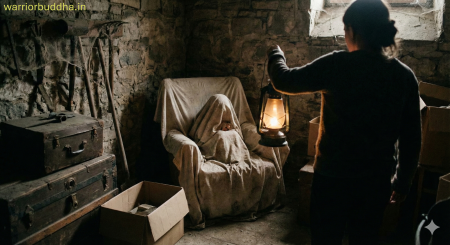
Cleaning the Basement — The Slow Work of Healing
Entering the basement is courage. Cleaning it is devotion.
Healing happens quietly. Not in dramatic breakthroughs, but in patient moments of honesty. Some days, all we can do is sit in silence and allow ourselves to feel. Some days we cry for the first time in years. Some days we simply breathe through the heaviness. Some days we confront a memory, name an emotion, or speak a truth we once buried.
Piece by piece, the room changes. The dust settles. The chaos becomes order. The air becomes lighter.
The ghosts stop haunting because they have been heard.
This is what Jung called shadow integration — transforming what once hurt us into something that strengthens us. The parts we once rejected return as power. Anger becomes boundaries. Fear becomes awareness. Pain becomes compassion. Sensitivity becomes insight. Darkness becomes depth.
We do not erase the past: we reorganize it into meaning.
Individuation — The Birth of a Stronger Self
Carl Jung saw individuation as the deepest task of a human life: the journey of becoming whole. Not perfect. Not polished. Whole.
He said:
“One does not become enlightened by imagining figures of light, but by making the darkness conscious.”
Real growth does not happen by pretending to be spiritual or strong. It happens by facing what we fear. By accepting the parts of ourselves we once rejected. By integrating what we once abandoned.
When we do this, a quiet power rises within us — the power of someone who knows themselves fully. A person who has walked through their own underworld and returned with wisdom. A person who cannot be shaken easily because they have already survived their own storms.
The outer world begins to change because the inner world has healed.
We navigate relationships with clarity.
We respond instead of reacting.
We speak with honesty instead of fear.
We stand grounded instead of collapsing.
The basement stops being a prison. It becomes the foundation of strength.
The Basement Becomes a Sanctuary
There comes a moment when we return to the basement and it no longer frightens us. The room that once felt haunted now feels holy. The silence that once suffocated now feels sacred. We visit this space not to fight demons, but to sit with ourselves honestly.
The basement becomes a temple — a place of reflection, grounding, and truth.
Because once we have faced ourselves, the world cannot scare us anymore. No darkness outside can defeat someone who carries light within.
Conclusion — A Call to Courage
If you feel disturbances within — the emotional storms, the unexplained pain, the silent knocking inside your chest — don’t run. Those are not punishments. They are invitations. Your soul is calling you to open the door you’ve avoided for years.
You don’t have to be fearless. You only have to be willing.
Take a breath. Take a step. Carry your light.
Because the transformation you seek is waiting in the place you fear the most. The warrior is born in the basement. The Buddha awakens under the assault of inner demons. The hero returns from the underworld carrying fire.
So open the door. Walk down the stairs. Clean the room. Turn the shadows into strength. Turn the ghosts into guides. Turn the basement into a sanctuary.
And rise—not as who you were, but as who you were always meant to become.

 Musings of a Warrior Buddha
Leave a comment