
A story of leaving comfort, confronting fear, and rediscovering the wild truth within.
1. The Lion in the Zoo
There once lived a lion in a beautiful cage.
It wasn’t a cruel place — no, it was warm, polished, and safe.
Every morning, the keeper brought food, the visitors cheered, and the lion basked in the soft light of admiration. He had everything a creature could need — comfort, order, attention.
But sometimes, when the night deepened and the wind blew from the faraway mountains, the lion would lift his head.
He would smell the wild — a scent faint and ancient — and something inside him would stir.
He didn’t hate the cage. He had grown used to it, perhaps even grateful for its safety. But with every sunrise, he forgot a little more of the rhythm that once pulsed through his veins — the rhythm of running without walls, of hunting not for survival but for the sheer joy of being alive.
The cage had taken away nothing visible, yet it had quietly borrowed his fire.
And that, perhaps, is how captivity often works — not through cruelty, but through comfort.
It soothes the body, even as it silences the roar.
2. My Life in the Zoo — The Warm Cage of a Secure Job
For years, I lived much like that lion.
The cage didn’t feel like a prison — it felt like success.
The world around me called it stability, and perhaps they were right. The salary came on time, the walls were strong, and my name carried the weight of respectability. I was part of a structure built to last — a government institution where certainty was currency.
There was pride in it, too. The kind that comes from fulfilling what society calls a dream: a secure job, a clear title, a seat in the system.
And yet, behind that sense of order, something quiet kept moving inside me — a restlessness I couldn’t name. It wasn’t rebellion; I wasn’t ungrateful. It was more like a soft knocking from within, asking if this was all there was to life — this rhythm of safety and repetition, this comfort that never quite nourished the soul.
I began to notice how easy it is to confuse comfort with peace.
Peace asks for alignment; comfort asks only for endurance.
And so, even though everything looked perfect from the outside, I could feel a slow, subtle erosion from within — the fading of curiosity, the dulling of instinct, the silence of that inner roar that once made life feel wild and alive.
But it’s never black and white.
The cage had its kindness — it sheltered me when I needed ground. It taught me discipline, structure, and patience. I learned the value of persistence, the strength of routine, and the dignity in responsibility. I don’t resent that chapter.
But deep down, I also knew: I had begun to trade wonder for certainty, and soul for structure.
And once you start hearing that inner knock — the call of something unnamable yet deeply your own — it never really goes silent again.
3. The Wilderness Calls — The Restlessness Before the Leap
There comes a time when silence turns into noise.
When the walls that once felt protective begin to echo your own heartbeat back at you — louder, sharper, almost accusatory.
The same routine that once offered peace now starts to suffocate. Every small comfort begins to feel like a chain made of velvet.
Something inside me began to burn. It wasn’t anger toward the world or rebellion against authority — it was something deeper, more personal.
It was the ache of a lion who had remembered his roar.
I remember sitting at my desk some days, doing the same work I had done a hundred times before, and suddenly feeling a surge of restlessness rising from within — like the body knew something the mind refused to admit.
I would look around at faces — calm, disciplined, resigned — and wonder if they felt it too, that quiet starvation of spirit that hides beneath routine.
The question wasn’t whether I had food, comfort, or security. I did.
The question was whether I was still alive.
There was a storm forming inside me, and it didn’t care for logic.
It came with questions that tore through the fabric of comfort:
What is the use of safety if your soul is slowly dying?
What is the meaning of success if it demands you silence what you truly are?
How long can one live pretending that peace and stagnation are the same thing?
I would try to quiet the storm with reason, with pragmatism.
But freedom has its own language, and once you understand even a single word of it, you can’t unhear it.
That word began to repeat itself inside me like a prayer: more.
Not more money, not more recognition — but more life.
More truth, more courage, more of myself.
And I think that’s how every wilderness begins — not with a grand plan, but with a quiet breaking.
Something in you dies when you stay too long in a place your spirit has outgrown.
And something in you is born when you finally stop apologizing for wanting to feel alive again.
4. The Leap — Leaving the Cage
There are moments in life when the mind loses all authority.
When no argument, no logic, no voice of reason can stand against the command of the soul.
For months, I had wrestled with myself — torn between gratitude for what I had and grief for what I was losing inside.
The battle wasn’t against the system, it was against my own fear. Fear of the unknown. Fear of regret. Fear of falling without a plan.
But the voice within had grown relentless.
It no longer whispered — it thundered.
It said, “Better to die free than live in quiet suffocation.”
And then, one morning, I simply woke up and knew.
There was no grand event, no lightning bolt. Just a quiet certainty that I couldn’t continue betraying that voice.
I walked into the office, wrote my resignation, and handed it over — with no backup plan, no savings blueprint, no future mapped out.
People talk about courage as if it’s something heroic. But that day, it didn’t feel heroic. It felt like surrender — surrender to something larger than reason.
The world around me, of course, didn’t understand.
A few tried to remind me of what I was losing — the stability, the security, the respect that comes with a government badge.
And they weren’t wrong. I was walking away from everything that made sense in a practical world.
But here’s what they couldn’t see — the fire that had been burning in silence.
They didn’t see the nights I lay awake, staring at the ceiling, feeling my soul shrink a little every day.
They didn’t hear the inner gods whispering in the dark, telling me that life had stopped being alive.
Because that kind of truth can’t be explained. It can only be lived.
And so I stepped out — not into a plan, but into uncertainty itself.
It wasn’t a leap of faith. It was a leap of necessity.
I didn’t know what I was running toward — only what I couldn’t stay with any longer.
When you finally leave the cage, there is no music, no applause.
Just wind — cold, unfamiliar, and honest.
It cuts through you, yes, but it also reminds you that you still bleed. That you still breathe.
5. Life in the Wilderness — The Struggle and the Beauty
The first days in the wild are not what the dreamers imagine.
There are no cinematic sunrises, no sudden wings of freedom.
There is only vastness — open, unstructured, and painfully honest.
When I first stepped out, everything that once defined me vanished overnight — the title, the timetable, the safety net.
What replaced it was uncertainty so large it almost swallowed me whole.
There were mornings when fear sat beside me like an old friend, whispering, “Go back.”
And there were nights when doubt grew louder than the stars.
But alongside the fear, there was also something else — a strange, steady calm.
A peace that didn’t come from answers, but from alignment.
For the first time in years, my inner voice and my outer life were saying the same thing.
Even when I felt lost, I wasn’t divided.
It’s strange how life works when you finally stop forcing it to fit the old mold.
Yes, there was anxiety, confusion, even loneliness.
But beneath it all, there was this faint joy — a quiet pulse of knowing that I was on the right path, even if I didn’t know where it led.
I began to see that the wilderness doesn’t hand you a map.
It hands you yourself.
Every day becomes a lesson in trust — trust in your own rhythm, in the whispers that guide you, in the unseen forces that start to move when you take that first, uncertain step.
There were days when nothing made sense, and days when everything did.
Slowly, without my noticing, the chaos began to turn into clarity.
The mind that once demanded control started learning to listen.
And life — unpredictable, raw, wild life — began to flow through me again.
It’s not easy to walk without walls, but you start to realize something:
When you stop clinging to what was safe, life begins to reveal what’s true.
And even in struggle, there’s a strange beauty — because it’s your struggle now, chosen, earned, and alive.
In the wilderness, you may not always know where you’re going.
But for the first time, you know who’s walking.
6. Reflections — What I’ve Learned (and Still Am Learning)
If there’s one thing this journey has taught me, it’s that life was never meant to be a straight line from safety to success.
It’s a winding path — full of detours, storms, stillness, and light.
The meaning lies not in the destination, but in how truthfully we walk.
Freedom, I’ve realized, is not a geography. It’s not found in the wilderness any more than it’s lost in the cage.
It’s a state of being — a deep alignment between what you are and how you live.
When your inner voice begins to match your outer choices, peace appears almost silently. And once you taste that peace, you can’t return to pretending.
Security too is misunderstood.
The world teaches us to seek it outside — in money, structure, approval, or the known.
But true security is born when you stop betraying yourself.
When your soul no longer fights your life, you stop fearing the unknown, because you carry a compass that can’t be stolen.
This journey has also humbled me.
I no longer see the system as the enemy. I’ve met people inside it who are freer than many wanderers I’ve known.
Freedom has nothing to do with the walls around you — and everything to do with the truth within you.
What matters is honesty.
Some are called to build within the structure; others are called to walk alone through the wild.
Both paths are sacred if they arise from the same source — the voice within.
The tragedy is not in staying or leaving. The tragedy is in muting that voice for fear of losing comfort.
Because if the soul and the self are divided, no success will soothe you.
You may have all that the world offers, yet something in you will remain restless, unfulfilled, half-alive.
But when the inner and the outer finally stand as one — even if it costs you everything — a quiet completeness takes over.
You stop searching. You start being.
And that, I think, is where real freedom begins.
7. The Lion Still Roars
These days, the roar is no longer loud.
It’s not the thunder of defiance or the cry of rebellion.
It’s quieter now — more like a hum that lives beneath the breath, a knowing that doesn’t need to be proven.
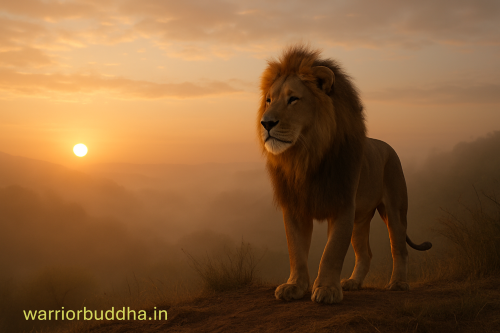
The lion still walks the wilderness.
He still feels hunger, still bears the scars of his old cage, still faces nights when the wind howls a little too cold.
But he has made peace with the wild — not because it is easy, but because it is true.
There’s a beauty in this silence, the kind that only comes after the storm.
When the noise of the world fades and you can finally hear your own heartbeat again.
The mountains teach you that freedom is not noise, it’s stillness.
It’s the space between two breaths — the moment when you no longer wish to be anywhere else.
Sometimes I look back at the cage — not with anger, but with gratitude.
It sheltered me once, just as the wilderness shelters me now.
Both were needed. Both were teachers.
But this — this quiet, uncertain vastness — feels like home.
Not because it is safe, but because it is mine.
And as the sun sinks behind the Himalayan ridges, painting the sky in quiet gold, I understand something I didn’t before:
The lion doesn’t roar to prove his strength.
He roars to remember who he is.
And maybe that’s what freedom really is — not a place you arrive at, but a rhythm you learn to walk with.
Some days the roar is loud, some days it’s silent.
But as long as it’s honest, as long as it comes from within, the journey continues —
one step, one breath, one truth at a time.
 Musings of a Warrior Buddha
Leave a comment