
🌱 Introductory Note
This essay was born from a question that kept returning in different forms:
Why do genuinely good people so often stand silent when darkness rises?
History offers countless examples. Intelligent, compassionate individuals supporting systems, traditions, and narratives that later reveal themselves as cruel or destructive. They never questioned what they were taught to call “good.”
This contradiction unsettled me.
If goodness alone were enough, the world would look very different. And yet, again and again, cruelty is enabled not by monsters, but by ordinary people — good people — who never pause to examine their moral inheritance.
This led me to a deeper inquiry:
Is morality something we inherit from society, or something we must discover within ourselves?
Through history, psychology, and personal introspection — this is my journey into that question.
This essay is an exploration:
Of obedience and conscience.
Of kindness and awareness.
Of how morality, when unexamined, becomes a tool of control rather than a force for truth.
This essay is not a rejection of goodness — but a questioning of goodness without awareness.
The Anatomy of Evil
Evil rarely enters through monstrous men. It seeps quietly through the cracks of ordinary life — through obedience, through convenience, through the comforting illusion that someone else will take responsibility.
History has shown us this pattern again and again. The tyrant needs not millions of evil men; he only needs millions who would rather not see.
When we think of Nazi Germany, we imagine Hitler as the villain, but he was merely the conductor. The real orchestra was made up of clerks, officers, neighbors — people who went home every night, kissed their children, and told themselves they were “only doing their duty.” That phrase — I was only following orders — has been humanity’s most tragic lullaby.
This is the face of evil when stripped of its drama — banal, polite, efficient. It doesn’t roar; it organizes. It doesn’t hate personally; it obeys impersonally.
And yet, behind this mask of duty lies a deeper truth: every time we silence our conscience in the name of obedience, we surrender a fragment of our soul. The bureaucrat who signs the paper enabling cruelty is no less complicit than the soldier who pulls the trigger — for both have outsourced their moral responsibility to “the system.”
The Good Person Illusion
We grow up believing that good and evil are two separate kinds of people — that the good ones stay kind no matter what, and the bad ones are simply lost causes. It’s a comforting story, but a dangerous one. Because in reality, most people aren’t wholly good or evil; they’re simply conveniently moral. Their goodness lives as long as it doesn’t cost them comfort, approval, or safety.
What we often call “a good person” is someone who fits neatly into the moral code of their surroundings. They obey the rules, help their neighbors, say polite things about justice and compassion — but this morality is borrowed, not built. It stands on the fragile ground of social validation. And when the culture shifts, when cruelty becomes fashionable or rewarded, many of these “good” people shift too.
You can see it through history: when oppressive regimes rise, they rarely begin with monsters. They begin with ordinary citizens who adjust to the new normal. Those who once stood for fairness start echoing slogans they barely believe. They tell themselves, this is just how things are now. They adapt not because they’re evil, but because they’ve never learned how to stand alone.
Surface goodness is easy — it asks nothing of you except conformity.
But real goodness demands rebellion when morality becomes inconvenient. It means refusing to nod along when the crowd chants lies. It means risking alienation, comfort, sometimes even safety. And that is where many “good” people falter. They mistake being nice for being righteous, being agreeable for being moral.
Goodness without courage is like a flower without roots — it withers in the first storm.
So the “Good Person Illusion” becomes a belief that goodness is a permanent trait, rather than a choice that must be renewed, especially when the world grows dark.
True morality has nothing to do with personality or politeness. It’s about the strength to stay truthful when truth turns unpopular.
✨The Island as a Moral Laboratory
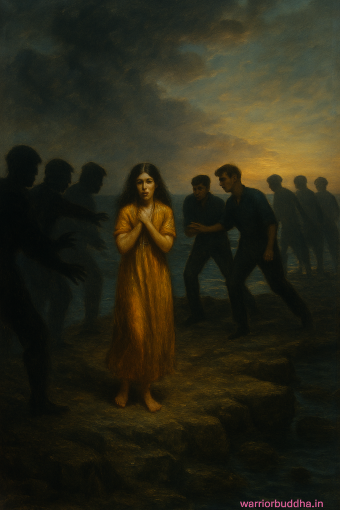
Let’s say you are stranded on an island.
There is no law, no police, no religion, no heaven, no hell.
No one watching over you, no one to judge — only your own breath, your own being.
You’re not alone on this island. There are others — desperate, wild, stripped of civilization’s thin veil. Among them is a woman. One night, a few men decide to violate her. They are driven not by need, but by power — the kind of power that feeds on fear and helplessness.
Now the question is: what will you do?
Some will join the act — intoxicated by the mob, hiding their cruelty behind the excuse of instinct.
Some will stay silent, turning away, convincing themselves it’s “not their fight.”
And then there will be one — maybe two — who will stand up, even if it means being beaten, killed, or left alone. They won’t do it because it’s heroic. They’ll do it because something inside them cannot stay silent in the face of injustice.
That moment defines who a “good person” truly is.
A good person is not the one who talks about kindness, who quotes moral texts, or who obeys laws out of fear.
A good person is the one who stands for what is right even when there are no consequences — no heaven to reward, no hell to punish, no society to applaud.
They act not because they are told to, but because it would destroy something sacred within them if they didn’t.
🌊The Island as the Mirror of the Soul
That island is not just a place — it’s a metaphor for the human condition.
Every thought that we nourish within ourselves, every decision we make in solitude — how we treat a weaker person, how we act when we could easily exploit, lie, or manipulate — that’s where our real morality resides.
Most people’s goodness is dependent on external scaffolding — religion, reputation, law, and social acceptance. Remove those, and their “goodness” collapses. Their morality is borrowed — it doesn’t come from inner conviction but from outer fear.
That’s what I call ‘the good person illusion’.
🪞The Three Archetypes
In that island story, humanity reveals itself in three archetypes:
The Abuser (Active Evil):
The one who acts upon his darkness without restraint. The shadow takes full control — desire, cruelty, and dominance rule. There is no conscience left, only appetite.
The Bystander (Passive Evil):
The one who sees what’s wrong but remains silent. He convinces himself he’s innocent because he “did nothing.” But doing nothing is doing something — it’s protecting evil through inaction. History’s greatest atrocities weren’t carried out by monsters alone, but by millions of bystanders who looked away.
The Protector (Active Good):
The rare soul who stands up, even if it costs him everything. His morality isn’t a performance — it’s a compulsion. He acts not to prove he is good, but because his conscience gives him no other choice. It’s a kind of sacred disobedience — the courage to follow one’s own light even when the world is dark.
🪷Conditioning vs. Conviction
This is where we see the real difference between moral conditioning and moral conviction.
- Conditioning comes from outside — family, religion, culture, fear of punishment. It’s the morality of obedience.
- Conviction comes from within — the morality of awareness, of soul. It doesn’t bend to fear or favor.
When someone’s morality is borrowed, it can easily be replaced — today it’s religion, tomorrow it’s nationalism, next it’s ideology. They aren’t rooted in truth, only in belonging.
But a person of conviction carries their morality like fire in the heart. They don’t need to be told what’s right — it’s an integral part of their being.
That is the difference between appearing good and being good.
🔍The Hidden Message
When we call ourselves “good,” we often mean “socially approved.” But social approval has nothing to do with goodness — it only means conformity.
Because goodness without consciousness is just blindness with a halo.
So maybe the question is not “Am I a good person?”
Maybe the question is:
When the island appears — when there’s no one watching, no law, no God, no consequence — who will I be then?
That’s where your soul answers truthfully.
And that answer cannot be faked.
Education ≠ Wisdom
We often mistake intelligence for understanding, and education for wisdom.
But they are not the same — not even close.
A person can have degrees, titles, and fluent opinions about everything, yet remain blind to truth.
And another person — a poor farmer, a village elder, an unlettered grandmother — might hold a quiet wisdom that humbles philosophers.
Because wisdom is not what’s on the surface. It’s the hidden messages that lies beneath.
📝The Mirage of the Educated Mind
Modern society worships intellect.
We measure worth in academic achievements, language fluency, social sophistication. We assume that if someone is educated, they must be insightful, rational, maybe even moral.
But education often polishes the mind without touching the soul.
It might teach you how to argue, not how to empathize.
How to remember, not how to reflect.
It can fill your head with borrowed ideas, but leaves your soul untouched.
That’s why some of the most monstrous regimes in history were led and supported by educated people — who knew how to think, but not how to feel. They could justify anything, because intellect without conscience is just a sharper knife.
💭Why the Educated Fall for Propaganda
When the minds are trained to analyze, not to awaken — even the smartest people can become blind followers. . They use intellect to defend their biases, not to question them.
So when the evil comes dressed in ideology, logic or “national interest”— when it sounds intelligent, moral, even progressive — the educated often fall for it first.
They think they are thinking, but they are only rationalizing.
That’s the most dangerous illusion of all — when intellect becomes a servant of blindness.
🌅The Root of True Wisdom
Wisdom begins when we listen to life. It grows in silence, in observation, in humility. It asks not “How much do I know?” but “What have I learned from my own experience?”
To be wise is to be awake — awake to one’s own darkness, one’s own conditioning, one’s own capacity for both cruelty and compassion.
Education can teach you to make a living. Wisdom teaches you how to live.
Willful Blindness – The Comfort of Not Knowing
Sometimes people don’t see because they can’t.
But far more often, they don’t see because they won’t.
The truth is visible — lying in plain sight — yet they look away. They scroll past it, rationalize it, mock those who speak of it. Not because they’re stupid, but because truth threatens the delicate story that keeps their world intact.
It’s easier to close your eyes than to rewrite your life.
🧠The Psychology of Avoidance
Willful blindness is not ignorance — it’s self-preservation.
When a person senses that what they believe, what they’ve built their identity around, might be wrong, the mind resists like a body rejecting poison.
It whispers, This can’t be true. Not the people I admire. Not the country I love. Not the faith I was raised in. So they turn away. And each time they do, they lose a little more of their moral sight.
That’s how entire nations slip into darkness — not through sudden evil, but through millions of tiny acts of looking away.
🪞Anne Frank’s Mirror
Anne Frank wrote in her diaries (while she was in hiding from the Nazis) that she still believed people were good at heart.
But even as she wrote those words, her neighbors, teachers, and “respectable citizens” were betraying families like hers — not always out of hatred, but fear and conformity.
Later, when the war was ending, even as Germany lay in ruins, mothers still wept for Hitler. They sent their fourteen-year-old sons to die for him — not because those mothers were monsters, but because they believed that they were sacrificing for a great cause.
To admit that everything they’d believed in was evil would have shattered the meaning of their lives.
So they clung to the illusion, even as it burned their world down.
That is willful blindness — the refusal to awaken, because awakening costs too much.
🗣️The Modern Echo
You can see the same mechanism today, in subtler forms.
People know something feels wrong — the hate, the division, the propaganda — but they scroll past it. They repeat slogans to silence their discomfort. They tell themselves it’s “for the greater good.”
They mistake loyalty for virtue and confusion for peace.
It’s not that they don’t see.
It’s that they’ve made peace with not seeing.
⚡The Fear Beneath the Blindness
At its root, willful blindness comes from fear — fear of losing identity, belonging, and meaning. When truth threatens to take away the illusion that gives your life order, your mind resists with all its strength. That’s why propaganda doesn’t need to convince you; it only needs to soothe you.
It gives you something to hold on to — a story, an enemy, a hero, a flag — anything that lets you stop thinking and start belonging.
The human spirit doesn’t go dark because it loves evil, but because it cannot bear the uncertainty of being alone with the truth.
And then there is another kind of fear too.
More real. More visceral.
Fear of losing one’s job, reputation, family or life.
Fear that the system will turn against you if you dare to question it.
Even the educated, the privileged, the famous — they sense this danger. They choose silence because they believe it keeps them safe.
But silence is never neutral. Every time truth is swallowed out of fear, the lie grows stronger. And history shows that those who stay silent to save themselves eventually lose the very safety they were trying to protect.
Resentment – The Poison of Equality Gone Wrong
Not all followers of harmful systems are driven by fear or blindness. Some are driven by something quieter but more corrosive — resentment.
Resentment is the feeling that hides beneath words like fairness and justice when they are spoken without empathy. It’s the ache of those who feel unseen, unappreciated, inferior — and who secretly wish to bring everyone down to the same level rather than lift themselves higher.
🔥Nietzsche’s Warning: The Morality of the Resentful
Nietzsche called this poison Ressentiment — the morality of the powerless.
When people can’t rise, they curse the mountain.
When they can’t win, they rewrite the rules of the game so that losing becomes “moral.”
Out of this bitterness, a new kind of virtue emerges — one that glorifies victimhood and condemns strength.
The man who fails calls himself righteous.
The one who succeeds becomes suspect.
It’s a quiet revenge disguised as moral purity.
That’s why many harmful systems — fascism, communism, religious fundamentalism — draw their first strength not from hate, but from humiliation. They give the wounded ego a noble cause. They promise the resentful heart that its suffering is not failure, but proof of virtue.
A perfect illustration of this comes from Ayn Rand’s Atlas Shrugged. In one haunting scene, a tramp tells Dagny Taggart the story of the 20th Century Motor Company, where the owners tried to implement a new moral law: “From each according to his ability, to each according to his need.”
At first, everyone rejoiced. The workers thought, “Finally, those who have more will share it with us.”
If their supervisors had two cars, they expected to be given one. They imagined fairness as gain — but only for themselves.
What they didn’t realize was the darker side of this equation.
If they had two bicycles or two bullock carts, someone below them would soon come demanding one. The very same envy they celebrated would eventually devour them too.
In time, the factory collapsed — not because of greed, but because of moral corruption disguised as fairness.
When resentment becomes virtue, society begins to rot from within.
This is the tragedy Nietzsche foresaw — when the powerless, instead of transforming their suffering into strength, weaponize their weakness against anyone who dares to rise. It’s the inversion of morality: the worship of mediocrity, the crucifixion of excellence.
🕳️Resentment’s Modern Faces
You can still see it today — in politics that promise to destroy the “elites” (In India, they have coined a word for it – Urban Naxals), in movements that worship mediocrity as fairness, or in social media mobs that punish anyone who dares to stand out.
The same ancient cry echoes through new slogans: If I can’t rise, let no one rise.
But resentment never builds; it only consumes. It replaces admiration with accusation, and justice with vengeance.
✅The Antidote
The cure for resentment is not forced humility or guilt. It’s self-respect.
When people rediscover their own worth and power, they no longer need to drag others down. They can admire strength without feeling diminished by it.
True equality does not mean sameness. It means standing tall beside another without envy or fear — knowing that their light does not dim yours.
The Hunger for Meaning
At the heart of all obedience and madness lies a quiet ache — a sense of emptiness.
Most people are not evil; they are hollow. They move through life like shells, doing what’s expected, saying what’s acceptable, never touching the question of who they truly are. Beneath their busyness and beliefs lies a frightening silence — the absence of a living center.
This emptiness is unbearable. So they rush to fill it.
That’s when ideologies, cults, and religions arrive — not as external tyrants, but as psychological saviors. They offer ready-made meaning: a tribe to belong to, an identity to wear, a cause to fight for. They say, “You don’t have to carry the burden of thinking for yourself. We’ll tell you who you are and what’s right.”
The tyrant, the cult leader, the narcissist — all understand this hunger. They don’t create it; they feed on it.
They know that a person starving for purpose will swallow anything — even poison — if it tastes like belonging.
That’s why entire nations have surrendered their conscience to demagogues, and why individuals surrender their boundaries to narcissists. The pattern is the same. The lost soul finds someone who promises meaning, and in return, gives away its autonomy.
When the soul is empty, even poison tastes like purpose.
But borrowed meaning never lasts. It feels profound only as long as obedience continues. The moment one begins to question, the illusion trembles — and the whole scaffolding of false certainty collapses. That’s why cults demand loyalty, not understanding. Tyrants demand devotion, not clarity. They thrive on confusion — because a person who truly understands themselves can never be controlled.
This hunger for meaning, when unmet consciously, becomes the root of every manipulation — from personal relationships to political movements. The narcissistic partner and the political tyrant operate on the same law: they promise identity to those who have none. They say, “Merge with me, and you’ll never be lost again.”
And for a while, that feels divine — as if the aching void has been filled. But it’s not meaning; it’s dependency.
The self becomes a reflection of another’s will. The center one was searching for is replaced by a leash.
The only true cure for this hunger is the discovery of one’s own inner anchor — awareness, individuality, and the courage to stand alone.
Meaning cannot be received; it must be realized.
It is not given by gods or governments, lovers or leaders — it’s born the moment one begins to see directly, to feel deeply, to live consciously.
Until then, humanity will keep mistaking chains for safety and slogans for truth.
The Real Measure of Goodness
When I look back now, I understand something that once felt unbearable:
most of the people who seemed good on the surface were simply unanchored.
Their goodness was sincere but shallow, built on habit, not conviction.
It took only a shift in the wind for their moral compass to spin.
That realization broke something in me once. But now I see it differently. Human beings are fragile vessels; we absorb whatever fills us — fear, pride, faith, love. If we do not fill ourselves consciously with truth, something else will rush in to occupy the void.
Real morality is not about being polite, or generous, or well-educated.
It’s about what you do when the lights go out — when standing by your principles costs you something real. It’s about the strength to say “no” when everyone else is chanting “yes.”
Healing, both personal and collective, begins when we stop outsourcing conscience — to governments, to gods, to crowds. When each person reclaims the responsibility of seeing and feeling for themselves, systems begin to change. Because tyrants can rule only over the morally lazy.
So yes, I still believe in goodness — but not the fragile, smiling kind that wilts in the sun of comfort. I believe in the quiet, stubborn kind that holds its ground when storms rise.
Goodness that is not performance, but presence.
Goodness that is not convenient, but courageous.
“The world doesn’t need more agreeable people — it needs awake souls.”
And maybe that’s the real revolution — not overthrowing systems, but awakening hearts. Because the fate of every civilization, and every soul, begins there.
Final Reflection – The Eternal Test
When I step back and look at history — and at life — I see a pattern repeating like an ancient echo.
From age to age, darkness rises in new disguises: a flag, a faith, a voice that promises order. And every time, the so-called “good” people are tested. Some bend, some break, some awaken.
This has always been the rhythm of the world — the dance between conscience and comfort. Many good souls lose their way, but a few rise stronger, forged by the very fire that was meant to destroy them. It’s through them that the torch of truth keeps passing forward.
If evil truly won, the world would have ended long ago. But it hasn’t — because truth, however wounded, never dies.
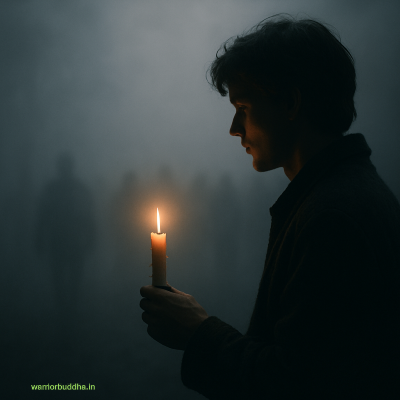
It waits in the hearts of those who refuse to surrender their humanity, who keep their inner flame alive when the night grows long.
Maybe that’s what goodness really is — not perfection, but endurance.
A karmic test that every generation must face anew:
Who among us will remain kind when cruelty is convenient?
Who will stay awake when the crowd dreams?
In the end, masks fall, illusions fade, and only the rooted souls remain.
The world doesn’t need more “good” people — it needs strong ones.
Those who carry both light and courage, and walk through darkness without losing either.
 Musings of a Warrior Buddha
Leave a comment