
Diwali — the festival of light, renewal, and hope.
Every year it reminds us that even a single lamp can push back the darkness.
But this year, something else burned across India — not lamps, not fireworks, but egos.
When YouTuber Dhruv Rathee released a video urging people to limit firecrackers because of Delhi’s choking pollution, his message was simple: celebrate, but with responsibility. It wasn’t an attack on tradition; it was an appeal to conscience.
Yet within hours, social media erupted. People mocked him, posted videos boasting they would now burn more crackers — as if defying reason were a badge of pride.
It wasn’t fireworks in the sky; it was egos exploding.
The smoke wasn’t only in the air — it was in the mind.
Rathee had simply held up a mirror, and many couldn’t bear what they saw. The reaction wasn’t against pollution, but against discomfort. Because when truth enters a space ruled by pride, people don’t listen — they defend.
This pattern of resistance is the same everywhere. Whenever someone speaks with clarity, the insecure hear insult instead of insight. It is discomfort — and that discomfort often wears the mask of mockery.
When truth feels like an attack, the sickness isn’t in the truth — it’s in the self.
The Mass Mind — When the Crowd Becomes the Wounded Collective
When individuals merge into a crowd, something subtle shifts.
The thinking mind fades, and emotion takes command. One person’s insecurity becomes everyone’s outrage. One person’s emptiness becomes the group’s noise.
A gathering of humans slowly turns into a swarm — driven not by thought, but by reaction.
The crowd rarely asks, “Is this right?”
It only asks, “Whose side are we on?”
That’s how reason disappears and belonging takes its place.
The outrage against Dhruv Rathee wasn’t about pollution; it was about pride. “Who is he to tell us what to do?” Beneath that defiance was not strength, but fragility — the kind that hides behind loudness. The insecure often seek power through numbers, not understanding.
When many hollow minds come together, their shared noise feels like strength.
But it’s only emptiness echoing in every direction.
Every generation repeats this drama — the few who reflect, and the many who feel threatened by reflection.
In today’s world, that mob lives online. Comment sections, reels, and tweets are modern battlefields for fragile egos.
The crowd doesn’t debate; it mocks. It cancels. It floods timelines with noise.
Because when you have no light of your own, the easiest comfort is to blow out someone else’s lamp.
A crowd is like a mirror maze — each ego reflecting another’s wound until illusion feels full.
But beneath the shouting, there’s fear — fear of silence, fear of seeing the truth of their own hollowness.
The Inner Mirror — The Crowd Within
What plays out on the streets or screens is only a magnified version of what happens inside one human being.
Every insecure person carries a small crowd within. Thoughts clash, emotions shout, silence feels unbearable.
When such a person meets someone calm, grounded, or joyful from within, it unsettles them.
And it gives them discomfort.
The other’s peace becomes a reminder of their restlessness.
So instead of rising toward that peace, they try to pull it down.
You can see it everywhere —
a friend who mocks your discipline,
a colleague who laughs at your contentment,
a relative who belittles your dreams.
They just can’t stand the reflection of what they’ve lost.
Your calm becomes their mirror, and they mistake reflection for insult.
And rather than face that discomfort, they tried to destroy the reminder.
People often attack what they secretly admire.
Like moths circling a flame, they resent what they cannot embody.
The more fragile the ego, the louder the armor.
It’s never strength that mocks awareness; it’s weakness pretending not to tremble.
The Hollow Within — The Spiritual Root
At the root of all this noise lies a quiet, aching truth — hollowness.
Not the sacred emptiness of meditation, but the emptiness born of disconnection.
Modern life leaves little space for silence.
We scroll, consume, argue, compete — anything to avoid meeting ourselves.
And when the silence does arrive, it feels unbearable.
The mind, unused to stillness, runs from it into stimulation.
In that running, it loses meaning.
The people mocking Rathee weren’t celebrating Diwali; they were escaping themselves.
Their laughter was an anesthetic, not joy.
When you cannot feel alive from within, you seek noise to prove you exist.
The tragedy is that the cure is simple — to pause, to breathe, to look inward.
But we’ve built a civilization terrified of stillness.
Until that fear is faced, the hollowness will keep echoing — in mobs, in relationships, in nations.
The Way Out — From Reaction to Awareness
So how does one live among the noise without being consumed by it?
How can a sensitive soul stay centered when the world rewards outrage?
The answer isn’t in withdrawal.
It’s in awareness — the quiet rebellion of refusing to react.
The awakened learn to witness without absorbing.
To see the chaos, understand it, even feel compassion for it — but not let it enter their bloodstream.
The moment you react to madness, you feed it.
The moment you stay grounded, you reveal its powerlessness.
This is the real strength — not to shout louder than the mob, but to remain unshaken in its presence.
Each time you choose silence over reaction, you reclaim yourself.
Each time you respond with clarity instead of anger, you light another lamp within.
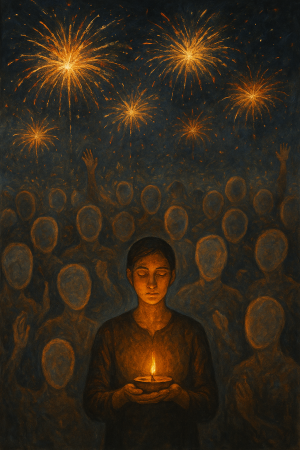
And that is the essence of Diwali — not fireworks that darken the sky, but inner lamps that brighten the soul.
Let the crowd burn its crackers; you burn your ignorance.
Let them chase noise; you choose awareness.
Because when you can find peace without needing witnesses, no mob, no system, no chaos can take it from you.
That is the real rebellion —
to be at peace in a world addicted to disturbance.

 Musings of a Warrior Buddha
Leave a comment