
In the first part of this series, we stepped into the world of Anthem and saw how a society built on “we” crushed the spark of “I.” In the second part, we witnessed Equality 7-2521’s awakening—his discovery of forbidden knowledge, his love for Liberty 5-3000, and his defiance against blind scholars. Now, in this final part, we arrive at the ultimate transformation—the moment when “I” rises like fire in the wilderness.
Into the Wilderness: Solitude Without Chains
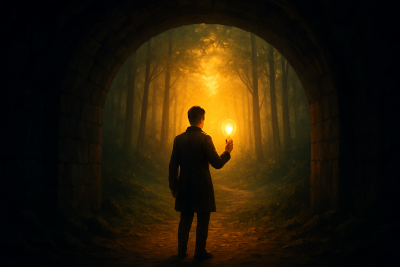
Equality 7-2521 walks into the wilderness not as an exile, but as a man finally breathing. For the first time, the silence around him is not empty—it is alive. Every rustle of leaves, every beam of sunlight, every heartbeat feels like a hymn to freedom.
This is the paradox of true solitude: it does not suffocate, it liberates. Loneliness belongs to those chained to the crowd. Solitude belongs to those who have found themselves.
He has broken free from the iron cage of “we.” And in doing so, he finds something greater than survival—he finds wonder.
The House of the Forgotten: A Sanctuary of the Self
In the wilderness, he discovers an abandoned house, a relics from the past. Unlike the gray, suffocating barracks of the collective, this house was built for the few—for the individual. Its walls breathe privacy, its rooms sing of intimacy.
Walking through its corridors, Equality 7-2521 and Liberty 5-3000 marvel at the forbidden luxury of doors that close, windows that belong to one soul, books that whisper to one mind. It is as if the house itself had been waiting for them, like a temple holding its breath until the seeker arrived.
And then—within the pages of those books—he finds the word.
The word that was stolen, buried, erased.
“I.”
That single syllable falls upon him like thunder rolling across the sky. A word so small, yet so infinite. A word that separates the slave from the free, the machine from the man.
In that moment, Equality 7-2521 is reborn. He is no longer a shadow in a mass of shadows. He is Prometheus, the fire-bearer.
This moment is one of the most powerful in the novel. For the first time, he understands that his thoughts, desires, and existence belong to no one but himself. Ayn Rand builds this revelation as the emotional and intellectual climax of Anthem, where Equality 7-2521 fully realizes the core philosophy of Objectivism: that the individual is the ultimate source of meaning and purpose.
Reclaiming Names, Reclaiming Destiny
Equality 7-2521 renames himself Prometheus, after the Titan who brought fire to mankind and suffered for it. In this act, he declares: I am the bringer of light, and I will pay the price.
He names Liberty 5-3000 Gaea, the mother of a new dawn. Their names are not mere labels—they are swords, cutting away the last remnants of their chains.
How many of us live with identities shaped by others—be it society, family, culture? How many live and die without ever meeting their true selves?
To rename oneself is to seize destiny with one’s own hands.
Light to the Blind: The Rebellion of “I”
What is more tragic than blindness? Not blindness of the eyes—but blindness chosen, blindness embraced.
Equality understood the Scholars’ original sin: it was not ignorance, but but refusal. They rejected the light of the individual to preserve the comfort of the collective.
And is this not our world too?
- Citizens who worship corrupt leaders, defending them even as they sink deeper into chains.
- Crowds that follow ideologies like flocks of sheep, mistaking obedience for virtue.
- A society that confuses conformity with morality.
To see truth—and still reject it—is the darkest blindness of all.
The New World: A Fire That Cannot Be Extinguished
Prometheus dreams of a new society—not of mass obedience, but of free spirits. A place where the word “I” is sacred, where children will grow knowing that their minds belong to them alone.
This is not just his vision. It is Rand’s prophecy. And it echoes into our age with unrelenting force.
For though our chains look different, they remain chains:
- The tyranny of mob opinion.
- The slavery of algorithmic approval.
- The pressure to fit into boxes—political, cultural, tribal.
To live as “I” is still rebellion. To think for yourself is still dangerous. To love freely, create fearlessly, and stand alone in truth is still the rarest courage.

The Fire of “I”
Anthem ends not in despair but in fire. A fire lit by one man who dared to say “I.”
Prometheus writes upon the stone:
“I am. I think. I will.”
And this is no mere declaration—it is a revolution.
The question is not whether his world will change. The question is whether ours will.
Conclusion: The Enduring Relevance of Anthem
Anthem is not just a dystopian novel; it is a philosophical call to arms. It challenges us to reject collectivist control and embrace individualism as the highest virtue. In an era where personal identity is often shaped by external forces—social media, institutions, cultural norms—Rand’s message is more relevant than ever.
Through Equality 7-2521’s journey, we are reminded that our thoughts, dreams, and desires are ours alone. To live for oneself is not selfish; it is the deepest affirmation of life.
So, what is your “I”?

 Musings of a Warrior Buddha
Leave a comment