
In Part One of this series, we entered the bleak world of Anthem—a bleak society where individuality is erased, the word “I” is forbidden, and life is lived only in service of the collective. We saw Equality 7-2521, our protagonist, begin to sense the cracks in this system as he stumbled upon a hidden tunnel and the forbidden thrill of independent thought.
Now, in Part Two, the story deepens. Equality 7-2521 begins to embrace his identity, moving from quiet questions to bold defiance. His secret experiments, his forbidden love, and his confrontation with the blind arrogance of the Scholars bring us to the heart of Ayn Rand’s warning: what happens when human spirit collides with the machinery of control.
The Journey of Self-Discovery and Defiance
Every act of self-discovery is, at its core, an act of rebellion.
To truly know yourself is to say: I am not what the world tells me to be. I am not your “we.” I am “I.” And in societies built on control, that is the greatest crime of all.
This is the path of Equality 7-2521 in Anthem. He is not merely breaking rules; he is breaking the very spell that keeps his society intact. His journey of forbidden knowledge and forbidden love reminds us of a timeless truth: nothing frightens systems of control more than an individual who dares to think and love for himself.
The Fire in the Tunnel
The journey begins in darkness. Equality 7-2521 stumbles upon an abandoned tunnel from the Unmentionable Times—a forgotten relic buried beneath the earth. To most, it would be a place of fear, but for him, it becomes a sanctuary.
There, in secret, he begins to experiment with fragments of lost knowledge. Electricity. Sparks. Each experiment is a small act of treason, but also a small act of liberation.
In the silence of the tunnel, he rediscovers what society has worked tirelessly to bury: curiosity, imagination, the thrill of asking why. His hands, stained with soot and persistence, craft a light unlike any the world above has seen for centuries. A lightbulb—fragile, glowing, radiant.
It is not just an invention. It is a symbol. A living defiance.
Because in a world that insists everything worth knowing is already known, to discover something new is to commit the ultimate rebellion: the rebellion of the mind.
Love: The Most Dangerous Revolution
But knowledge is not his only crime. He meets Liberty 5-3000, and their eyes lock in silent recognition. In a world where love is forbidden—where even friendship is erased—this single glance is enough to brand them heretics.
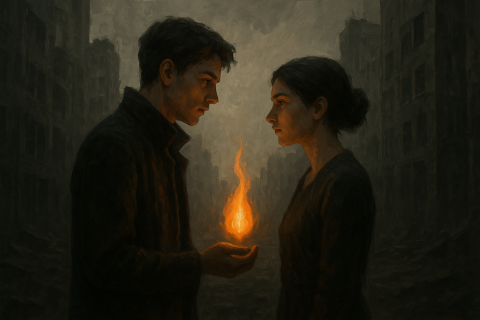
Why is love so dangerous to authoritarian systems? Because love is a choice. It is personal. It says: I see you. I choose you.
It is the most individual act a human being can take. No state, no priest, no elder, no collective can dictate who we should love. And in that freedom lies its danger. Because the moment two people decide their lives belong to each other—not to the “we,” not to the collective—the illusion of total control begins to crack.
This is why love stories are always suppressed in controlled societies. Even today, in many places, love across caste, religion, class, or ideology is condemned as betrayal. Lovers are punished, exiled, even killed. Not because love is immoral, but because love is free.
Equality and Liberty’s affection—expressed not through grand declarations but stolen glances and whispered words—is the quietest, yet loudest act of rebellion in Anthem. It is love as defiance. Love as fire.
The Light and the Blind
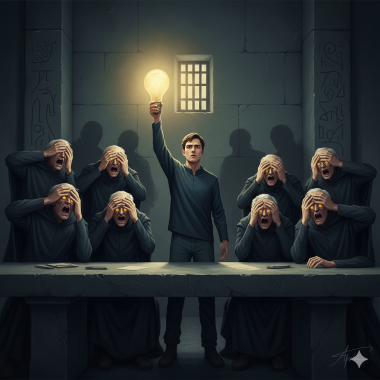
With trembling hope, Equality decides to share his discovery with the World Council of Scholars. He believes—naively—that they will welcome his invention. That they will see its beauty, its power, its gift.
But what happens instead is a scene as tragic as it is revealing.
Imagine holding a lamp in your hands, showing it to a room of men groping in darkness, believing they would rejoice. Instead, they recoil. They do not merely fail to see—they refuse to see.
It is like offering sight to the blind. But here’s the bitter truth: they are not blind by nature. They have tied cloths over their eyes, chosen ignorance over vision. To remove the cloth would be to accept that they were wrong, that one man, acting alone, had created something greater than the collective.
And so, they spit out bread while starving. They smash the lamp while suffocating in darkness.
This is not fantasy. It is a mirror. How many times in our world have innovators, rebels, or thinkers bring light, only to be met with rejection by those in power? How often do we see governments, corporations, or cult leaders encourage their followers to keep the cloth over their eyes, to reject reality even when truth burns before them?
It is not ignorance that destroys societies—it is willed blindness.
Breaking the Chains
With his dream shattered, Equality realizes the truth: this society does not seek knowledge, progress, or truth. It seeks only control. His light was never going to be accepted, because it was born of independence.
And so, he does the unthinkable. He runs.
Into the Uncharted Forest—the place of exile, the place of death. Where others see terror, he finds freedom. Every step into the wilderness is a shedding of chains. Every breath of open air is an act of becoming.
The forest is more than a setting. It is a symbol: the raw, untamed space where a man can finally be himself, unbound by rules, expectations, or the suffocating “we.”
Sometimes freedom cannot be granted within the walls of society. Sometimes it can only be seized in the wilderness, in exile, in solitude.
Reflection: The Fire We Fear
Anthem forces us to ask questions that echo in our own time:
- Why do certain societies fear thinkers more than criminals?
- Why is love across boundaries still punished in so many cultures?
- Why do we so often choose the comfort of blindness over the risk of seeing?
From authoritarian regimes silencing dissent, to democracies where cancel culture kills conversation, the pattern is the same: the system fears the unpredictable flame of individuality. It fears the one who says, “I will think for myself. I will love for myself. I will live for myself.”
And perhaps you have felt this too—the weight of family, school, or society demanding conformity. The rejection you face when you present something new, something different, something that does not fit the script. That sting is the same rejection Equality faced when he offered his light.
But here is the truth: progress is always born from defiance. Every revolution begins with someone daring to say no. Every transformation begins with someone willing to walk into the wilderness.
Conclusion: Toward the Wilderness Within
Part Two of Anthem is the story of a man who discovered two truths: that to think is rebellion, and to love is freedom. Knowledge and love—these are the flames no darkness can extinguish.
When Equality walks into the forest, he is not fleeing. He is being reborn. For the first time, he is not “we.” He is “I.”
And perhaps this is the question Ayn Rand leaves us with here: What wilderness awaits us if we choose to remove the cloth from our eyes, if we dare to think, to love, to live as individuals?
The forest is not only outside us. It is within us. And the courage to enter it—that is the beginning of freedom
[With Equality’s escape into the forest, we move into the final part of Anthem—where he fully embraces his identity and the philosophy of individualism. In the next blog of this series, we will explore his ultimate transformation and the powerful message that Ayn Rand leaves us with.]

 Musings of a Warrior Buddha
Leave a comment