
A Whisper in the Dark
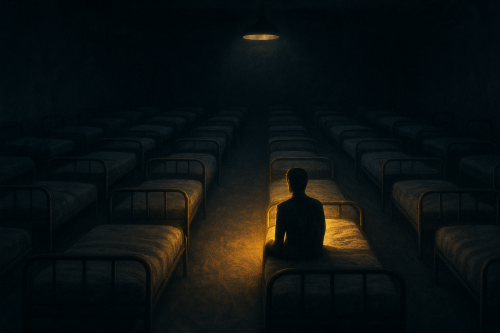
Imagine this: a young boy sits in a crowded dormitory, dozens of identical beds lined up in perfect order. He wants to ask a question that burns in his mind—why the stars glow at night. But he swallows the thought, because questions are sins. To wonder is forbidden. He lies awake, whispering the thought only to himself, terrified the walls might hear.
This is not a nightmare. This is the world of Ayn Rand’s Anthem. A world where the word “I” has been erased. A world where to be different is to be damned.
And if you think it’s only fiction, pause for a second. Look around. Have you never hidden a thought, stifled a dream, or silenced your voice because society told you it was dangerous to stand out?
That’s where Anthem stops being just a story—it becomes a mirror.
The Great “We”
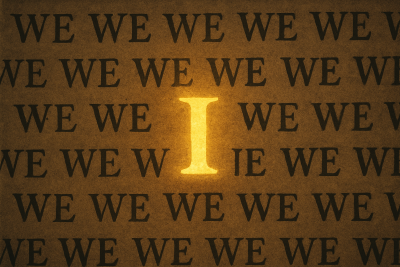
The society of Anthem runs on one commandment: “We are one in all and all in one. There are no men but only the great WE.”
No names, only numbers. No families, only collective homes. No love, no friendship, no choice. People speak of themselves only as we.
It sounds exaggerated, almost absurd. But think of the subtle ways we already live this. How many of us chase careers we don’t love because “that’s what people do”? How often do we echo opinions online, not because we believe them, but because standing out feels dangerous?
The world of Anthem is a magnifying glass—it shows us what happens when conformity isn’t just encouraged, but enforced.
Equality 7-2521: The Unforgivable Sin
But even in such a world, one voice dares to question. The heart of Anthem beats through its protagonist: Equality 7-2521. His crime? Not theft, not violence—his sin is curiosity.
As a child, Equality 7-2521 realized he was not like the others. Unlike his peers, he was naturally curious, intelligent, and independent-minded. He enjoyed learning, asked forbidden questions, and dreamed of understanding the mysteries of the world. However, in a society where being different was a sin, these traits made him a transgressor. His teachers and elders warned him against thinking beyond what was taught. “It is a sin to write this. It is a sin to think words no others think.” His teachers scolded him, his peers shunned him. In his world, to be smart was to be selfish. To be curious was to be corrupt.
When the government assigned jobs, he hoped to become a Scholar—a position where he could pursue knowledge. But instead, he was given the job of Street Sweeper. Society tried to crush his gift beneath a broom. He was expected to accept his fate without question, but his mind refused to be enslaved.
How many of us know this story? The child who loved art, but was forced into engineering. The teenager who wanted to write, but was told writing doesn’t pay bills. The woman who longed to dance but was told it was shameful.
The tools change—elders, teachers, corporations, governments—but the message is the same: Do not be yourself. Do not stand apart.
The Tunnel and the Light
And yet, fire cannot be smothered forever. Equality 7-2521 discovers an abandoned tunnel, a forgotten relic of an older world. Here, in secrecy, he begins to think freely, to experiment, to create.
It is in this tunnel that he rediscovers electricity. When he lights a bulb for the first time, it is not only a physical light that shines. It is the blaze of individuality, of forbidden thought, of one human being daring to say: I will not obey.
This tunnel is a symbol every one of us knows. It is that notebook hidden from parents. That late-night Google search for answers nobody wanted us to ask. That secret corner of the soul where we nurture dreams we’re too afraid to share.
The light in the tunnel is a metaphor for awakening—the moment when obedience collapses under the weight of truth.
Mirrors in Our World
You might say: “But that’s fiction. We don’t live in Anthem’s nightmare.”
Don’t we?
In India, how often do we see individuality swallowed by family honor, by societal pressure, by the suffocating weight of—“what will people say”?
In China, millions move like cogs within the machine of state power, ensuring that no one strays too far from the collective script.
And in the so-called free West, isn’t there another kind of conformity? Here, it isn’t the state demanding obedience but the mob. The cancel culture, the ideological policing, the pressure to shout the “right” slogans or risk being cast out.
Different systems. Same outcome. The great “We” devours the fragile “I.”
The Cost of Silence
But the danger isn’t only out there—it seeps into us.
Think back: when was the last time you swallowed your truth because you feared judgment? When did you betray your own voice to fit in with the group?
Every time we do this, we live a little more inside Anthem. Every time we trade our authenticity for approval, we step deeper into the dormitory of silence.
It may not look as extreme as Equality 7-2521’s world. But the mechanics are the same. Silence is rewarded. Conformity is praised. And truth is punished.
A Choir with One Note
Here’s a metaphor to understand this better: life in Anthem is like being born in a choir where everyone must sing the same note forever. No harmonies, no solos, no music—just one endless, suffocating sound.
Now ask yourself: how many of us live this way? Singing songs we do not love. Playing roles we never chose. Smiling masks plastered on, while the real self dies unheard beneath the noise.
The tragedy of Anthem is not only in its society. It’s in how easily we accept cages when they are decorated with words like “unity,” “tradition,” or “progress.”
The First Spark of Rebellion
Equality’s tunnel is more than a hiding place. It’s a declaration. It says: I will not let the world kill my mind.
And here’s the real question: where is your tunnel? Where do you go to nurture the forbidden thoughts that make you who you are?
It could be your journal, the silent archive of forbidden thoughts. Your art, a canvas of unapproved colors. A solitary walk, where the world cannot follow. A quiet conversation with the one person who truly sees you. But most vital of all, it is your inner world—the boundless realm where the word ‘I’ can be spoken without limit.
The tunnel is not only in Anthem—it’s in every one of us. The light waits, but only if we dare to strike the match.
Closing Reflection: Your Own Anthem
The first part of Anthem ends with a lightbulb flickering to life in the dark. It’s fragile, small, and easily destroyed. But it exists.
And maybe that’s all it takes. A single spark to remind us that even in the loudest choir, a solo voice can rise.
So I’ll leave you with this:
What truth are you silencing right now? What dream waits in your tunnel? And when will you stop saying we and finally whisper the most dangerous, beautiful word of all—I?
Stay tuned for Part 2, where we’ll explore Equality 7-2521’s forbidden love and how it pushes him further toward the ultimate act of defiance: becoming fully, unapologetically human.

 Musings of a Warrior Buddha
Leave a comment