
The Stories That Changed Me
Some stories don’t leave you.
You don’t just remember them — you carry them.
Long after the words fade, they keep living inside you —
like seeds buried in your soul, waiting to bloom when life makes space for them.
I heard these two stories when I was a child.
They were simple, almost like fables. But strangely, they never left me.
Over the years, I’ve found myself returning to them — not just remembering, but feeling them again.
They helped shape my values. They stirred questions I still carry.
Even now, decades later, I still see the scene playing in my mind like a quiet flame that never went out.
And I thought… maybe it’s time to share them.
The King with Empty Hands
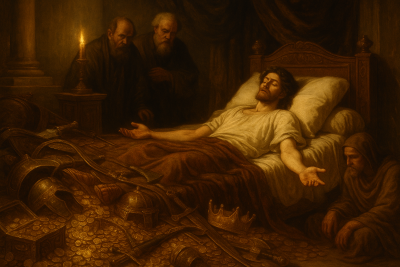
Alexander the Great — the mighty conqueror who stretched his empire across the known world — was dying.
Only 32 years old, but death, like truth, is no respecter of titles.
He had summoned the finest physicians. Demanded the most powerful medicines.
He was the emperor — the one who had never lost a war.
Surely, if anyone could beat death, it was him.
But the physicians looked down.
There was nothing more they could do.
Alexander went into a deep reflection. And it was then, at the edge of his final breath, that Alexander gave his last command.
He told his ministers:
“When I die, let my hands hang outside my grave.”
His ministers were confused.
“Why, my Lord?” they asked.
Alexander replied:
“So that the world may see… that the one who conquered everything… even he left this world empty-handed.”
Even as a child, that image haunted me.
The greatest king the world had known — hands hanging out of his grave, holding nothing.
It wasn’t just dramatic.
It was… true.
So raw. So final.
That story planted something in me:
The seed of a question.
What are we really chasing? And what will we take with us in the end?
I didn’t have the words for it then. But the silence it left in me was louder than any sermon I’ve heard since.
Maybe that’s why I’ve never been able to forget it.
The Laughing Crowds and the Wise Gods
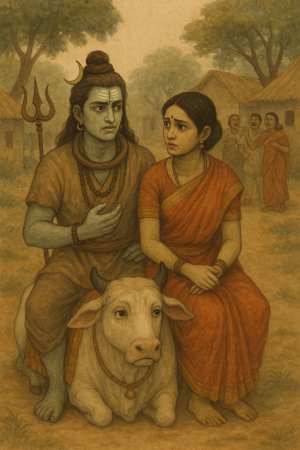
In another story, Lord Shiva and his consort Parvati were taking an evening walk.
Alongside them trotted their faithful companion — the bull, Nandi.
They had disguised themselves as ordinary villagers. No godly symbols, no cosmic auras. Just a husband, a wife, and a bull, wandering through the villages like anyone else.
Soon, they passed by a group of people sitting by the roadside.
The villagers saw the couple walking on foot, with their bull strolling beside them.
They laughed and mocked:
“Look at this foolish couple — they have a bull, yet they’re walking like beggars. What a waste!”
Shiva and Parvati paused.
They looked at each other.
Maybe they’re right, they thought. Why are we walking when we have a bull?
So they climbed onto Nandi’s back — both of them — and continued.
A little while later, they encountered another group.
This time, the people scoffed:
“How cruel! Both of them sitting on the poor bull? Don’t they have any shame? No compassion?”
Embarrassed, they got down.
Parvati said, “You sit, my lord. I will walk beside you.”
So Shiva mounted Nandi, and they resumed their journey.
But soon, another crowd appeared — and again came the laughter.
“What a disgrace! The man rides like a king while the poor wife walks behind him like a servant. Is this how a husband treats his wife?”
Shiva was now uneasy.
He got down and said, “You sit, Parvati. I’ll walk.”
And so they continued — until they met yet another group of people.
And once again, the crowd burst out laughing:
“Ha! Look at this weak man. His wife rides in comfort while he walks like a slave. Who wears the crown in this marriage, eh?”
Shiva and Parvati stopped.
They had tried every possible arrangement — and yet, in every version, someone laughed.
And so, they came to a quiet realization.
There is no way to please the world. No matter what you do, someone will always find a reason to laugh.
Someone will always criticize, judge, or find fault — even in gods.
I remember hearing this story and feeling strangely quiet inside.
Like something in me had been explained — but without words.
It made me reflect on how easily we surrender our peace to the opinions of others.
And how ridiculous that can become if we never draw the line.
Even today, when I find myself overthinking what “they” will say, I return to this story.
Of Shiva, Parvati, and Nandi — trying to please a world that was never going to be pleased anyway.
What These Stories Gave Me
Both stories, though different, led me inward.
One taught me about the emptiness of external conquest.
The other taught me about the noise of external judgment.
And between them, a quiet truth emerged:
Live simply. Live truthfully. And live from within.
Because in the end, we all leave with empty hands.
And until then, the world will keep talking.
Let it.

 Musings of a Warrior Buddha
Leave a comment