
We live in a world that runs—not walks.
A world that praises momentum, visibility, and output. From the moment we step into school, we are conditioned to stay ahead: to compete, to perform, to always be doing. Achievement becomes our oxygen.
To stop, even for a moment, is to risk losing your place in the race. So we keep running—fuelled by anxiety and comparison.
We scroll, respond, and hustle—terrified of what might happen if we disconnect.
In workplaces, it’s no different. Stress is worn like a badge of honor. The system rewards the relentless, glorifying exhaustion as ambition. Slowing down feels like weakness. Rest becomes rebellion.
And in such a world, solitude becomes taboo. It’s mistaken for loneliness, depression, even failure. A person choosing to be alone is often seen as someone who is broken, antisocial, or lost.
Yet solitude is none of those things. In fact, it’s often the opposite. It is the choice to turn inward, to pause and listen, to tend to what the world taught us to ignore.
And herein lies the paradox:
In a society that glorifies constant connection, solitude becomes a radical act of self-respect.
Because it is in solitude that we begin to hear the voice beneath the noise—the voice of truth, longing, and forgotten wounds. It is in solitude that we remember who we were before the world told us who to be.
This is not a celebration of isolation, nor a rejection of the world.
It is an ode to the sacred pause—the still space where something begins to heal.
My Journey into Solitude: A Call from Within
I didn’t seek solitude because it sounded spiritual or poetic.
I entered it because life gave me no choice.
Each time I entered solitude, it was a calling from within. A deep, inner voice would whisper: Stop. Now. And I had to listen. The body couldn’t keep up. The mind was cluttered. The heart was hurting. There were too many wounds I hadn’t processed. Too many truths I hadn’t faced.
Solitude became not an escape, but an emergency landing.
Over the years, I’ve entered radical solitude again and again. Sometimes for weeks. Sometimes months. And each time, it was triggered by a storm within—a soul-level exhaustion, a knowing that I couldn’t keep pushing forward without turning inward first.
I didn’t go inward to escape the world. I went inward to find myself again.
To find the answers. To feel what I hadn’t felt. To process what I had buried.
To breathe again.
The Difficult Beginning: Soul Detox
People often romanticize solitude—imagining peace and clarity. But the truth is, the beginning is anything but peaceful.
The first few weeks, even months, can feel disorienting. Without distractions, time stretches. There’s no external structure to lean on. You’re suddenly alone—with your thoughts, your memories, your emotions. And at first, it’s overwhelming.
Thoughts you’d long buried rise. Wounds you avoided begin to knock. Desires you silenced come alive. The mind, no longer distracted, turns inward—and what it finds isn’t always easy to face.
This is the detox phase—not of the body, but of the soul.
In a world wired for stimulation, this stillness can feel like withdrawal. Restlessness creeps in. You wonder what you’re doing. The ego panics. It wants to be useful, productive, seen.
But this discomfort is not a sign something’s wrong.
It’s a sign something’s beginning to unclog.
You’re not wasting time.
You’re clearing space.
Stay with it, and something shifts:
The noise begins to quiet.
The breath slows.
And your inner world, for the first time in a long while, becomes visible.
Solitude doesn’t soothe you at first. It confronts you.
Where the Wounds Speak
And then—slowly—the stillness starts to soften.
Wounds begin to speak. Grief you never grieved. Questions you never asked. Longings you buried to survive. In solitude, they rise—not to torment you, but to be heard.
Solitude becomes a kind of inner therapy.
A dialogue with all the parts of you that got left behind in the race.
It’s like waking up after a long surgery—not yet ready to walk, but finally feeling your body again.
You sit. You write. You reflect. You stare. You let things rise and pass. And through it all, something starts to realign—wordless, patient, real.
Solitude doesn’t change you.
It reveals the part of you that never left.
But that confrontation is the beginning of real clarity.
Metaphors of Solitude: The Car and the Arrow
Sometimes, metaphors say what words alone cannot.
These two metaphors have stayed with me, shaped me, guided me. They’ve helped me understand what solitude truly is.
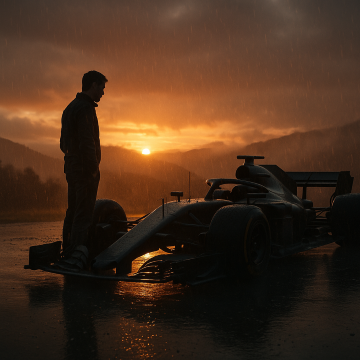
🏎️ The Formula One Car – The Garage of the Soul
Even a Formula One car, the fastest machine on the track, has to pause. It needs to enter the garage.
Not because it’s failing. But because it’s smart.
In the garage, the engine is checked. Tires replaced. Leaks detected. Damage repaired. Without those pit stops, the car would break down—or worse, catch fire mid-race.
That’s what solitude is for all of us:
A garage for the soul.
A space to pause, inspect, heal, recalibrate.
And in that sacred pause, you realize that you had been leaking energy, dragging emotional debris, and pushing through without tending to your engines. If you hadn’t stopped, you wouldn’t have survived the race. And every time you come out of that garage, you feel sharper, faster, more alive than before.
Solitude doesn’t put you out of the race. It keeps you in it—safely, wisely, sustainably.
🏹 The Bow and Arrow – The Sacred Pullback
The second image that always stayed with me is that of the bow and arrow.
You can’t shoot an arrow forward without first pulling it back. The deeper the pullback, the farther the reach.
Solitude is that pullback.
It looks like you’re retreating. It feels like you’re regressing. You’re not producing. You’re not posting. You’re not visible. But inside, a quiet tension is building—a gathering of force and clarity.
When the time is right, you release.
And you don’t just move forward.
You fly—with direction, with speed, with precision.
We often misunderstand solitude because we mistake stillness for stagnation. But what if stillness is just preparation for the next flight?
These metaphors aren’t just poetic—they are psychological truths. We all need the garage. We all need the pullback.
We just have to give ourselves permission to pause.
The Fire Returns
And then, without effort—you feel it.
A new fire rising.
Not the fire of anxiety or ambition.
But a fire that burns clean. Clear. Alive.
Your decisions become clearer. Your emotions settle. You return to the world—not desperate to prove anything, but grounded in something deeper.
Solitude doesn’t make you soft.
It tempers you—like metal in the forge.
You went in fractured.
You came out whole.
When you return to the world, you carry something most people have lost:
Clarity. Stillness. Direction.
Why the World Fears Solitude
Most people don’t resist solitude.
They resist what it reveals.
Solitude is a mirror. It doesn’t flatter. It reflects truth—often the kind we’ve been trained to avoid. In a culture of noise, silence feels dangerous.
We’ve built systems that glorify the loud, the visible, the relentless.
Children are taught to compete. Employees are rewarded for burnout.
The person who pauses is seen as unambitious, the quiet one as weak.
But what if it’s the other way around?
What if the bravest thing you can do in this world is… stop?
But for many, solitude isn’t even an option. When you’re struggling to survive, to meet your basic needs, solitude feels like a luxury. Life demands presence in a different way.
But even then—solitude isn’t about location.
It’s about attention.
Five minutes of stillness. One quiet walk. A screen turned off. A breath. A pause.
That’s where it starts.
A World That Honors Solitude
Not every culture is afraid of silence.
In Finland, for example, solitude is respected. People don’t talk just to fill space. Silence isn’t awkward—it’s meaningful. It’s one of the few societies where introversion isn’t pathologized—it’s normalized.
And perhaps that’s why Finland consistently ranks among the world’s happiest countries.
Now imagine a world where solitude was seen as essential, not eccentric.
Where workplaces offered time to reflect.
Where schools taught children how to sit with themselves.
Where silence wasn’t feared—but felt.
A world where going inward wasn’t seen as falling behind,
but as catching up with who you truly are.
That world begins with us.
Conclusion: The Sacred Pause We All Need
In a world addicted to movement, solitude is a sacred pause.
A return to your inner source. A fire that burns away the fog.
Solitude doesn’t isolate you.
It reconnects you—to your body, your truth, your purpose.
So if your soul is whispering stop—listen.
Go inward.
Let yourself break.
Let yourself breathe.
Let yourself burn and be rebuilt.
Because when you return, you’ll be carrying something this frantic world desperately needs:
A fire that doesn’t burn out.
And a presence that outlasts the noise.
 Musings of a Warrior Buddha
Leave a comment