
The Lamp and the Moths
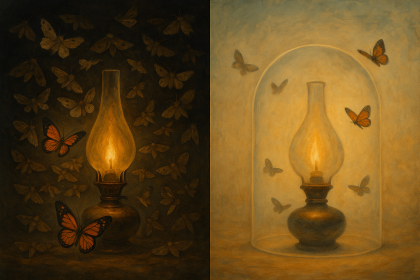
There is a certain kind of person who grows up believing that being good means being available, that being loving means being endlessly accommodating, and that being compassionate means leaving the door of the self permanently open. Such a person becomes, without quite realizing it, like a lamp in the night—warm, visible, inviting.
And like every lamp, they do not only attract those who are lost and need light. They also attract moths.
This is not a moral story about villains and victims. It is a human pattern. Wherever there is unguarded warmth, there will be those who come not to share it, but to live off it. Wherever there is light without discernment, there will be both gratitude and hunger.
Many sensitive, idealistic, or inwardly conscientious people discover this only after they have burned themselves for years.
Why Some People Grow Up Without Boundaries
Most people who struggle with boundaries did not choose that struggle. They were shaped into it.
Often, from a young age, they learned that being loved meant being useful, that being good meant not disappointing others, and that having needs of their own was somehow inconvenient or selfish. In such an atmosphere, the self learns to stay open, but not protected. It learns to give, but not to guard.
Sensitivity, empathy, and moral seriousness—beautiful qualities in themselves—can, without guidance, turn into a quiet form of self-erasure. The person does not think, “I have no boundaries.” They think, “This is what love looks like.”
The difference between being open-hearted and being unguarded is rarely taught. One is a strength. The other is an unprotected wound.
Why the Unguarded Attract the Wrong Kind of Attention
Human beings are extraordinarily sensitive to emotional signals, even when they are not consciously aware of it. Someone who over-gives, over-listens, and over-accommodates broadcasts something very specific into the world: “Here is a place where little resistance exists.”
This does not mean that everyone who comes close is malicious. But it does mean that those who are chronically hungry—emotionally, psychologically, or even existentially—will notice.
Some people do not know how to build their own inner light. They survive by borrowing, leaning, or feeding on the emotional energy of others. They are not always cruel. Often they are simply empty. But emptiness, when left unexamined, still consumes.
And so the moths come—not by accident, but by resonance.
The Hidden Cost of Living Without Limits
The cost of this way of living is rarely paid all at once. It is paid slowly, in exhaustion, in quiet resentment, in a growing sense of inner thinness.
At first, the person tells themselves they are just tired. Then they think they are unmotivated. Then, perhaps, they begin to suspect something deeper is wrong.
At some point, many have a painful moment of clarity: they realize that some of the people they have given the most to have also taken the most from them. Not always with cruelty. Not always consciously. But taken, nonetheless.
For some, this realization is not theoretical. It is personal. It is the moment when they see that their idea of love has been costing them their own center.
The Cultural Confusion About “Limitless Love”
This problem is not only personal. It is also cultural and, in a subtle way, spiritual.
Many of us grow up surrounded by the idea that real love has no limits, that goodness means endless giving, and that saying no is a moral failure. Saints and sages are often presented to us not as sovereign beings, but as endlessly available ones.
But this is a distortion. Mature spiritual traditions have always understood that wisdom includes discernment, that compassion includes clarity, and that not every door should be open to everyone.
Love that has no boundaries is not higher love. It is confused love. It may look noble, but it often ends in quiet self-destruction.
The First Reaction: Fear and Walls
When someone finally sees how much they have been giving away, the first response is rarely calm wisdom. It is usually fear.
Suddenly, the world looks dangerous. Motives look suspect. Every smile seems to hide an angle. Trust collapses, and in its place rises a defensive instinct: close the gates, build the walls, let no one in.
This phase is understandable. It is a nervous system learning to protect itself after a long period of exposure. But walls, while they can stop the bleeding, cannot become a way of life. They keep harm out, but they also keep life out.
The Mature Answer: Discernment Instead of Fear
The real solution is neither permanent openness nor permanent closure. It is discernment.
Discernment is the quiet intelligence that knows the difference between a guest and a trespasser, between a relationship and a drain, between generosity and self-betrayal. It does not shout. It does not panic. It simply sees.
Boundaries built from fear are rigid and brittle. Boundaries built from clarity are flexible and alive. They do not isolate. They filter.
What Healthy Boundaries Actually Are
Healthy boundaries are not acts of aggression. They are acts of self-respect.
Emotionally, they mean you do not carry feelings that are not yours to carry. Psychologically, they mean you do not take responsibility for other people’s inner work. Relationally, they mean you allow closeness without surrendering your center.
A boundary is simply the place where you end and another begins—and where both can exist without invasion.
The Inner Sanctuary
When boundaries become natural rather than forced, something subtle changes inside.
Life becomes quieter. Decisions become cleaner. There is less drama, less justification, less exhaustion. In its place appears a kind of inner room—a stable, private space where one’s own thoughts, values, and rhythms can exist without constant interference.
This is not withdrawal from life. It is the condition for meeting life without being consumed by it.
A Quiet Word to the Reader
If you recognize yourself in any of this, know that you do not need to become harder to become healthier. You need to become clearer.
You do not have to stop being kind. You only have to stop confusing kindness with availability. You do not have to stop loving. You only have to stop abandoning yourself in the name of love.
Let your light remain, but let it become stable rather than sacrificial. Let it warm, not burn you away.
That is not selfishness. It is maturity.
 Musings of a Warrior Buddha
Leave a comment