
It’s been raining in this Himalayan town for the past few days. Not the short, passing showers—but long, steady, silent rain. Sometimes it falls softly, like a whisper. Other times, it drums steadily on the roof above, on the leaves outside and on the quiet earth that always seems ready to receive.
I sit in the balcony most mornings, holding a cup of hot tea, wrapped in silence. All around me, the mountains disappear into the mist, and the world feels paused. The sound of rain fills the space—pure, endless, sacred. There is something about rain in the Himalayas—it doesn’t just fall, it descends. Like something ancient. It quiets the noise inside me. It invites me inward, into my true home.
And every time it rains like this, something in me stirs. Something wakes up. The rain doesn’t just water the hills—it waters memory.
The Rain of Childhood
I think my earliest memory of rain goes back to the house where I was born. It was a big old house, shared by three or four families. I must have been four or five years old then. That house had a courtyard where all the neighborhood kids would gather—dozens of us, wild and happy, with not a single care in the world.
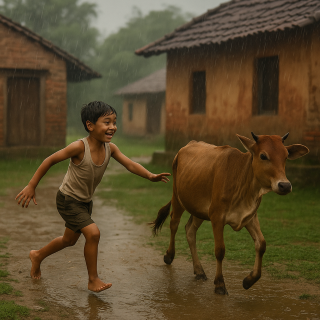
When it rained, we didn’t run for shelter. We ran into the rain. We danced, slipped, shouted, splashed water, and laughed until our stomachs hurt. Our clothes stuck to our bodies, our hair dripping, mud everywhere—but it didn’t matter. In fact, it made everything more fun.
I still remember this one time—it was raining hard, and for some reason, I was chasing a cow. I slipped, landed flat on the ground, completely soaked in mud. And of course, all the kids burst into laughter, teasing me for days after. But even that felt like joy. It was magic. It was all so alive.
Looking back, I realize: those moments weren’t just about rain. They were about belonging. About being held by a place, by people, by the joy of being young and wild.
That rain wasn’t just falling from the sky. It was falling into memory, into something I would carry with me forever.
The Rain of Awakening
I was around seventeen, just out of school, and caught in that familiar storm that so many of us face at that age—uncertainty, fear, a thousand questions about the future, and no real answers. I didn’t know what I wanted to do, who I wanted to become, or how I would ever find my way in the world. Deep down, I think I was just scared—of failing, of staying stuck, of not being able to fulfill my dreams.
One afternoon, during the monsoon, I remember sitting alone while it rained outside. I don’t know how long I sat there—maybe an hour, maybe two. I wasn’t doing anything. I wasn’t even thinking in words. I was just… there. Watching the rain fall. Listening to it. Something about that moment slowed everything down.
And then, in that moment, something shifted.
It felt like I wasn’t alone. Like there was someone else inside me—quiet, calm, steady. A voice that didn’t speak in sentences, but in knowing. And I felt as if I was talking to him. And in that conversation, without words, something changed in me.
That rain didn’t just soak my body—it marked a transition. From boyhood into something else. Maybe not a full man yet, but someone who had at least begun the journey inward. Someone who knew he had to find his own way, no matter how unclear the path was.
That day, the rain became more than water from the sky. It became divine presence. It became a mirror.
The Rain in the Himalayas
Of all the places I’ve lived, Himalayan rains have felt the most alive—and the most inward.
Here, during the monsoons, it rains almost continuously. The sky remains a soft shade of grey for days. Clouds drift across the hills like slow-moving thoughts. The mountains hide behind mist, as if guarding something sacred. The air feels thick with silence—not the absence of sound, but a silence that breathes.
There’s something meditative about it all. The rain becomes part of the rhythm, part of the space around you, and sometimes, part of your inner world too. After a while, it stops feeling like weather. It begins to feel like a quiet companion.
And in that presence, I often feel reminded of Lord Shiva.
In the place where I was born, the month of Shravan (around July)—when it rained the most—was dedicated to Shiva. I remember the sound of temple bells, people walking barefoot to offer water to the Shivling, the sky heavy with clouds. That memory has stayed with me.
But here, in this Himalayan town, it’s even more personal.
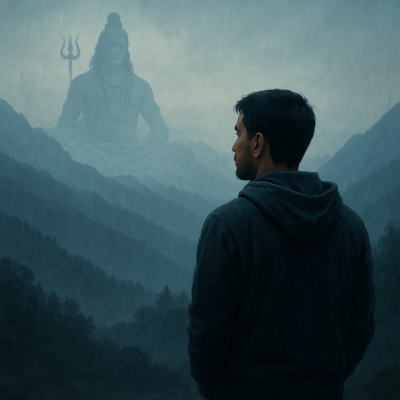
From my balcony, on clear days, I can see the snow-capped Himalayan peaks in the distance. And sometimes, when the clouds lift and the peaks appear—silent, ancient, untouched—I feel as though Shiva is sitting there. Meditating. Watching. Holding space for all of us.
It’s hard to explain. It’s not just a belief. It’s a presence I feel.
And on days when the mist is thick and the rain doesn’t stop, I imagine that Shiva is still up there meditating—in silence, in strength, in stillness. And that somehow, I am not so far away.
The rain, in those moments, becomes more than water. It becomes a blessing. A reminder. A conversation.
When It Rains, I Return
Over the years, the places have changed. The people have changed. Even I have changed. But one thing has stayed with me, like an old friend walking beside me through time—the rain.
It’s been with me in childhood joy, in teenage uncertainty, in Himalayan silence. It has played, questioned, and prayed with me. And maybe that’s why it feels so personal—because it’s been there through every version of me.
Sometimes it brings memories. Sometimes it brings silence. Sometimes it brings sadness—and somehow, even that feels like a gift.
I don’t think I’ll ever stop loving the rain. Not just for the way it smells or sounds or looks—but for the way it reminds me of myself. For the way it brings me home.
And maybe that’s what rain does best—not just water the earth, but water something inside us.
So whenever it rains—wherever I am—I close my eyes, take a breath, and return.
To the quiet, to the questions, to the gods. To the boy still dancing in courtyard puddles. To the man learning to kneel in mist.

 Musings of a Warrior Buddha
Leave a comment