
Rain in New York, Silence in the Himalayas
Some days, I sit in the silence of the Himalayas… while my heart roams New York. I watch those ASMR videos of someone walking through rain-washed streets — the neon lights flickering on the wet pavement — and something inside me longs to be there.
There’s something poetic in that contrast — like living in a Zen temple while watching a jazz club in motion.
It got me thinking.
What kind of life do I truly want to live?
If God appeared before me and asked — “Who would you like to be?”
Would I say Buddha, the silent sage? Or Howard Roark, the unyielding creator?
It’s a strange question, yet deeply honest.
Because both live inside me — the urge to be free from the world, and the urge to create something magnificent within it.
So this essay is my meditation on that paradox.
A conversation between two seemingly opposite energies.
Buddha, the inner silence.
Roark, the outer fire.
Let’s begin.
The Two Archetypes — A Brief Sketch
Buddha and Howard Roark are not just individuals.
They are archetypes — symbols of two extreme modes of being.
Buddha represents stillness, detachment, and inner freedom — a man who saw through the illusion of the world and chose renunciation.
Roark, the hero of Ayn Rand’s The Fountainhead, stands for passion, creation, and integrity — a man who lives not by society’s rules but by the truth of his own vision.
Both reject the herd.
Both are uncompromising in their pursuit of truth.
And yet, they walk opposite paths.
One turns inward, renouncing all desire.
The other dives headfirst into the world, building and shaping it from scratch.
One seeks to transcend the world.
The other seeks to transform it.
But is that the whole story?
What It Means to Be Roark
Many people haven’t heard of Howard Roark.
He’s not a saint, not a monk, not a philosopher.
He’s an architect — fictional, yes, but more real than many living men.
Roark doesn’t build to impress. He builds to express.
He is the embodiment of a soul that creates not for fame, not for wealth, not even for others — but simply because creation is truth.
His integrity is brutal. He would rather break than bend.
He walks alone, and never complains.
Roark doesn’t care what people think.
Not because he’s arrogant, but because he knows that truth doesn’t need permission.
Yet, Roark isn’t angry or rebellious. He is not at war with the world.
He simply refuses to lie.
In this, he reflects the essence of detachment — not from action, but from outcome.
He is passionate, but not needy.
He is fully present, but not enslaved.
If you look closely, you’ll see that Roark, too, has a kind of meditative clarity.
He may not sit under a tree in silence, but he’s detached from praise, from blame, from applause, from the herd.
In that sense, there’s a quiet Buddha inside him too.
What It Means to Be Buddha
Everyone knows Buddha — the prince who walked away from palaces and pleasures to find inner truth.
He left everything behind: family, name, status, ambition.
But he didn’t escape the world — he understood it.
And once he attained enlightenment, he didn’t disappear into silence.
He came back — to share, to teach, to heal.
Buddha is not passivity.
He is clarity.
He is the courage to see things as they are, and the strength to let go of what no longer serves truth.
His renunciation isn’t nihilism — it is freedom from illusion.
Yet, even in his detachment, there is an immense love — vast and universal.
Buddha didn’t build monuments.
He built inner space — vast, silent, eternal.
And that I think, is the ultimate creation.
The Paradox — Can They Coexist?
Now we arrive at the real question.
Can Buddha and Roark live together — not in a book, but within us?
Is it possible to be still and passionate?
Silent and expressive?
Detached and creative?
At first, it seems impossible.
Buddha says: let go.
Roark says: build it, even if the world burns.
Buddha watches the world dissolve like a dream.
Roark molds that dream into steel and stone.
And yet, deep down, don’t we carry both voices?
This paradox is not just philosophical.
It is deeply human.
Most people avoid it. They choose comfort over complexity.
And only a very few dare to hold both.
And that is where transformation begins.
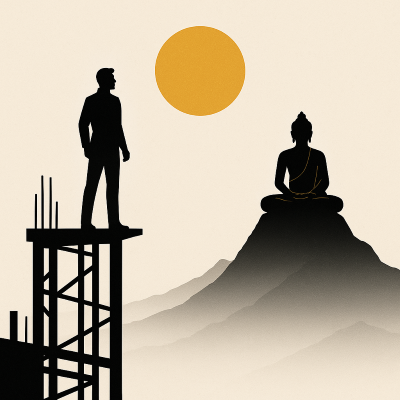
The Way Out — Integration, Not Division
What if the answer is not choosing one… but integrating both?
To try to be like Roark without the depth of Buddha is to burn without clarity.
To try to be like Buddha without Roark’s fire is to see the truth but never give it form.
But neither Buddha nor Roark were incomplete.
They had already integrated what we struggle to separate.
It is we, the seekers, who must evolve toward their wholeness.
That’s the invitation.
That’s the path.
To be in the world — but not of it.
To create with fire — but not burn ourselves.
To love deeply — but never beg.
To walk alone — and yet feel one with all.
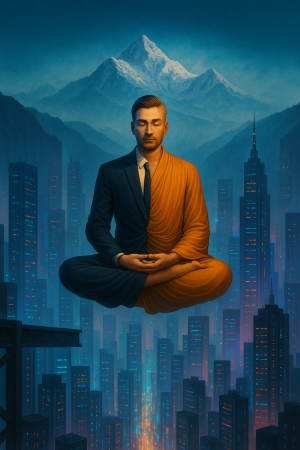
This is the Roark-Buddha within.
And maybe, just maybe…
This is who we were meant to become.
Closing Note to the Reader
To those of you who have always felt split —
Between detachment and passion,
Between being spiritual and being ambitious,
Between loving the world and feeling alien in it —
You are not lost.
You are just being forged.
And your task is not to reject one side —
But to integrate both:
The stillness of the Buddha
With the fire of Roark.
This is not an easy life.
But it is a true one.
 Musings of a Warrior Buddha
Leave a comment