
In every era, humanity has given birth to brilliant minds—writers, philosophers, and truth-seekers whose ideas could shake the very foundations of society. Yet, a strange phenomenon persists across time: these individuals are often ignored, ridiculed, or misunderstood in their own lifetimes. We celebrate them decades or centuries later, but rarely when they’re alive and struggling to be heard.
There’s a strange loneliness in being a thinker in the modern world—a kind of ache that doesn’t come from isolation, but from invisibility. You speak, you write, you share pieces of your soul, hoping that someone out there will hear the heartbeat between your words. And yet, often, the silence is deafening.
You begin to wonder—Is it me? Am I too intense, too reflective, too serious for this world of scrolling thumbs and instant dopamine? But then history whispers something different: You are not alone.
The world has always struggled to recognize the revolutionary thinkers while they’re still alive. But here’s the irony—decades or centuries later, those same voices become sacred. Quoted. Worshipped. Turned into memes, tattoos, and temple statues. The same world that once silenced them now finds solace in their wisdom.
And this piece is about them. About the deep thinkers, the storytellers, the philosophers, the ones who carry the flame and walk through darkness—not for applause, but because their inner light refuses to die out.
This is a reflection on that silence. A meditation on the ignored contemporaries—the modern philosophers.
1. Why We Ignore Our Own
There’s something deeply human about dismissing the person next door. We tend to measure credibility through distance—geographical, historical, or social. If a person lives in our time, speaks our language, and walks our streets, we often think: “What makes them so special? I’ve lived life too. I’ve suffered too. Who are they to speak as if they know more?”
The modern philosopher becomes uncomfortable company. Their words make people reflect, question, and often confront uncomfortable truths. For many, this doesn’t inspire admiration—it evokes defensiveness. They feel as if the thinker is trying to be “superior,” even when that’s not the case.
So they mock. Or they ignore. Or they ask for proof.
“Where did you get this idea from?”
“Is this from a book or research paper?”
“Who else has said this before?”
In a world obsessed with references and credentials, originality becomes suspicious. And the philosopher is left standing with their raw, unpolished truth—unsupported, unendorsed, but deeply real.
2. Historical Echoes: Socrates, Kafka, Osho, Rand…
This isn’t new. It’s a pattern etched in time.
Socrates was executed by the very society he tried to awaken. Kafka died largely unknown, his genius recognized only posthumously. Osho, one of the most radical mystics of the modern age, was vilified more than understood. Ayn Rand was condemned as arrogant and extreme, even while building one of the most influential philosophical movements of the 20th century.
All of them were called controversial. And yet, their words now echo in libraries, universities, and conversations across the world. Time gave them a hearing. But during their lifetimes, it gave them resistance.
3. Why It Happens: Society’s Psychological Armor
At its core, this rejection stems from a deep discomfort with disruption. Modern philosophers are not entertainers. They don’t provide escape; they provide mirrors. And mirrors can be threatening.
Most people live in routines built around survival, comfort, and social acceptance. Philosophers—by nature—question these routines. They ask: What are we doing? Why? Is this enough? In doing so, they unintentionally expose the hollowness of certain societal beliefs, careers, and even identities.
So people push back. Not because the thinker is wrong, but because the truth feels dangerous.
It’s not just society. It’s also psychology. We are more likely to trust someone endorsed by the majority or someone long gone, whose presence doesn’t threaten our current worldview.
⚡Dead philosophers are safe. Living ones are inconvenient.
4. The Inner Conflict of the Modern Philosopher
It’s one thing to be rejected by the world. It’s another to carry a truth so heavy, so luminous, that you often wonder if you were meant to carry it at all.
The modern philosopher doesn’t ask for attention. In fact, they often crave silence more than applause. But what makes it painful is not the absence of fame or followers—it’s the absence of resonance. The silence of disconnection. The feeling of speaking a language few understand.
There’s an ache in realizing that your insights, born from solitude and scars, often fall on ears too distracted to hear. That which cost you a decade of inner war is often skimmed through in ten seconds by someone scrolling between reels.
And yet, you keep sharing. Why?
Because the modern philosophers don’t speak for applause. They speak to relieve the burden of their own illumination. They write, speak, create—not to convince the world, but to stay sane within it. Each word released is a release within. Each insight shared is a step toward peace.
Still, there are days when doubt creeps in. Days when you wonder if your voice is just a whisper in a loud, indifferent world. If maybe you should stop feeling so deeply, thinking so much, dissecting every thought and emotion until it bleeds truth.
But even on those days, there’s a silent knowing within—a flame that doesn’t beg for validation. A whisper that says, “This light was given to you for a reason. You don’t have to shine for the world. Just don’t let it go out.”
That’s the quiet resolve of the modern philosopher. To keep walking, even when no one claps. To keep burning, even in the dark.
Not because the world is watching—but because the soul is.
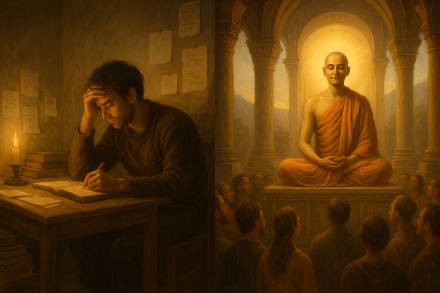
🌿Interlude: The Silence of the Awakened One
There’s an ancient story, told beautifully by Osho, about the days just after Siddhartha Gautama became the Buddha.
Having attained enlightenment under the Bodhi tree, he simply sat in silence. For days, he didn’t speak. Not because he was unsure—but because he knew. He knew that what he had touched was so deeply personal, so incomprehensible to the other minds, that any attempt to explain it would be futile. And those few who were already on the path—they didn’t need him; they would find their way, with or without a teacher.
And yet, the story goes, the gods themselves descended and pleaded with Buddha to speak. “Even if one soul,” they said, “even one, can hear a fragment of what you’ve seen—it will bring light to the world.”
So Buddha, with great reluctance and compassion, began to speak.
And so it is with many who carry the flame of insight—not driven by the hunger to teach, but by the quiet hope that someone, somewhere, is listening with the kind of ears that hear not just words, but the silence behind them.
5. Modern Platforms, Ancient Echoes
The internet has democratized expression—but not validation.
Millions share their thoughts online today, but recognition still follows old patterns. The louder voices win. Algorithms favor controversy over clarity. And nuanced thinkers get drowned out in the noise.
Still, many persist. They express their ideas that only a few read. They record videos that don’t go viral. They share insights without a following. And yet—they keep going. Because for them, the need to express is greater than the need to be seen.
6. A Grounded Tribute
So here’s to the modern philosophers—those who write without applause, think without permission, and speak truths that may never trend.
You are not wrong for being unseen. You are not foolish for sharing your vision. You are not alone.
Your work may not be on billboards or bestseller lists, but it might be etched quietly into the soul of someone, somewhere.
And that is more than enough.
So if you’re carrying a light no one sees yet—carry it anyway.

 Musings of a Warrior Buddha
Leave a comment