
Let me start with a little story.
Picture this: I’m logging into a Zoom call, all set to discuss a noble project promoting ancient Tibetan healing practices. It’s a brainstorming session with the founder of a prominent European company that deals with traditional medicine. I’m excited. I enter the call early. He joins. He smiles. I smile. He asks me what I do.
I say, “I’m a marketing consultant.”
And then—boom—the smirk. Not a big one, but just enough to say, “Ah, you’re one of those guys.”
You know the type. The spin doctors. The ad whisperers. The ones who slap a tagline on a rock and try to sell it as a wellness crystal.
I got the message loud and clear. Even in the gentle world of ancient healing, the moment the word marketing enters the room, eyebrows go up and judgments roll in.
That little smirk told me what the world often thinks of marketers: manipulators, tricksters, the smooth talkers pushing products nobody needs.
It stuck with me—not because I was offended (okay, maybe just a little), but because it revealed a much deeper issue:
Why does marketing have such a bad name?
The Case Against Marketers
Let’s be honest. The skepticism isn’t baseless. We’ve all seen the shady side:
- Ads that lie.
- Products that overpromise and underdeliver.
- The infamous “limited offer” that somehow never ends.
And yes, there are marketers who’ll sell you a leaky boat and throw in an umbrella as a bonus. But those are the exceptions—not the rule.
The truth is, marketing isn’t the villain. Bad marketing is. And bad marketing is just bad communication wrapped in glitter.
What Marketing Actually Is
At its heart, marketing is storytelling. It’s not just about selling; it’s about showing—showing the world what you’ve built, what you believe in, and why it matters.
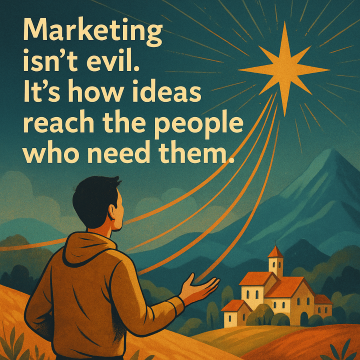
It’s the bridge between the creator and the customer. It’s how ideas travel, grow, and find the people who need them.
Take Tibetan medicine, for example. Without marketing, it would still be sitting in a remote monastery, untouched by the world.
What good is a treasure if no one knows it exists?
My Own Journey in Marketing
When I worked as a marketing consultant for an NGO, I loved it. It wasn’t about hard-selling or pushing things down people’s throats.
It was about raising awareness, crafting narratives, building trust.
Marketing, to me, was creativity in motion. Researching, learning, adapting. Finding ways to tell meaningful stories.
And yes—helping people discover ideas or products that could genuinely add value to their lives.
We often forget that even the greatest products can fail without visibility.
And no amount of marketing can save a bad product.
Eventually, the truth comes out. Word of mouth always wins.
A Funny Incident (Starring an AI Tool)
Here’s another little story.
I was testing how my website looked to a new user by opening it in incognito mode. Just experimenting.
I casually asked this to an AI tool to give its feedback.
The tool replied something like: “Focus on your content, not marketing.”
There it was again—that subtle shade. That lingering idea that if you’re thinking like a marketer, you’re somehow being disingenuous.
But here’s the thing:
Even the best literary piece in the world needs a nudge, a whisper, a spotlight.
If you don’t market your work, it stays hidden—like a wallflower at a party, quietly hoping someone notices.
Steve Jobs Was a Marketer Too
Let’s go bigger. Steve Jobs—the icon, the visionary—was he not a marketer?
He didn’t invent the MP3 player.
But he made people feel something about the iPod. He made them believe.
Marketing was how he changed culture.
You can build the most beautiful product, write the most brilliant book, or offer the most life-changing service—
But if no one hears about it, it’s as good as invisible.
So Why the Hate?
Because bad marketing is loud. It’s everywhere. And it has made people cynical.
But that doesn’t mean we throw the baby out with the bathwater.
You don’t judge all teachers by one bad teacher, or all doctors by one misdiagnosis. Why judge marketing by its worst examples?
My Final Word: Marketing Isn’t the Enemy
If you’ve ever shared a blog post you loved, recommended a book to a friend, or posted about a project you’re proud of—guess what?
You were marketing.
Marketing is human. It’s connection. It’s belief in motion.
Yes, some marketers lie. Some manipulate.
But that’s a human problem—not a marketing problem.
Marketing isn’t evil. It’s just a tool.
And like all tools, it depends on the hands that wield it.
If we can learn to use it with honesty, creativity, and heart—marketing can move the world.

 Musings of a Warrior Buddha
Leave a comment