
Introduction:
We live in a world where masks are the norm—not the exception. Emotional masks, social masks, professional masks. People wear them to survive, to belong, to manipulate, to be accepted, to avoid pain. Somewhere along the line, we stopped questioning whether these masks were necessary, and started believing they were natural.
But what happens when someone walks into this world—without one?
What happens to a soul that refuses to pretend?
We often cheer for such characters in films and stories. We admire their courage. We clap for them when they fight injustice or speak the truth, even at personal cost. But in real life, when such individuals appear before us, something else happens—resentment, discomfort, and often, hate. The heroes we cheer for on screen are often crucified in real life.
This essay is for those rare souls—for the unmasked ones—and for those trying to understand them.
Why Does Society Thrive on Masks?
Masks serve a function. They help people navigate the chaos of society without getting hurt. They offer protection, comfort, and control. When you smile while breaking inside, you’re wearing a mask. When you play agreeable at a toxic job, you’re wearing one. When you laugh in crowds but feel hollow alone, you’re in costume.
Society thrives on this masking because truth is unsettling. A real face—vulnerable, raw, unpredictable—is too much. It shakes the comfort zones. The system prefers predictability over authenticity, conformity over honesty.
That’s why we’re trained early—by parents, teachers, workplaces—to adapt, adjust, and “fit in.” The price of truth? Rejection. The reward of masks? Acceptance, at least on the surface.
So masking becomes a survival mechanism. And over time, most people forget they’re even wearing one.
Why Do People Choose to Stay Masked?
Because being unmasked is terrifying.
To be truly seen is to be vulnerable. And vulnerability in an indifferent or cruel world often leads to pain. Rejection, ridicule, betrayal, abandonment—these are the risks an unmasked life brings.
Most people sense this, consciously or unconsciously. So they compromise. They put on the ‘right’ smile, follow the ‘safe’ opinions, and live lives that look good from the outside. It’s not that they’re weak—it’s that the cost of truth feels too high.
Also, many people don’t even know they’re masked. The mask becomes their face. Their identities are so entwined with social roles, expectations, and borrowed beliefs that the idea of a separate, authentic self feels abstract—if not threatening.
So they stay masked. They call it “maturity” or “practicality” or “being realistic.” But deep down, there’s a quiet loss. A self that was never lived. A truth that was never spoken.
The Art of Conscious Masking
There is a difference between hiding who you are and protecting who you are. Not every situation deserves your naked truth. Sometimes, choosing a mask is not dishonesty — it’s wisdom.
The unmasked one doesn’t have to bleed everywhere. They learn to reveal themselves where their soul is safe. They aren’t pretending to be someone else — they are simply shielding who they really are from those who won’t honour it.
A wise soul does not scream authenticity into deaf ears.
They decide where to shine and where to stay guarded.
Because boundaries are not masks — but sometimes, they look similar from the outside.
What Happens When Someone Comes Without a Mask?
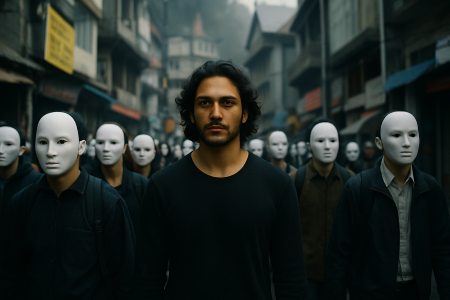
When a real face enters a world full of masks, it’s like a candle in a room of darkness—it lights up, but it also exposes. People get uncomfortable. The light isn’t always welcome.
The unmasked one becomes a mirror. And most people don’t want to see what’s beneath their surface. So the truth-teller, the unmasked soul, often ends up being feared, mocked, or ostracized.
They are called “too intense,” “too sensitive,” “too idealistic,” or even “crazy.” Because they disturb the game. They don’t play along. And their refusal to pretend becomes a threat to those whose lives depend on pretending.
Even history shows this. Socrates was poisoned. Buddha was opposed. Jesus was crucified. They were light—and light is painful to unprepared eyes.
The same happens today. A truthful soul faces resistance—not just from systems, but from friends, families, and even strangers. Because authenticity demands others to face their own masks. And not everyone is ready for that.
What Becomes of the Unmasked Ones?
Most of the time? Loneliness.
The unmasked walk through a world that doesn’t understand them. They speak truths that unsettle. They love deeply but are rarely loved back with the same purity. They often feel alien—like old souls in a distracted world.
Sometimes, they break. The pressure to conform, to not be alone, gets too much.
Yet even in those moments of breaking, something in them refuses to die. They carry a quiet knowing that truth is never lonely forever. Sooner or later, the unmasked find other unmasked souls — through a book, a moment, a conversation, or a single look of recognition. And when that happens, the loneliness that once felt like a curse becomes the very reason they can love with such depth.
Others find quiet solitude. They build inner worlds, rich with meaning. They walk with nature, books, art, or silence as companions. They don’t always find “their people,” because such souls are few. And even finding one true soul in a lifetime—someone who sees and accepts you fully—is rare. It’s a blessing, not a guarantee. So the unmasked must not wait or hope for it. They must learn to stand alone if needed.
But there’s also power in that path.
Because the unmasked don’t live half-lives. They know who they are. They feel everything, but they do not hide. They may bleed often—but they do not bleed in vain. Their suffering is not meaningless. It births depth, wisdom, and sometimes, quiet radiance.
So What Should the Unmasked Do?
First: Accept the loneliness. Don’t fight it. Don’t fear it. Know that you are not alone in being alone. Every truthful soul walks this path, across time and continents.
Second: Don’t dim your light just because others are afraid of it. You don’t need to shout your truth, but don’t suffocate it either. Let it shine in your art, your silence, your actions.
Third: Stop seeking to be understood. Most won’t get you. Not because you’re wrong, but because they’re not ready. You are not here to convince; you’re here to be.
Fourth: If love comes, accept it. But never beg for it. If someone sees you fully and still stays, let that be a blessing, not an expectation.
And finally: Live anyway. Even if the world ignores you. Even if no one claps. Even if your truth costs you everything—live it. Because at the end of the day, all the masks will rot. Only the real will remain.
Final Note:
To the unmasked ones: I see you.
To the masked ones: May you one day meet your own face—and not look away.
 Musings of a Warrior Buddha
Leave a comment