
Buddha As the World Knows
When the world hears the name Buddha, an image often comes to mind—serene, cross-legged, eyes half-closed in deep meditation. A symbol of peace. Of silence. Of transcendence.
But Buddha was never just a statue or an icon on a prayer shelf. He was a spiritual anarchist. His journey is an act of rebellion against unconscious living. At a time when society was tangled in rituals, caste, and blind authority, he broke away. He turned inward, pondered on all the questions that matter, and emerged with a clarity that would ripple across millennia.
He taught no dogma. Offered no promise of heaven. He simply said: “Look within. Suffering exists—but so does the path to end it.” That quiet declaration changed everything.
To the world, he is the Enlightened One. The founder of a path that emphasizes awareness, compassion, and self-mastery. From Japanese Zen gardens to Tibetan monasteries, his essence pulses in different forms—but the core remains unchanged: liberation through inner clarity.
That’s the Buddha history remembers. The Buddha the world bows to.
But the Buddha I met was different.
The Child I Recognized
The first time I heard the name Buddha, I didn’t imagine a serene monk draped in robes or a statue seated in stillness. No. My first image of Buddha was as a young boy named Siddhartha.
I must have been 7 or 8 years old. And I read this poem in my Hindi textbook. It was simple, tender—a conversation between a young Rahul and his mother, Yashodhara. Rahul, the son of Siddhartha—now the Buddha—asks his mother to tell him a story. And Yashodhara, instead of bitterness or grief, shares with him a memory. Not of the Enlightened One… but of Siddhartha, the boy.
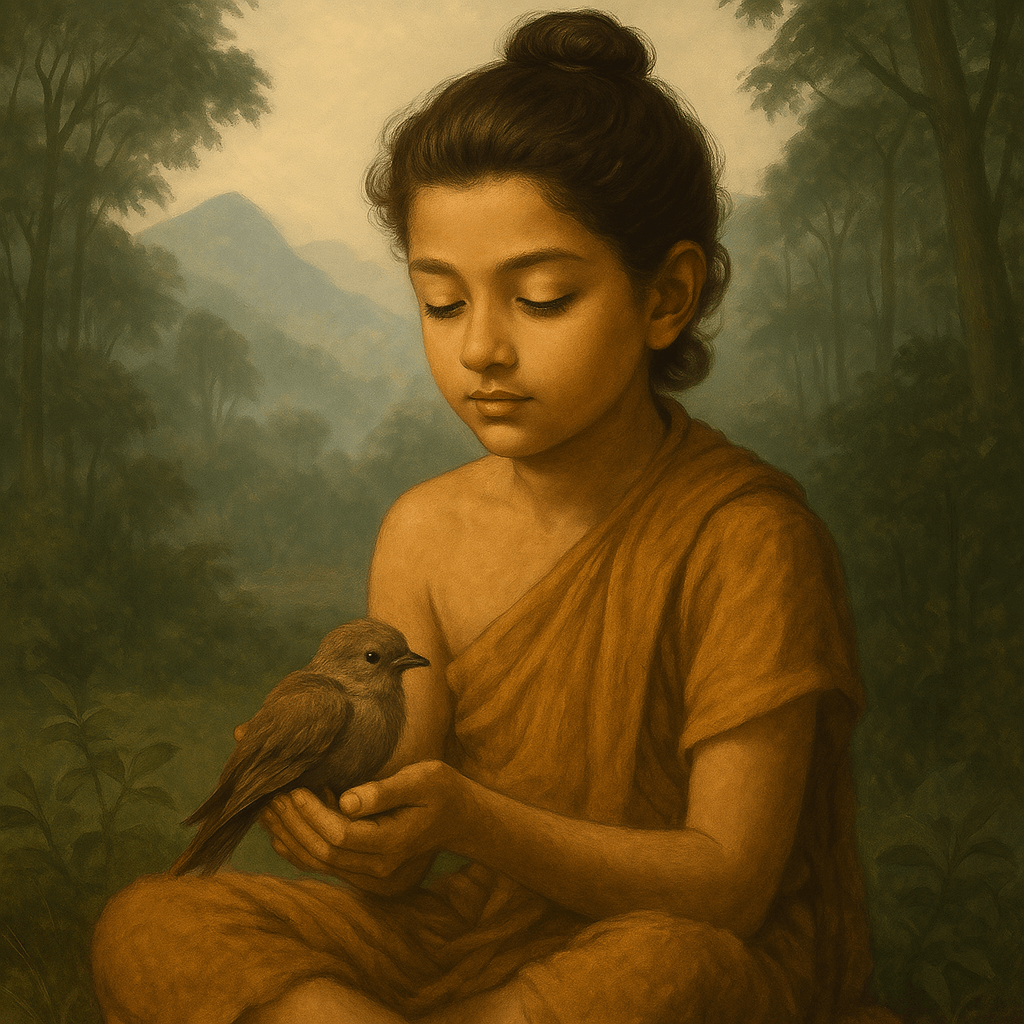
In the story, a bird injured by an arrow falls to the ground. Siddhartha finds it, cradles it in his hands, and tends to its wounds. His cousin, Devadatta—the one who shot the arrow—claims the bird as his. But Siddhartha refuses. He says, “This bird belongs to the one who saves it, not the one who tries to kill it.”
That image stuck with me.
Not the Sage under the Bodhi Tree. Not the Enlightened One. Just a boy—gentle, brave, and kind. A boy who chose compassion over power. That was the first Buddha I ever met. And perhaps that is why, even today, I don’t relate to him as a distant, divine figure—but as someone I’ve known all my life. Like a brother. Like a friend.
Beyond the Monasteries
Living in the Himalayas, I’m surrounded by the imagery of Buddhism—monasteries, monks, prayer wheels, and chants. It’s beautiful. But I must confess: my deepest moments with Buddha don’t happen in temples.
They happen in my room. In my thoughts.
When I walk alone through pine forests or sit on a rock, gazing at the mountains…
That’s when I feel him most—not as an icon, but as an old friend.
Buddha, to me, is not a symbol of escape. He’s a reminder of return.
A return to stillness. To clarity. To myself.
And what draws me to him more than anything is his humanity. His journey wasn’t about becoming divine—it was about understanding suffering, looking it in the eye, and walking through it with awareness. No shortcuts. No magic. Just truth, and the courage to face it.
The Magadha Within Me
There’s another layer to this connection—one that goes beyond stories and teachings.
I come from Bihar. From the ancient land of Magadha, where Buddha walked, sat, taught, and awakened. The dust of Bodh Gaya, the whispers of Nalanda, the silence of Rajgir—it’s all part of my spiritual DNA. And I can’t help but feel that his presence is ancestral for me. He isn’t just a historical figure. He’s a part of my soil. My psyche.
Even though I now live far from Magadha, I carry that geography within me. Perhaps that’s why my connection feels more personal, more visceral. Maybe it’s in the blood. Maybe in the bones. I don’t know. But I do know this—I don’t have to travel to a stupa to find him.
He finds me. In the stillness. In the seeking. In the silence.
The Buddha Who Walks With Me
I don’t remember a specific moment when I chose Buddha. It feels more like he has always been walking beside me—quiet, patient, smiling in that gentle way only he can. I never had to chant his name or sit before a shrine to feel close to him. He’s simply… there.
Sometimes in my solitude. Sometimes in my struggles. Sometimes in the quiet joy of watching a sunrise or the ache of searching for meaning in a chaotic world.
Over the years, I’ve realized that Buddha doesn’t demand belief. He doesn’t even ask for devotion. All he offers is a presence—a stillness. An invitation to look within, to understand rather than judge, to listen rather than speak, to walk rather than rush.
In that sense, he’s not just a figure of the past. He’s my present. My inner compass. And at times, my companion when the world feels too loud or too heavy.
For me, Buddha isn’t about renunciation. He is about returning—to myself. Again and again. With more awareness, more compassion, and more clarity.
And maybe that’s the point of it all. That he never really left us. He simply disappeared into silence. So we could learn to hear our own.
And You?
So this is who Buddha is to me—not a distant icon on a pedestal, but a presence that walks quietly beside me.
Now I wonder…
Who is Buddha to you?
 Musings of a Warrior Buddha
Leave a comment