
The Lightbearer Returns to the Cave
“No man lights a lamp and hides it under a basket, but puts it on a stand, so that those who enter may see the light.”
— Luke 11:33
There comes a time in the journey of a select few Lightbearers when they feel compelled to return to the shadows they once escaped. As discussed in the previous chapter, not everyone who escapes the cave looks back. Some chose to remain in the sun forever. But there are a few—very few—who turn around and step back into the darkness. Thus begins the painful journey of re-entering the world they once outgrew.
This is the story of the lightbearer who returns.
Why the Lightbearer Returns
Not all who escape return. So why do some come back?
The answer lies beyond logic—it’s a divine calling. A whisper from the soul. A deep, inner knowing that their purpose isn’t just to be free, but to help others awaken. They return not because they have to, but because they cannot not return. He returns for himself.
There’s also empathy and love for fellow seekers. The lightbearer remembers the pain, the confusion, the long crawl through that narrow tunnel of uncertainty. He knows there are others still stuck—others who are seeking but don’t know what they’re seeking. He returns for them.
Then there are the rare ones—Jesus, Buddha, Socrates—whose light is too fierce to contain. Their very being demands to share. Their return is not a decision; it’s a divine compulsion. Even silence becomes unbearable.
And sometimes, the Lightbearer returns not to preach, but simply to be—to let his life, his story, and his presence become a silent beacon for those ready to see.
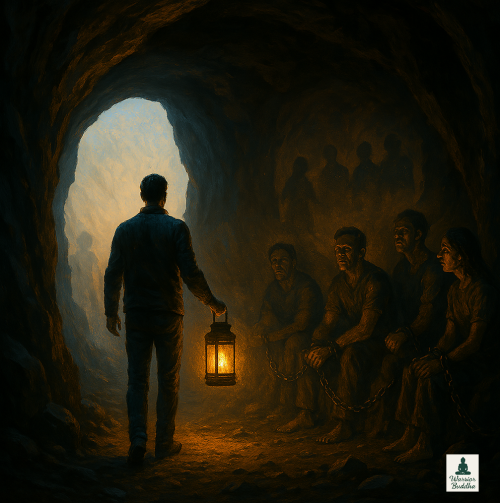
The Lightbearer returns…
Fumbling in the Dark
When the lightbearer re-enters the cave, something strange happens—he stumbles. His eyes, once accustomed to the brilliance of the sun, take time to adjust to the murky shadows of the cave. To those still chained inside, this makes him appear disoriented, weak, even blind. They mock him, not realizing that his clumsiness isn’t because he can’t see—it’s because he sees too much and too clearly.
He no longer speaks their language. He doesn’t know where to begin or how to explain what he has seen. His words seem foreign, poetic, often incoherent to ears trained only in shadow-speak. His presence itself becomes unsettling—an anomaly that disturbs the carefully maintained facade. Even his silence is loud.
Now that he’s returned, he sees the cave in a new light—its structure, its illusion, and most tragically, the chains that are mostly self-imposed. The people cling to their comfort and stability, no matter how false. They’ve known this darkness their whole lives. To them, anything beyond the cave is madness.
When He Speaks
But speaking truth in a world of illusion is not welcomed – it is dangerous.
The moment the lightbearer starts to speak of what he saw outside the cave, the masses turn on him. He is a soul who has seen the sky, whispering of stars to those who’ve never looked up. His words sound like fairy tales. He speaks a truth no one understands. His vision feels like threat. His very presence disrupts the manufactured peace of the cave.
The Lightbearer becomes a mirror the masses cannot bear to look into. In his presence, their illusions tremble. He reflects their unspoken fears, the compromises they’ve made, their lack of courage, and the comfort they’ve mistaken for truth. His very being unsettles them—not because he attacks, but because he reveals. And so, for many, it’s easier to shatter the mirror than confront what it reflects.
This has happened throughout history. Socrates was poisoned. Jesus was crucified. Gandhi was assassinated. Truth has always been a threat to those invested in shadows.
The puppet masters—those who profit from the illusion—view the lightbearer not as a messenger, but as a threat. Whether they are religious gurus, political demagogues, or corporate moguls, they cannot afford someone who exposes the strings. So they twist his message, mock his voice, or turn the masses against him.
To the cave-dwellers, he becomes the enemy—not because he’s wrong, but because he’s right too soon.
The Few Who Understand
Yet, for a few—the lightbearer is a savior.
Among the crowd, there are always a few—restless hearts, quiet seekers—who feel something stir in the presence of a Lightbearer. For them, his voice is not noise but a divine whisper. His words strike a chord they didn’t know existed.
The Lightbearer doesn’t offer salvation. He doesn’t hand out answers or walk the path for anyone. He simply shares his story—the pain, the doubt, the struggle, and the climb toward the sun. In doing so, he becomes a compass, not a crutch. Each seeker must walk their own path—but in his presence, they remember which way is forward.
And often, he doesn’t even need to speak. His being is the message. His presence radiates something that words cannot carry—hope.
He becomes a living possibility.
The Price He Pays
But make no mistake – this return is not without cost.
The lightbearer pays dearly. Sometimes with his voice, sometimes with his peace, and sometimes with his life. Like Jesus, who knew the price and walked into it willingly. Like Buddha, who was mocked before he was revered. The world often crucifies its teachers before it worships them.
But for the lightbearer, fear, rejection, and even death have lost their grip. He has seen his true home — beyond form, beyond fear. And thus, he is free even in the cave. Life and death are no longer ultimatums. He says what must be said, and entrusts the unfolding to something far greater than himself.
In the Next Chapter…
So far, we have followed the Lightbearer’s journey. But now it’s time to turn our gaze toward the cave itself.
In the next chapter, we will explore the structure of the cave—its walls, its chains, and the puppet show that keeps the masses entranced. We will also examine the complex relationship between the masses and the puppet masters. Do the cave dwellers unknowingly sustain their own captivity? Do the puppet masters require the consent of the masses to maintain their power? We’ll dive deep into the psychology of the masses, the strategy of the puppet masters, and why truth is so fiercely resisted.
Because before one can break free, one must understand what holds them captive.
One day, the lightbearer will walk past you—maybe not in robes, maybe not quoting scripture—but glowing with something rare. When he does, how will you respond? Will you reject the mirror he holds… or will you dare to look?

 Musings of a Warrior Buddha
Leave a comment