
There is a quiet tension that I have come to recognize within myself—and over time, I have started to see it in almost everyone.
A pull between two very different ways of being.
On some days, there is an impulse to act — to speak up, to confront, to protect, to draw boundaries. There is a part of us that does not want to remain silent when something feels wrong.
On other days, there is a very different impulse — to pause, to observe, to soften, to understand. A part that resists immediate reaction, that senses the value of awareness and inner steadiness.
These two forces often feel opposed. And yet, both are deeply human.
This inner tension is what the idea of the Warrior Buddha points toward.
The warrior aspect represents our capacity for agency. It is the part that refuses to collapse into fear or compliance. It allows us to say no, to stand our ground, to protect what matters.
I’ve seen how necessary this part is. Without it, we start knowing what feels right—but lack the strength to act on it.
At the same time, the warrior carries a shadow.
When strength is not guided by awareness, it turns into reactivity. Courage becomes aggression. Honesty becomes an excuse to wound. Action happens faster than understanding.
I’ve seen this too—how easy it is to justify reaction in the name of truth.
The Buddha aspect represents something equally essential. It is the capacity to observe rather than immediately react. To notice emotions without being ruled by them. To step back, breathe, and see more clearly.
There is a certain peace in this. A quiet clarity that changes how we respond to life.
But stillness also has its shadow.
Awareness can quietly turn into avoidance. Silence can hide fear. Detachment can become a way of escaping responsibility.
At times, what looks like peace is actually withdrawal.
Most of our inner struggle does not come from having these two forces—but from identifying with only one.
Some people live almost entirely from the warrior. Life becomes a series of battles.
Others drift into passivity—mistaking non-reaction for wisdom, and withdrawal for peace.
The tension exists because life demands both.
There are moments that require restraint and understanding, and moments that require firmness and action.
Truth needs courage.
But courage without awareness easily becomes harm.
Compassion needs understanding.
But understanding without strength collapses into silence.
The idea of the Warrior Buddha is not about balance as a permanent state.
It is about discernment.
The ability to sense what a moment is asking of us.
Sometimes the most conscious act is to remain still.
Sometimes it is to speak, even when it is uncomfortable.
Sometimes restraint is wisdom.
Sometimes restraint is fear.
The work lies in learning to tell the difference.
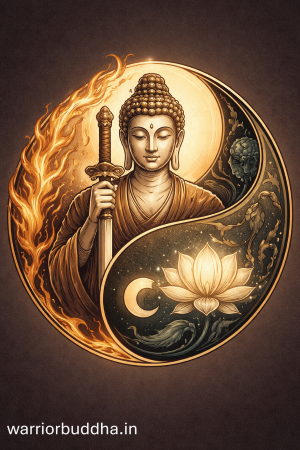
In everyday life, this tension appears quietly—in relationships, in conflict, in conversations we avoid, and in words we speak too quickly.
It shows up when we are torn between defending ourselves and trying to understand another.
Between reacting from habit and responding with awareness.
The Warrior Buddha does not resolve this tension once and for all.
It asks us to stay attentive to it.
Strength guided by clarity.
Stillness that does not collapse into passivity.
Not the absence of inner conflict—
but a more conscious relationship with it.
Most of us are not lacking courage or awareness.
We are learning when each is needed.
And that learning, moment by moment, is the path this idea quietly points toward.
 Musings of a Warrior Buddha
Leave a comment