
The Lightbearer’s Journey Beyond the Cave
In the first part of this series, we stepped into Plato’s cave – a dark and suffocating space where prisoners mistook shadows for reality. Most remain there for life. But not all.
One soul stirs. One prisoner breaks free. He turns away from the familiar shadows and begins the agonizing ascent toward the light.
In this chapter, we meet him – the Lightbearer.
Who is he?
Why does he break free while the others remain?
And what gives him the courage to step toward the unknown?
Let us walk with him — not triumphantly, but hesitantly — toward the light.
1. Who Is the Lightbearer?
At first glance, he is just another prisoner. He is bound by the same chains, staring at the same wall, immersed in the same shadows. There is nothing outwardly special about him.
And yet, something within him refuses to rest.
It may appear as an unexplainable restlessness, a quiet resistance, or a persistent doubt. In spiritual terms, this could be called the Atman (soul) in Vedanta, the Buddha-nature in Mahayana Buddhism, or the Christ-consciousness in Christian mysticism—the innate divinity or higher self that pulls the individual toward truth.
He does not see the whole truth yet. He does not understand the cave in its entirety. But he carries within him a rare capacity — to reflect, to doubt, and to turn inward when others turn away.
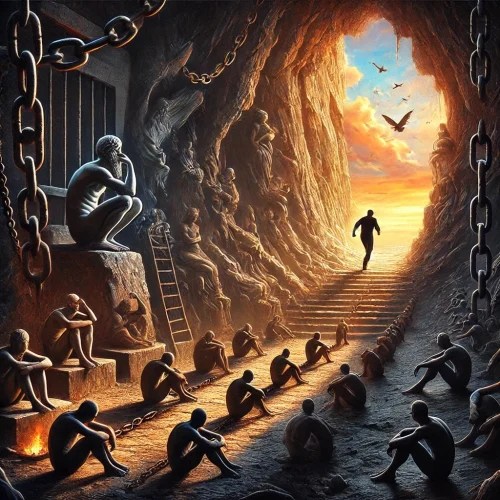
The Lightbearer is the one who dares to question.
While others accept the shadows as truth, he senses something is amiss. His dissatisfaction with illusion makes him restless. He may not fully understand what lies beyond the cave, but he feels — deep in his bones — that there must be more.
The Lightbearer exists. He is the seeker, the wanderer, the misfit. The one who feels suffocated by the artificiality of the world. The one who looks at the puppet show and whispers, “This cannot be all there is.”
In essence, he is a truth-seeker. Someone whose mind refuses to remain shackled, even if breaking free means suffering.
Echoes of the Lightbearer
We see reflections of this archetype across history and literature.
In Ayn Rand’s Anthem, Equality 7-2521 is born into a society where individuality is forbidden. From the beginning, he feels an inner dissonance — a sense that something vital is being denied. His curiosity becomes his crime, and his awakening forces him beyond the collective cave.
Siddhartha Gautama, the Buddha, walked away from his palace of gold to seek a truth no crown could offer.
Socrates questioned power, certainty, and inherited wisdom — and paid for it with his life.
Galileo defied the shadows of dogma, insisting that the Earth revolved around the Sun, despite the Church’s condemnation.
Malala Yousafzai refused to accept imposed darkness and was punished for seeking light.
Different eras. Different cultures. The same pattern.
The Lightbearer appears wherever illusion hardens into law — and someone refuses to comply.
2. Why Does the Lightbearer Escape the Cave?
If the cave represents ignorance, conformity, and illusion, then the Lightbearer is the one who decides he can no longer live in its darkness. But what compels him to break free when others remain shackled by the familiar?
🪷The Discomfort of Seeing Through Illusion
The Lightbearer is not someone who merely glimpses at the shadows – he begins to see through them. What once seemed real now appears hollow. The puppet show loses its spell, and the chains, once invisible, now cut into his skin. This disillusionment makes the cave unbearable.
When he tries to question the nature of the shadows or express doubt, the masses scoff at him. His questions are dismissed, and his restlessness is ridiculed. The cave’s rules are simple: don’t think, just obey.
But the Lightbearer has already thought too much. He knows too much. And knowing makes it impossible to stay.
🪷The Pain of Being Different
For the Lightbearer, the greatest suffering is no longer the chains –it is the alienation they bring. He no longer belongs among the prisoners. His questions disturb their comfort. His restlessness threatens their certainty. Difference, in the cave, is dangerous.
Like Siddhartha Gautama, who could no longer enjoy the pleasures of palace life after witnessing suffering, the Lightbearer cannot return to innocence. Comfort begins to feel like betrayal.
Truth isolates before it liberates.
🪷When Truth Matters More Than Comfort
For most prisoners, the familiar shadows are enough. They prefer certainty in ignorance over the uncertainty of seeking. But for the Lightbearer, the opposite is true. The mere possibility of truth, however painful or terrifying, becomes worth the risk.
He may not know what lies beyond the cave, but he knows he can no longer stay. The pain of remaining where he is now outweighs the fear of the unknown.
🪷When There Is No Other Choice
Sometimes, the Lightbearer is not merely drawn out — he is pushed.
When he challenges the illusion too openly, the system reacts. He is ridiculed, punished, exiled. The cave reveals its hostility.
Like Malala, forced to leave in order to live.
Like Equality 7-2521, cast out for daring to think.
Rejection becomes the final catalyst. Freedom begins where belonging ends.
3. How Does He Break Free?
The Lightbearer’s escape from the cave is not sudden. It is a slow, deliberate struggle—one that demands courage, persistence, and the willingness to shatter his own illusions. The cave has been his reality for so long that freedom feels alien.
He hesitates. He doubts. He considers turning back.
But something within him insists.
These forces may guide his liberation:
🔥The Spark of Inner Conviction
Before the Lightbearer moves outward, a battle unfolds within him. Something stirs – a faint but unyielding voice that makes him question everything around him. This inner conviction — though fragile at first — becomes his guiding flame.
He begins to see contradictions. The cave’s structure no longer feels absolute. Skepticism becomes his first act of freedom.
🔥Influences That Stir the Soul
Rarely does the Lightbearer walk alone.
Books, ideas, art, and stories act as cracks in the cave’s walls — letting faint beams of light slip through. The influence of those who escaped before him offers proof that freedom is not a myth.
These glimpses do not free him.
They remind him that freedom is possible.
🔥The Crucible of Solitude
The Lightbearer also finds strength in solitude. The cave is filled with noise – distractions, clamor, and voices that drown out his own thoughts. But in solitude, he can finally hear himself.
It is in the quiet where he confronts his fears and weaknesses. Alone, he stares into the unknown. At first, it terrifies him – the uncertainty, the void.
But over time, he learns that the void is a new beginning. It holds space for new truths, deeper insights, and inner resilience.
In solitude, he learns to listen to his own soul.
🔥The Courage to Choose Freedom
The Lightbearer knows the outside world may bring loneliness, suffering, and danger. He has no guarantee of peace or meaning.
And yet, he chooses to leave.
Not because he is fearless —
but because he refuses to live a lie.
He would rather be lost in truth than safe in illusion.
Next Chapter: The Lightbearer and the Sun
The Lightbearer has broken free — but freedom is not gentle.
The ascent toward the light brings disorientation, pain, and resistance. The truth does not arrive as comfort, but as fire.
In the next chapter, we will follow the Lightbearer beyond the cave — toward the sun that reveals reality, and demands a price few are prepared to pay.

 Musings of a Warrior Buddha
Leave a comment