
In the first part of this series, we saw how Santiago, a young shepherd, followed his dream leaving behind the comforts of his familiar life. His journey took him to a foreign land, where he lost everything, only to rebuild his life by working at a crystal shop. But deep within, he knew his journey wasn’t over. The call of his Personal Legend was still strong, and he had to make a choice: settle for security or step into the unknown once again.
At this moment, Santiago has another realization: “I can always go back to being a shepherd. But I may never get another chance to find my treasure.” He understands that stagnation is worse than failure and decides to continue on his journey. With the money he had earned, he sets off toward the desert. He joins a caravan that will take him to Egypt, where his dream had first pointed him. But this isn’t just a journey across the sands – it is a journey deep within himself.
Knowledge vs. Experience – The Englishman’s Lessons
On the caravan, Santiago meets an Englishman, a man obsessed with the study of alchemy. The Englishman seeks wisdom in books, searching for the elusive Philosopher’s Stone and the secrets of transformation. But Santiago believes in learning through experience. The contrast between them is striking – one relies on theories and ancient texts while the other puts his faith in intuition and lived experiences.
Yet, they both had something to learn from each other. The Englishman introduced Santiago to the idea that everything in the universe is interconnected – and that true alchemy isn’t just about transforming metals, but about the transformation of the human soul. And Santiago, in turn, reminded the Englishman that knowledge alone is not enough – one must live the lessons, not just read them.
When the Desert Spoke: Listening Beyond Words
As the caravan moves deeper into the desert, Santiago begins to notice patterns in nature. He observes how the wind moves the sand. He sees how the stars guide travelers at night. He listens to how animals sense danger before humans do. This is where he begins to understand a key idea in the book:
“Everything is connected. Everything in the universe has a language.”
When the caravan reaches an oasis, Santiago witnesses an unexpected omen. He sees a vision of an army attacking the tribes at the oasis. It is an impossible thought, yet deep within, he knows he must trust what he has seen.
Summoning all his courage, he approaches the tribal leaders and warns them of the impending attack. At first, they doubt him – after all, who is he but a young traveler? But wisdom listens where arrogance does not. They take his words seriously, and when the attack actually happens, Santiago’s vision saves the entire community.
This moment changes him. It proves that when we trust in ourselves and in the signs the universe gives us, we can tap into something greater. But what is this invisible force that speaks through omens and guides us toward our destiny? Santiago begins to sense that there’s a deeper energy at play – something that connects his personal journey to the wider universe. This is where Paulo Coelho introduces one of the most profound ideas in the book: The Soul of the World.
The Soul of the World
Paulo Coelho introduces the concept that there is a spiritual force that connects everything – humans, nature, dreams, and fate.
This force is called the Soul of the World (Alma del Mundo in Spanish). It’s similar to ideas found in various philosophies and religions – whether it’s Brahman in Hinduism, Tao in Taoism, or the Holy Spirit in Christianity.
✔ It is the spiritual energy that binds all things – living and non-living.
✔ It guides those who follow their Personal Legend (true destiny).
✔ It communicates through omens, dreams, and intuition.
To understand this force, we must observe, listen, and trust – just as Santiago did when he saw the omen. Think about those moments in life when everything seemed to align perfectly – when we met someone at the right time, found a book that answered our questions, or experienced an unexplainable synchronicity. Those are glimpses of the universe communicating with us. The more we tune into this, the more we move effortlessly toward our Personal Legend.
Love, Letting Go & The Meaning of Maktub
At the oasis, Santiago meets Fatima, a desert woman who captures his heart instantly. This moment introduces a new test: the choice between love and purpose. Many people, when they find something comfortable, stop their journey. Love, security, and peace can be tempting reasons to settle down.
But Fatima was different. She did not ask Santiago to stay. Instead, she encourages him to continue on his journey, knowing that if he is meant to return, he will. Unlike the love Santiago had imagined – one that binds, holds, and demands – Fatima’s love was different. She believed in Maktub, meaning “It is written.” She knew that true love doesn’t ask someone to stay, but gives them the strength to go. And if it is destined, they will cross their paths again.
This is a rare and beautiful kind of love – the kind that does not seek to possess but rather to support. It is a love that strengthens, not weakens.
This was a painful yet liberating realization for Santiago. He loved Fatima, but he knew his journey wasn’t over. And real love wouldn’t stop him from chasing his destiny – it would only make him stronger.
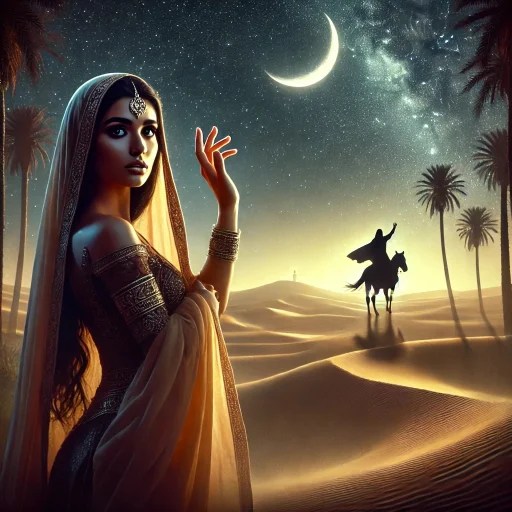
True Love sets you free…
Where Santiago’s Journey Leads Next…
As Santiago stood in the oasis, having witnessed an omen, having understood love in a new way, and having begun to hear the whispers of the universe, he didn’t yet know that his greatest test was yet to come.
Soon, he would meet the one man who would change his life forever – the Alchemist. And with him, he would face trials that would demand everything he had learned so far.
But before we move to that final chapter, let us ask ourselves – how often do we truly listen to the language of the universe? How often do we let fear hold us back from speaking up, from believing in our own visions? And most importantly, do we see love as possession, or as the freedom to rise?
The journey continues in Part 3…

 Musings of a Warrior Buddha
Leave a comment