
A few days ago, I came across a video on social media – a young girl in a movie theatre screaming hysterically while watching Chhava, a historical film based on the life of Sambhaji Maharaj. Her voice cracked from the intensity of her shouting, yet she didn’t stop. She looked possessed – swept up in a storm of emotion. And she wasn’t alone. Dozens of videos showed similar scenes: young boys and girls standing on seats, waving their hands in frenzied chants, some even in tears. The cinema looked less like a hall and more like a battleground.
I couldn’t help but wonder – what exactly was happening here? Were these people truly overcome with emotion? Or were they reacting to the collective hysteria around them? Was this a deep, individual connection with history, or were they unknowingly participants in a larger psychological phenomenon?
And more disturbingly – why does a film evoke such emotional intensity, while real-world crises like farmer suicides, rising unemployment, or the collapsing health and education infrastructure barely stir us?
The Rise of Mass Psychosis
What we’re witnessing, I believe, is the gradual rise of mass psychosis in India – a psychological state where critical thinking is suspended, and collective emotion becomes the dominant currency. While this isn’t exclusive to one nation or ideology, what makes it alarming is how mainstream and normalized it has become in our daily lives – cinemas, classrooms, rallies, WhatsApp groups, and primetime news. People are being conditioned to feel outrage, pride, or fear on demand, often without even knowing why.
Mass psychosis isn’t just about loud crowds or passionate slogans. It’s about a systematic breakdown of independent thought, where emotion is manipulated, and reaction is engineered. Fear, insecurity, social conditioning, and the suppression of dissent are its oxygen.
History has seen this before – Nazi Germany under Hitler, Stalinist Russia, Maoist China – entire populations swayed into fanaticism by ideology and propaganda. And while India’s context is different, the psychological mechanics are hauntingly similar.
Real Patriotism vs Manufactured Nationalism
Let’s be clear: not all emotional reactions are fake. Many Indians feel genuine pride in their history and culture. That’s natural, even beautiful.
But the problem arises when this pride is hijacked by political interests. When patriotism is reduced to performative loyalty. When films become substitutes for facts. When national identity is enforced, not chosen.
It’s not about whether we should love our country – it’s about how we are being taught to express that love.
The Machinery Behind the Madness
Here’s how the mass psychosis is being manufactured and sustained:
1. Distraction from Real Issues
When you’re screaming in a theatre or obsessed with a religious spectacle, you’re not asking questions about lack of jobs or rising fuel prices.
This is not new. In ancient Rome, emperors organized gladiator fights to keep the masses entertained while the empire crumbled. Today, it’s hyper-nationalist films, cricket, and media spectacles.
The Mahakumbh Mela stampede is a case in point. When chaos claimed lives, the tragedy was quickly buried under religious justifications. No real questions asked. No accountability demanded.
2. Fear of Being “Unpatriotic”
In today’s climate, to question is to be labelled a traitor. If you don’t clap at the cinema, you’re “anti-national.” If you criticize a policy, you’re “against Indian culture.” This weaponization of patriotism kills dissent – and democracy.
3. Herd Mentality
Humans are social creatures. When everyone’s chanting around you, it’s hard to be the lone silent one. And in the age of social media, herd behavior is viral – trending hashtags become moral compasses, no matter how absurd the direction.
4. The Role of Mainstream Media
The media’s job is to inform, educate, and question those in power. But many Indian news channels have become amplifiers of hysteria, pushing ideological agendas over truth. They manufacture outrage, vilify dissenters, and deflect attention from real issues.
5. Erosion of Critical Thinking
When education prioritizes rote learning over reasoning, citizens become easy to manipulate. They believe, repeat, obey – without reflection.
6. Deep Social Conditioning
From childhood, many are taught to revere, not to question. Whether it’s nationalism or religion, belief is drilled in as sacred and non-negotiable. In such a climate, the line between genuine emotion and engineered hysteria becomes dangerously thin.
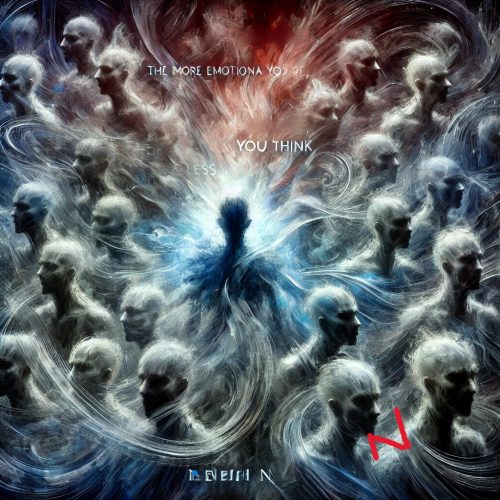
The more emotional you are, the less you think rationally…
Breaking the Cycle: Reclaiming Sanity
Mass psychosis is not permanent, but breaking free requires a conscious effort. Here’s what we can do to break this vicious cycle:
Question the Narrative: Whenever a major distraction appears – whether a historical film, a religious event, or a controversy – it’s important to ask: What real issue is being ignored right now? And more importantly, whenever we feel an intense emotional reaction – whether it’s patriotism, outrage, or fear – pause and ask: Who benefits from me feeling this way? Emotional manipulation thrives on blind reaction, but critical thinking weakens its power.
Encouraging Rational Discussions: People must be encouraged to debate ideas rather than just accept them. Passion is not a problem – but blind passion is. When discussing history, politics, or nationalism, it is essential to allow room for different perspectives.
Encourage Critical Thinking: Education system in India discourages questioning. Parents, teachers, and communities need to promote debate, independent research, and open discussions, rather than blindly enforcing obedience.
Diversify Your Information Sources: We should not rely entirely on TV news and the mainstream media. We can also follow independent journalists, read alternative perspectives, and verify facts before forming opinions.
Avoid Emotional Traps: Social media thrives on outrage. We should be mindful of viral trends that trigger extreme emotions, whether it’s hyper-nationalism, communal divisions, or a cricket match. Instead of reacting instantly, we need to analyze why a particular narrative is being pushed.
Use Social Media Against Propaganda: The same platforms used to spread hysteria can also be used to dismantle it. Rational voices, sharp satire, and clear information can pierce through the noise. Sometimes, a single well-crafted meme or a sharp-witted post can dismantle propaganda faster than a long-winded argument.
Conclusion: A Nation at a Crossroads
India stands at a psychological tipping point.
This is no longer just a political battle – it’s a battle for the Indian mind. A choice between emotion and reason. Between spectacle and substance. Between being citizens and being puppets.
Yes, the screaming girl in the theatre is real. But so is the silent man wondering why his village has no clinic. So is the unemployed graduate scrolling past a thousand patriotic reels. So is the farmer who doesn’t know who to believe anymore.
We need to decide: Do we want to be a thinking nation or a cheering mob?
Because only one of those leads to progress. And the other leads to ruin.
Let’s choose wisely.

 Musings of a Warrior Buddha
Leave a comment